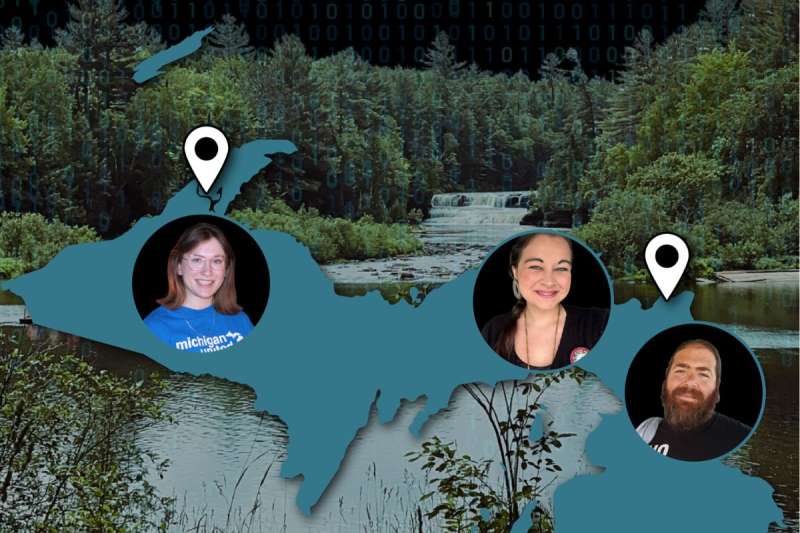
From Keweenaw to Sault Ste. Marie, communities across the Upper Peninsula are working together as AI data centers and bitcoin mining operations threaten their way of life—and they’re encouraging others to join the fight.
Kalvin Carter has seen firsthand how Big Tech companies are disrupting communities in Michigan’s Upper Peninsula.
After a bitcoin mining operation set up shop across from a local school in Dafter Township, a small town of about 1,300 people just south of Sault Ste. Marie, teachers and parents complained that the mine’s noise was disrupting students’ education, forcing them indoors and away from the natural learning landscape of the nearby forest.
While attending a Dafter Township Planning Commission meeting, Carter said he felt energized by watching community members from all walks of life and political ideologies unite around a common goal: voicing their concerns to elected officials about how the mining operation would negatively affect their communities.
“I think people are just really tired of being taken advantage of, and that’s really what we’re seeing,” Carter said, adding that the UP is home to mostly working-class families, many of whom are already living in poverty. These residents worry about losing resources as more Big Tech companies creep into the area.
“We don’t want billionaires coming here and thinking they can extract our resources for profit,” said Carter.
As the project director at UpNorth Advocacy, a nonprofit dedicated to encouraging local civic engagement, Carter aims to encourage more Michiganders to speak out and advocate for changes in their hometowns. It’s why he’s teaming up with other Yoopers to educate communities about the impact that AI data centers, bitcoin banks, and billionaire “tech bros” will have on the area—from higher utility bills to unhealthy air and water pollution in Michigan’s beloved Great Lakes.
“It’s important that we spread out because we have hands in our communities and we know where people are coming from,” Carter said.
WATCH: Big Tech found Michigan. Michiganders aren’t thrilled.
Getting schooled
Fighting alongside Carter in the battle against Big Tech is Audrey Gerard. She’s based in Hancock, just a few miles away from Michigan Technological University. Gerard regularly talks to college students about how data centers will impact future job opportunities, especially for those who want to stay and work in the UP after graduation.
During the first three months of 2025, the unemployment rate for recent college grads reached 5.8 percent, the highest it’s been since 2013. Experts say that’s due in part to AI taking on more entry-level tasks—pushing new grads out of the job market.
“I think this has definitely instilled the fear of God in many, especially young people who see themselves here post-graduation,” Gerard said.
As disdain grows for the barriers created by AI, Gerard says that she’s seen more college-aged students get involved with the broader fight against Big Tech in the UP.
“This has really given them the kick to start engaging, to start showing up and organizing around the issues they care about,” Gerard said. She added that she and many others in her community have joined Keweenaw Against the Oligarchy (KATO), a branch of the statewide social justice organization Michigan United, to connect and organize with other like-minded Michiganders.
When it comes to federal funding for tech expansion in rural areas like the UP, Gerard said attendees from both sides of the political spectrum voiced concern during a recent KATO listening session. Most expressed their desire to protect the UP’s natural resources, which have a long history of exploitation by the wealthy elite. Recently, Michiganders have been fighting back against the proposed Copperwood Mine, which would bring a sulfide mine just miles from Porcupine Mountains State Park—with plans to mine up to 100 feet from Lake Superior’s shore.
“Tech oligarchs are not normal business leaders. They have direct personal control over massive amounts of resources. We want people to be able to stay in the UP and have lives,” Gerard said.
During another KATO listening session in Sault Ste. Marie, attendees agreed that economic solutions and efforts to build stronger futures for UP residents should come from communities themselves—not wealthy out-of-towners.
“Our solutions are not going to come from the outside. They’re going to be coming from the creative ideas of the locals,” Gerard said.
It takes a village
Dr. Chloe Kannan—an educator, researcher, and member of the Sault Ste. Marie Tribe of Chippewa Indians—agrees with Carter and Gerard that all UP communities deserve a voice in the conversation about Big Tech. This includes the tribes that have called the area home for generations.
Throughout her career, Kannan has worked diligently to ensure that tribal communities are represented whenever key decisions are being made in surrounding areas.
“Oftentimes, tribal governments and local municipalities are often very siloed…We are at a point now with the landscape of the tech oligarchy, private equity, and what’s going on politically, that that can no longer happen,” Kannan said.
Kannan encourages tribal members to work alongside organizations like UpNorth Advocacy to push for sustainable economic investment in the Upper Peninsula.
“We want doctors, lawyers, and businesses coming to our community. We want our communities to grow and flourish,” Kannan said.
“We do not want AI data centers and bitcoin mining operations coming here, buying huge swaths of land, and extracting our resources—that’s not the economic development people want here.”
The road ahead
While it’s expected to be an uphill battle, Carter remains optimistic—especially as more and more Michiganders unite to discuss concerns related to Big Tech with their neighbors and community leaders.
“There’s a lot of power in this, and there’s a lot of positivity we can take out of this,” Carter said.
“These things will just keep coming—so let’s build something that we do want.”
Correction: The story was been updated to reflect that the fact that the 5.8% unemployment rate for college grads in 2025 was similar to the 5.9% rate in 2013, not 2021.