MICHIGAN—Michigan voters turned out for the August primary election in numbers that outpaced recent midterm cycles, setting up a November ballot with control of the US Senate, the governor’s office, and the country’s most competitive US House seats all on the line.
And the surge in voter turnout was visible well before polls opened.
By Monday evening, the number of absentee ballots returned for the 2026 primary election had outpaced the total number of mail ballots submitted for the entire primary election in 2022.
All told, more than 1.3 million Michiganders had already voted before polls opened on Tuesday—including more than 139,000 people who cast a ballot at an early voting site, state officials said. And because of Michigan’s same-day voter registration law, more than 2,800 Michiganders also registered to vote and cast a ballot at their local clerk’s office on Election Day.
State election officials billed it as a “safe, secure, and successful day of voting.”
“I want to make this clear: no matter how you vote, or who you vote for, you can be confident, as always, that your vote will count, and that the election results will reflect the will of the people,” Deputy Secretary of State Aghogho Edevbie said in a statement released late Tuesday night.
US Senate
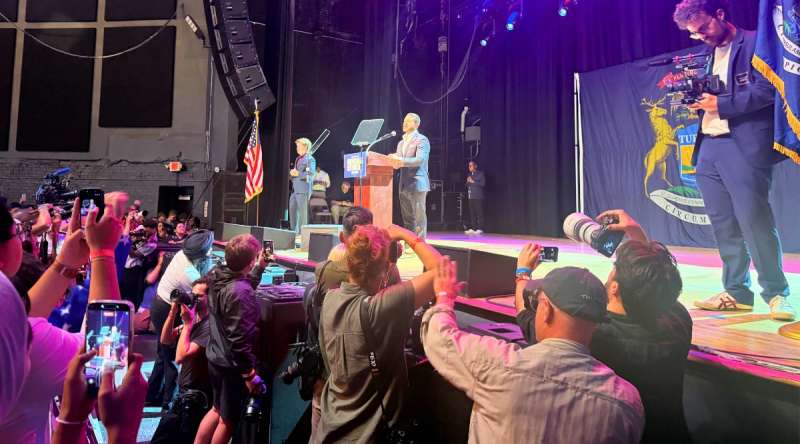
Abdul El-Sayed won the Democratic nomination for Michigan’s open US Senate seat, narrowly defeating US Rep. Haley Stevens in one of the most closely watched primaries in the country. El-Sayed led Stevens by less than 15,000 votes with 99% of precincts reporting Wednesday.
State Sen. Mallory McMorrow, who suspended her campaign in July, took about 4% of the vote—and then endorsed El-Sayed early Wednesday morning, hours after the race was called. Stevens followed suit by issuing her own endorsement for El-Sayed several hours later.
The primary was widely read as a proxy fight over the direction of the Democratic Party.
El-Sayed, the former Detroit health department director who lost the 2018 gubernatorial primary to Gov. Gretchen Whitmer, ran an explicitly anti-establishment campaign that was backed by US Sen. Bernie Sanders, US Rep. Alexandria Ocasio-Cortez, and Indivisible Michigan. Stevens carried the institutional lane with support from Whitmer, US Sen. Gary Peters, and Attorney General Dana Nessel. The two split hardest over US aid to Israel.
Outside groups aligned with the American Israel Public Affairs Committee—or AIPAC—spent heavily on Stevens’ behalf, with more than $30 million in TV ads flooding Michigan. By some counts it was the most expensive Democratic Senate primary election in US history.
Peters’ retirement makes this one of the seats that will decide control of the US Senate.
“Michiganders have spoken. This was always going to be the many versus the money,” El-Sayed’s campaign manager, Alia Kapasi, said in a statement Wednesday morning. “We have shown that Michiganders want money out of politics, money in their pockets, and Medicare for all. We are building a coalition that is fired up and ready to go beat Mike Rogers.”
El-Sayed will face Republican former US Rep. Mike Rogers, who was unopposed in his primary and has President Donald Trump’s endorsement. Rogers lost the 2024 US Senate race in Michigan to Elissa Slotkin by less than a single percentage point—or about 19,000 votes.
“The Democrat Party has been lost to the extremists,” Rogers’ campaign said Wednesday.
Governor
Secretary of State Jocelyn Benson won the Democratic nomination, beating Genesee County Sheriff Chris Swanson by nearly 1 million votes with 99% of precincts reporting on Wednesday.
US Rep. John James also secured the Republican nomination, handily defeating self-funded businessman Perry Johnson by more than 100,000 votes, according to preliminary results.
Gov. Gretchen Whitmer is term-limited, and what began several months ago as a 17-candidate field has now been narrowed to a straight two-way race heading into November.
“Let’s take tonight’s landslide victory and deliver another one this fall,” Benson said Tuesday.
Congress
7th Congressional District
Democrats picked William Lawrence as their nominee to challenge Rep. Tom Barrett, who was unopposed in the primary election. Lawrence—a local community organizer who co-founded the Sunrise Movement—beat out two candidates with national security credentials and far more campaign money: Bridget Brink, the former US ambassador to Ukraine, and Matt Maasdam, a retired Navy SEAL who was a military aide to President Barack Obama. Both outraised Lawrence better than two to one.
Lawrence ran an anti-establishment campaign that centered largely on a moratorium on new data centers, opposition to the war in Iran, and describing Israel’s conduct in Gaza as “genocide”—positions that some Democratic strategists had warned would be a liability. Lawrence also campaigned alongside El-Sayed, Sanders, and Ocasio-Cortez. The race is considered a toss-up heading into the November election.
10th Congressional District
With James running for governor, this Republican-leaning seat drew a crowded field. Democrat Christina Hines will advance to November, running against Republican Michael Bouchard.
11th Congressional District
State Sen. Jeremy Moss won the Democratic nomination to succeed Stevens in this safe blue seat and will go on to face Republican Troy Mayor Ethan Baker in November. If Moss wins the race, he’ll make history as the first openly LGBTQ+ member of Congress from Michigan.
13th Congressional District
State Rep. Donavan McKinney unseated two-term Rep. Shri Thanedar, one of the night’s genuine upsets and its sharpest break with Democratic Party leadership. McKinney ran on Medicare for All and a desire to get money out of politics, with backing from El-Sayed, Sanders, and US Rep. Rashida Tlaib. Detroit is now on track to send a Black lawmaker to Congress for the first time since Thanedar’s 2022 election, which broke a streak dating to 1955. McKinney will face Republican T.P. Nykoriak; the race isn’t expected to be competitive.
What’s next?
Election officials will canvass the results and review election processes to confirm accuracy and correct any clerical mistakes. Bipartisan boards of county canvassers oversee this process, conduct any recounts, and are required to certify the election results by Aug. 18. The Board of State Canvassers will then conduct its own review and certify the results no later than Aug. 24.
Two statewide offices weren’t on Tuesday’s ballot at all.
In Michigan, Democrats and Republicans pick their nominees for secretary of state and attorney general at a spring convention, and both seats are open this year.
Democrat Lt. Gov. Garlin Gilchrist is running against Republican Anthony Forlini for secretary of state, and Democratic Washtenaw County Prosecutor Eli Savit is facing off against Republican Eaton County Prosecutor Doug Lloyd for attorney general.
The general election is Nov. 3.
Absentee ballots hit mailboxes in September. Early voting opens at least nine days before the election. Michiganders can register and vote in one trip at your clerk’s office up to 8 p.m. on Election Day. And unlike Tuesday, they won’t be locked into one party’s column.
Learn more at michigan.gov/vote and click here to check your voter registration.
READ MORE: Outside spending floods US Senate race for Haley Stevens
Don’t miss Michigan’s biggest stories. Follow The ‘Gander on Instagram.