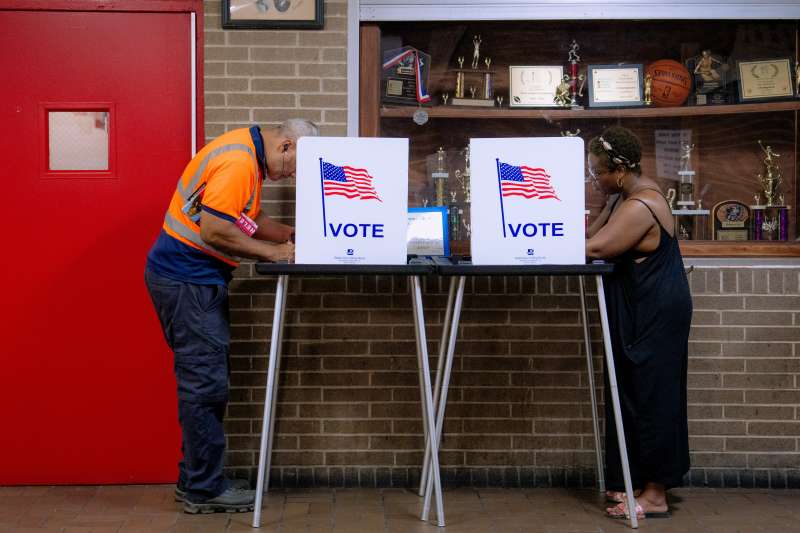
Michigan voters will head to the polls in November to cast their ballots for leadership roles across the state and in Congress. And while there, they’ll also fill in a bubble about an issue that could redefine the Great Lakes State entirely. Proposal 1 will ask whether voters want to convene a constitutional convention—which one expert described as opening Pandora’s box.
Quinn Yeargain, an associate professor of law at Michigan State University, explained that every 16 years, the state considers a rewrite of their most formative document through what’s known as a constitutional convention.
If approved, a group of 148 delegates would be elected to rework Michigan’s state Constitution—the document that defines the powers of the state Legislature and courts, local government frameworks, and the rights of every resident
The delegates could lightly edit the constitution, or rewrite it completely. In a sense, when deciding how to vote on Proposal 1, Michiganders have to consider whether to hand over the reins to unnamed lawmakers who could change the face of the state.
“With most constitutional convention questions, the biggest fear is the unknown,” Yeargain said. “While no constitution is perfect, the fact that convention delegates would be virtually unrestricted in the changes that they could propose to the constitution is a frightening prospect.”
How con-cons work
Yeargain recently wrote about constitutional conventions, also called a “con-con,” for MSU, explaining that while the vote offers a formal rewrite of potentially the entire document, state lawmakers are regularly updating the constitution with amendments in the intervening years.
In an interview with The ‘Gander, Yeargain said that while they haven’t heard an argument favoring a con-con over amendments, approving amendments can also be difficult.
“The hurdles for discrete amendments are sizable—a two-thirds majority in each house of the legislature for any legislatively proposed amendment, or a statewide signature gathering campaign for initiated amendments,” Yeargain said. “Doing that repeatedly is daunting. And in any event, neither party is likely to have a two-thirds legislative majority anytime soon, so more ideological amendments wouldn’t get traction.”
Michigan is one of 12 states in the country that asks this question of voters periodically. Ohio, Montana, New York and others ask voters every 20 years while states such as Alaska, Iowa and Hawaii ask every 10.
If approved, Proposal 1 would set in motion a six-month timeline during which delegates would be elected from each of the state’s 38 senate districts and 110 representative districts. Their election would have no guardrails, campaign funding transparency, or campaign funding limits. Similarly, their editing process would have no timeline, and would be paid for by taxpayers. A final version of the constitution would be presented to voters to approval.
The last approved con-con in Michigan
The first time Michigan voters approved a con-con was in 1960, with the convention held from 1961 to 1962. The new constitution was adopted in 1963 and has been in place since.
Yet every 16 years, voters have been asked to consider another convention. In 2010, the last time voters got to chime in, a sweeping 67% voted against the initiative.
Yeargain called the 1963 rewrite a substantial one that voters almost didn’t approve once it was presented to them.
“The previous constitution was adopted in 1908, and the 1963 constitution modernized state government in a variety of ways,” Yeargain said. “It was only narrowly approved—it won by a 7,424-vote margin—and the vote to call a convention only won 51% of the vote in 1961.”
What voters are saying now
Yeargain doesn’t think the measure will be approved.
“While I am not in the business of prognosticating, I would expect ‘no’ to win by a double-digit margin,” Yeargain said. “The prospect of convening a convention to rewrite a document that they don’t have strong negative feelings about is something that many voters are uninterested in doing.”
Dozens of groups in the state have joined forces to oppose another con-con. Protect MI Constitution, a bipartisan coalition urging voters to “Vote No on Prop 1,” has garnered support from more than 30 organizations including the Detroit Regional Chamber, the Michigan Education Association, the Small Business Association of Michigan, and the Michigan AFL-CIO. Groups such as the League of Women Voters for Michigan and the Michigan Democratic Party LGBT&A Caucus have joined alongside the Michigan Catholic Conference and Citizens for Traditional Values, a rarely seen pairing.
The coalition estimates it would cost $80 million in taxpayer dollars to pull off a convention.
After joining the coalition, the Michigan Education Association issued a release saying they support a rejection of the proposal, which favors “special interests in a way that sidelines voters.”
In the meantime, those in support of a con-con this year could use the initiative to force controversial measures into play. Yeargain said that while those supporting the con-con have been “relatively quiet,” it’s mostly been a particular group of conservatives who would like to see one approved.
“In the last decade, several ballot measures backed by progressive groups—legalizing recreational cannabis, creating an independent redistricting commission, and recognizing a right to abortion—have been approved by voters. At a convention, those measures could be repealed or curtailed,” Yeargain said.
In addition to Michiganders and out-of-state interests who might want to see changes beyond what the Michigan Catholic Conference and Citizens for Traditional Values might value—as those two and similar organizations are recommending that voters “Vote No on Prop 1”—deep-pocketed individuals and corporations affiliated with data centers could use unlimited and unreported funding to support delegates who would rewrite the constitution to allow unrestricted data center development across the state.
To see your ballot, register to vote, or find your polling location, click here.