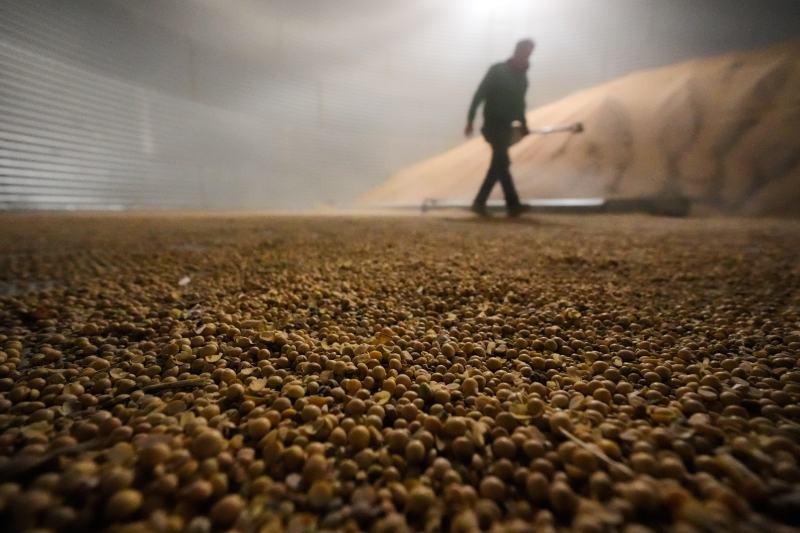
When I first called Dennis Kellogg, the sixth-generation soybean farmer was burning a mulch-like tangle of soybean pods that had amassed due to recent flooding. By attaching a 20-pound propane canister to a hose and dousing the tangle, he could perform controlled burns and avoid potential runaway fires.
I asked him about it when I spoke with him again on May 13.
“We’ve got it all worked up now, and we’re gonna start planting soybeans this week,” Kellogg said. “Depending on weather, if we can keep moving, we could be done in about 10 days.”
The Ithaca resident is beginning his 63rd harvest. He took up farming at the age of 14. Now, he’s teaching his son to one day take over the family business and hoping his granddaughter will follow suit.
The path won’t be as easy as it was when he started farming in the 1960s.
The Michigan state Legislature and the US Congress have recently passed agriculture bills—and are currently negotiating others—that critics say directly harm Michigan farmers by providing limited protection and access to resources compared to large, corporate operations.
In an exclusive interview with The ‘Gander, Kellogg, who also serves on the Board of Directors for the Michigan Farmers Union, told me what it means for family farmers like himself and his son.
The imbalance of farm aid in 2026
The US House of Representatives recently passed H.R. 7567—the Farm, Food, and National Security Act of 2026.
Every Republican Representative from Michigan voted for it.
Critics have argued that H.R. 7567 disproportionately benefits large-scale corporate farming operations to the detriment of small- and mid-sized operations like family farms.
Kellogg pointed out that farmers need a safety net in place before disasters happen, not after.
“Say we had a bad drought, say we had floods. That [safety net] would permanently be there to help the affected growers in the areas where it happened,” he said. “Now, they may appropriate funds to help the growers, but quite often, it’s after the fact that it’s happened—and it takes such a long time for that help, that support to get to the people who need it.”
He wasn’t exaggerating. In May 2025, the USDA acknowledged it had taken 13 months to distribute disaster relief funds to farmers. Research by the Government Accountability Office found that 20 months after similar funds were appropriated under the Inflation Reduction Act, only 74% of those funds had been released to farmers.
“Time can be of the essence, and whether someone makes a decision that they’re going to continue on or just gonna stop,” Kellogg said. “If you have to wait one or two years for that help to get to you, that’s when a lot of people just decide they’re going to quit.”
H.R. 7567 also offers some short-term relief to farmers who are currently suffering, but stops short of providing long-term solutions. And many American farmers are reluctant to take what they see as a handout, preferring an honest day’s pay for an honest day’s work.
“We would rather earn everything we have,” Kellogg said. “When we have to go to a government office and be involved in a program that provides any kind of funds, any kind of money, we feel as though we didn’t earn it.”
Meanwhile, several amendments have been made to the operating standards related to the Michigan Right to Farm Act of 1981. Originally framed as a series of protections against nuisance lawsuits for farmers, this state bill’s provisions have begun to favor larger agricultural corporations. In this case, the biggest beneficiaries are concentrated animal feeding operations (CAFOs).
These industrial agricultural facilities keep high numbers of livestock in small non-pasture areas for the purpose of maximizing production efficiency for meat, dairy, and eggs. However, they also produce high amounts of waste and pollutants.
“These people don’t seem to care for the land,” Kellogg said of the companies operating CAFOs. “I see them doing things that can have a negative impact on the land and even the properties next door.
“And when that happens, it seems like our quality of life deteriorates.”
As major corporate farms and CAFOs have moved in and grown, Kellogg said he’s seen changes in rural communities—and not good ones. Grocery stores, hardware stores, farm supply stores, and even family farms have had to close down.
“All it takes is a short time for people not going into their store.”
Can family farms survive tariffs and the war in Iran?
President Donald Trump’s second term began with sweeping tariffs imposed on countries around the world. As a result, China drastically reduced its purchase of soybeans from the US, from 985 million bushels in 2024 to just 218 million bushels from January to August 2025. Sales to China of US corn, wheat, and sorghum have also bottomed out. Overall, US agricultural trade around the world has dropped from a $44 billion surplus in 2011 to a $47 billion deficit in 2025.
“Any time a country considers the United States to be an unreliable supplier, they begin to look elsewhere,” Kellogg said.
Since the tariffs were enacted, China has done so in record numbers. China now buys soybeans and crops from Brazil and Argentina and is investing in agriculture in both countries, leaving American farmers with surpluses of crops that have no buyers.
“We’re growing the domestic [soybean] market, through the oil that is produced from the soybeans, and that’s going into biofuel,” Kellogg said. “The end result here, as I see it, is that the American consumer is going to have to pay a lot more money for everything.”
The war in Iran has also hurt farmers. Since its beginning, average Michigan gas prices have jumped from under $3 per gallon to $4.85, with no end in sight. Kellogg said his farm filled up their tanks last October and are still using that, but they’ll have to refill soon.
“We’re gonna take a hit right there.”
Higher prices aren’t limited to fuel costs, either. Since the war began, nitrogenous fertilizer costs have climbed more than 30%. Kellogg expects repair parts for his equipment will be more expensive too.
Farm bankruptcies soared throughout the first Trump term, to a record high of 599 bankruptcies in 2019. During former President Joe Biden’s time in office, they settled down to a low of 139 in 2023. However, that number is again on the rise. In 2025, 315 farms declared bankruptcy.
In Michigan specifically, the numbers are similar. According to the official website for the federal judiciary of the United States, 54 Michigan farms filed for Chapter 12 bankruptcy during President Trump’s first term, only 13 of which were during the height of the COVID-19 pandemic. Throughout President Biden’s term, that number dropped to 21. In 2025 alone, nine Michigan farmers have filed for bankruptcy, up from zero in 2023.
This takes an enormous toll on small farmers.
“If you’re the one that’s having to make the decision that a generational farm is going to end and it’s going to end on your watch, you really take that hard,” Kellogg said.
Research by Farm Journal reveals that farmer suicides are on the rise, driven by financial stress. Farmers have even noted that much of the second-hand inventory in the farm equipment market is partly driven by farmer suicides. Fortunately, there are resources available. Michigan State University recently announced it would resume providing free counseling through its Managing Farm Stress program, which offers psychological care for those working in the farming, forestry, and fishing industries throughout Michigan.
The bigger picture for America
Farm closures don’t just affect farmers. According to Iowa PBS, during the 1980s farm crisis, “It is estimated that for every four farms that went under, one rural business closed.” Agricultural supply manufacturers laid off 20,000 workers in the Quad Cities of eastern Iowa and western Illinois alone.
Even for those outside the agricultural industry, farm closure is bad news. As smaller farms go out of business, American agriculture is increasingly concentrated into corporate monopolies that count on lax antitrust legislation enforcement to price-gouge and cost consumers at the supermarket.
Some farms will survive the current disruption to the market, but many won’t. For now, Kellogg is optimistic.
“For those that are, such as myself, generational and like to stay that way, and have family members that would like to be involved, we’d like them to have the opportunity to continue and enjoy the land, as I have, and previous generations before us.”