This is Part 2 of a 5-part series. Read Part 1 here.
In Part 2 of the Legislative Loophole series, we put the indirect initiative loophole under the microscope to highlight three levels of deception that can be used to exploit the process. We also introduce you to Let MI Kids Learn, an initiative hoping to land in the Legislature’s lap later this year.
LET MI KIDS LEARN is a campaign to establish two things: a voucher-like program called “Michigan Student Opportunity Scholarships,” and tax credits for the individuals and corporations that donate to them.
Here’s how it would work:
Corporations and individuals donate to nonprofits, which manage the Student Opportunity Scholarships.
Those nonprofits then provide funding to qualified families for a list of approved expenses—namely to help afford private school tuition, for homeschooling expenses, and for private tutoring companies.
The corporations and individuals who donated to the nonprofits would receive a 100% tax credit on their donation, which they can use to offset their own state tax bills.
Let MI Kids Learn started out as a pair of Senate bills, proposed in October 2021 by Sens. Lana Theis (R-Brighton) and Tom Barrett (R-Charlotte). They were passed along party lines in both chambers, with the exception of Rep. John Reilly (R-Oakland Township), who voted against his Republican colleagues.
“I do not believe we should create a tax credit to incentivize this program,” Reilly said of his vote. “Nor do I believe there is anything to stop private businesses and individuals from creating and donating to scholarship programs under our current tax structure as written.”
Both bills died when they were vetoed by Gov. Gretchen Whitmer in November 2021.
[Editor’s Note: Read more about Let MI Kids Learn in Part 3: The Scheme.]
Deception Level 1 of 3:
More Special Interests Groups = More Money = More Signatures
In Michigan, initiatives currently require 340,047 signatures to make the ballot—a threshold that changes every four years, based on 8% of the turnout in the most recent gubernatorial election.
To get those signatures, citizen organizers use both volunteers and hired help to stand outside grocery stores, post offices, and on busy street corners asking people to sign their petitions. It makes sense that groups with more money can afford more hired help—in fact, several signature-gathering companies provide temporary workers just for that purpose, many of whom get paid up to $20 per signature. You might remember hearing about some of them back in May, when multiple Republican gubernatorial candidates were found to have fraudulent signatures on their petitions to run for governor.
It’s been a tough year for signature-gathering. Between a long winter and labor shortages, politicians have seen prices rise from $3 per signature to $20 per signature. They’re bringing in people from out of state to fill the gaps—and there’s often no real oversight during the gathering process beyond what each individual campaign decides to put in place.
The gubernatorial signature fraud scandal, for example, pushed one campaign—Secure MI Vote— to pre-emptively toss out about 20,000 signatures amid efforts to ensure their validity. The group’s spokesman, Jamie Roe, told The ‘Gander that he believed they had enough signatures, but wanted to be especially careful because of attention drawn to potential forgeries in the governor’s race.
The recent issues with fraudulent signatures make sense, especially when paired with market demands that put each signature at a premium, according to experts.
“When folks realize the kind of payday that can come when you’re collecting 20,000 signatures at $20 a pop, people start to skirt the rules,” political advisor John Sellek told Michigan Radio in June.
In Michigan, there’s no rule against paying by the signature, or even paying someone for their signature. There’s also no rule that says signature-gatherers can only work on one campaign—meaning the person who stops you outside of CVS and asks you to sign their petition on voters’ rights might also have a petition for governor in their bag.
Let MI Kids Learn has been well funded by the Betsy DeVos family and connected groups, who by April of this year had made donations of more than $1 million, according to campaign finance filings from that month. And the campaign has already spent more than that on signature-gathering alone.
The takeaway: The more funding a campaign has, the more people they can put in front of every busy building in town—even if that means paying big bucks to bring in temporary workers, sometimes even from shady signature-gathering firms, in order to push an issue into law.
Deception Level 2 of 3:
They Can Lie to You
In 2020, the Unlock Michigan initiative—mentioned in Part 1, which reduced the governor’s health emergency powers—technically had received enough valid signatures to make the ballot, but not without widespread controversy over whether or not signers understood the mission.
In September of that year, the Detroit Free Press broke a story about a secret video taken of a petitioner coach for Unlock Michigan training signature-gatherers on “giving voters false information, illegally collecting signatures without witnessing them, trespassing on private property, and even lying under oath.”
The coach reportedly told signature gatherers that he didn’t want them to do illegal things—but that they could if they wanted. He then told them exactly how to do illegal things, while only warning them to avoid directly forging signatures.
At one point in the video, the coach instructed petitioners to tell undecided voters that signing the petition would simply put the issue up for a vote—something everyone could have a say on.
A review from Attorney General Dana Nessel’s office found that the techniques used by Unlock Michigan were unethical, but there was not enough evidence to bring forward criminal charges.
“It is clear from this investigation that some paid circulators may resort to unethical practices in order to fulfill the demands of their clients,” Nessel said.
You might be thinking that 2022—a year when both the Michigan gubernatorial petition scandal and the Jan. 6 Special Committee hearings loom like a cloud over an already-fraught election cycle—would be different. But earlier this year, more video evidence revealed that paid petitioners are still lying to potential signers. In the video, a petitioner in Kalamazoo is collecting signatures for Let MI Kids Learn, Secure MI Vote, and Unlock Michigan 2 (a new version of the initiative passed in 2020). When describing the proposals, he says that they’re measures to help stop the spread of COVID-19.
In Lansing, one resident experienced this deception firsthand. Here’s her story.
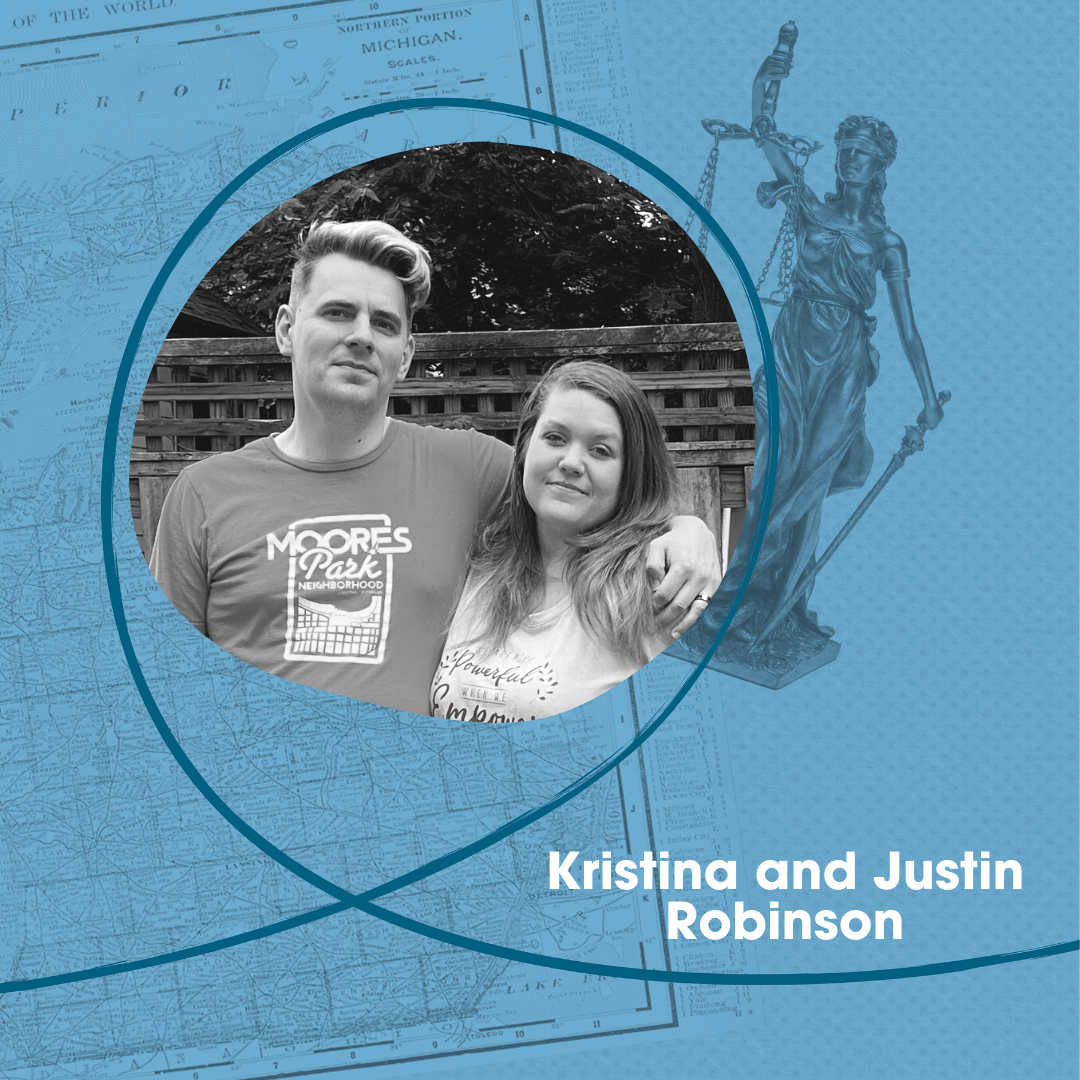
KATRINA ROBINSON was attending an art fair with her husband and daughter when she noticed people gathering signatures on petitions for abortion rights and education reform.
Robinson considers herself politically active and had already volunteered to collect signatures for Reproductive Freedom for All, a campaign to amend the state’s Constitution with provisions protecting reproductive rights. She said a sign near the signature gatherers caught her eye. It read: “Want up to $8,000 in additional funding for your kid’s education? Registered voters sign here.”
Approaching the petitioner, Robinson saw an opportunity to teach her 12-year-old daughter about the importance of being politically active and democratically engaged. She read the lines at the top of the petition, a three-sentence summary describing the campaign’s aim to establish a scholarship fund for low-income and underprivileged children. It was a mission that, on its surface, she agreed with.
Robinson had been a foster mom for three years before adopting her daughter, and she assumed the petition would supplement programs such as Fostering Futures, a state-supported scholarship program that awards college scholarships to children in foster care.
Poring over the lines so carefully that she accidentally underlined a segment of the petition with her uncapped pen, Robinson went on to sign it, believing she was supporting a cause she valued. As she talked about the process with her daughter, Robinson’s husband, Justin, also signed the petition.
Later that day, the family was approached by a woman attending the fair, who said she’d overheard what Robinson was saying and thought she may have misunderstood the petition. The stranger explained that the petition was not supporting scholarships to colleges, but instead was Let MI Kids Learn, a voucher program that would divert millions of dollars in public school funds to private and charter schools.
After researching the petition more and learning of her mistake, Robinson went back to the petitioner to ask why he didn’t stop her when he heard her inaccurately explaining the petition to her daughter.
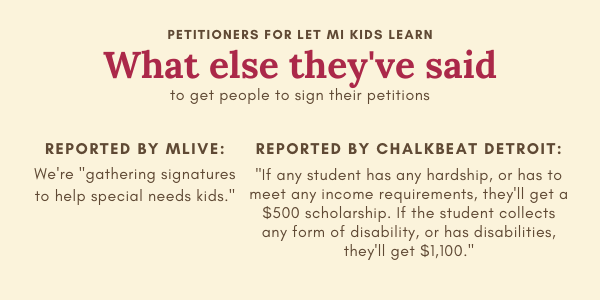
According to Robinson, he replied: “Well, that’s why you’re supposed to read it before signing.”
Michigan law has no provision to enable a voter to remove their name from a petition, even if they feel they were given misleading information about the campaign. Robinson, however, took matters into her own hands—simply asking to see the sheet and then crossing her name off the list
“I thought that was so nice and so convenient to make people’s voices heard—to have these canvassers out and about with clipboards where you can sign,” Robinson said. “It’s supposed to be safe, and it’s supposed to make it easier for the vast majority of the population.”
Now, though, Robinson is feeling disillusioned with the deception behind the process. When she went home, she created a Facebook post warning friends of what had happened to her:
“Please use this personal vulnerability as a reminder to stop and look for more detail about the petition you are signing, and always show up to vote to make your final decision counted,” she said.
That brings us to the third deception tactic: campaigns that plan to bypass voters from the start.
Deception Level 3 of 3:
Planning to Cut the Line
Here’s the 340,047-signature question: Who would want to keep this process on the books? For the answer, have a look at why people like it.
IT’S EASIER FOR LAWMAKERS.
If you’re a legislator, your party has a majority in the House and the Senate, and your governor is from the opposing political party (and therefore wields a potentially partisan veto), an indirect initiative must look like a pretty efficient way to get things done.
Indeed, said Jeff Timmer, a former executive director of the Michigan Republican Party who’s now a senior project manager at the Lincoln Project.
“It has only been in the last decade that we’ve seen this preponderance of attempts to use this just to ram through partisan legislation,” Timmer said. “Somebody just woke up and said, ‘Hey, we can do this. We have the majority in the legislature but we don’t have a willing governor. Let’s just sideline the governor and do this anyway, because we have the money to.’”
To put Timmer’s quote into context, here’s a look at party control in Michigan over the past 20 years:

Source: Ballotpedia
Jamie Roe, the spokesperson from Secure MI Vote, said that he sees no problem with letting the legislature decide the fate of ballot initiatives, referencing many other laws that came to be through the process. Secure MI Vote, he said, reflects the will of voters.
But Secure MI Vote missed the deadline to turn in their petitions for the 2022 election, and is instead hoping that a late submission will still get their initiative in front of the Legislature – in other words, the group is hoping the Legislature will pass their initiative indirectly. [Editor’s Note: If the Legislature chooses not to pass the Secure MI Vote initiative, it’ll go on the ballot in 2024.]
“We wish that we didn’t have to go through this process, but Gretchen Whitmer has vetoed every other common sense proposal that’s been a part of this,” he said. “Governor Whitmer could’ve made this a lot easier by signing those into law. She forced us to go this route.”
Roe’s claim about the will of the voters is worth pausing on. If the group behind a ballot initiative is convinced that their proposal does, in fact, reflect the will of the voters, it’d probably get passed a lot faster by simply letting voters vote for it. That’s because when voters pass a ballot measure, it becomes law 10 days later. If legislators intercept a ballot measure and pass it themselves, it takes effect 90 days after the end of the session in which it was enacted. The current session will end on Dec. 31. There is an option to immediately enact the law, but it requires a two-thirds approval from both the House and the Senate.
“We wish that we didn’t have to go through this process, but Gretchen Whitmer has vetoed every other common sense proposal that’s been a part of this,” he said. “Governor Whitmer could’ve made this a lot easier by signing those into law. She forced us to go this route.”
JAMIE ROE, SECURE MI VOTE
In 2018, a popular citizen initiative was heading for the ballot. Voters had overwhelmingly polled in favor of the measure’s two proposals: a minimum wage hike to $12 an hour, and new paid sick-leave options for Michigan workers.
But the Republican-controlled Legislature stepped in and passed the initiative before Election Day. That meant that instead of becoming law 10 days after Election Day (which is how it works when citizens vote to pass an initiative), it slowed the bill’s progress to 90 days into the following year. Then the Legislature then made the dramatic move of changing the initiative. Those changes included slowing down the timeline for the minimum wage increase – reaching $12 an hour by 2030 – eliminating the increase for tipped workers, and exempting a large number of small businesses from the sick-leave law.
Had the Legislature proposed their amendments before Election Day, the initiative process would have required them to offer the changed version as a different option to voters, in addition to the citizen initiative. Had voters passed the original legislation, the Legislature would have required a three-quarters vote to amend the proposal after it became law. Before 2018, no Legislature in Michigan history had ever adopted a piece of legislation ahead of a citizen vote just to take the teeth out of the proposal.
SIDE NOTE: That’s probably because before 2018, it was considered unconstitutional. The legal understanding of the initiative process was that the Legislature could not adopt and then amend a voter-initiated proposal in the same two-year legislative session. In fact, in 1964, then-Attorney General Frank Kelly made it clear that this was an accurate reading of the state Constitution. But 54 years later, Attorney General Bill Schuette, a prominent Republican, said the Republican-majority Legislature could adopt and amend the proposal that had been, in its original form, so popular with voters. Then-Governor Rick Snyder, also a Republican, signed off on those changes during the final weeks of his term.
Voters who felt shorted by these moves recently got good news. On July 19, four years of legal challenges paid off when Michigan Court of Claims Judge Douglas Shapiro ruled that the 2018 adopt-and-amend procedure was unconstitutional. This story is still developing.
IT’S EASIER FOR ORGANIZERS.
Just because initiatives are ballot proposals doesn’t mean the people behind them want them to end up on the ballot. Let’s say you’re one of those money-hungry dentists from our hypothetical example in Part 1 of this series. You know you can get at least 340,047 people to sign your petition to put “MI Sweet State” on the ballot. But convincing a majority of Michigan voters to approve your plan – especially with so many experts weighing in on how it would hurt Michiganders – will be difficult.
However, the majority party in Michigan’s House and Senate are tight with the sugar industry. So, knowing that petitions for ballot proposals must be turned in 160 days before the general election, but that the Legislature only needs 40 days before the election to consider an initiative, you miss the first deadline. Sure, the Bureau of Elections, who verifies the signatures on petitions, won’t be pleased. Spokespeople from their office might say things like, “We are under no obligation to validate signatures that have come in after the filing deadline until the next election cycle,” but you don’t care. You’re not in it for the ballot, anyway.
You offer a late submission. You won’t make the ballot, but if the Bureau of Elections finds time to review the signatures before the election, your initiative will make it into the hands of your sugar-friendly legislators. MI Sweet State gets its legislative vote, the people have been bypassed, and the governor cannot veto the legislation. Candy for everyone.
Nancy Wang, executive director for democracy advocacy group Voters Not Politicians, said that many Michigan citizens aren’t aware that signing a petition for a ballot measure may not put an initiative on the ballot at all – that there’s a chance it could instead be swept up directly by the Legislature.
“We’re finding that the campaigns and the circulators that they’re hiring, their interest is in not explaining what they’re trying to do to the people,” Wang said. “They’re incentivized to lie, to withhold information, and because they can, that’s exactly what they do out in the field.”
“We always looked at it like, we’ll do whatever the word of the law will allow us to do,” said Jeff Timmer, the ex-GOP leader. “Some of those areas might be a little gray, but we’re going to push those envelopes. Now, it seems like nobody gives a shit whether those areas are gray or clearly you dipped your toe over those lines.”
Katrina Robinson, the woman who signed the petition in Clawson, said when she signed, she believed it was to make the proposal eligible for a vote. She had no idea, and wasn’t told, that the Republican-majority state Legislature could simply bypass the people.
“Oh, that makes it even worse,” Robinson said.
Let MI Kids Learn turned in their petitions to the Bureau of Elections on Aug. 10—more than two months past the deadline. It’s unclear if they’ll be reviewed in time to head to the Legislature later this year.
THEY CAN SET UP THE SECRETARY OF STATE.
What if you get the timing wrong?
What if you, a dentist pushing MI Sweet State, miss the deadline, and when you do eventually turn in your petitions they get stalled with the busy Bureau of Elections?
While the bureau is obligated to review petitions submitted by the filing deadline, they are, in fact, under no obligation to validate signatures on petitions filed after the deadline until the next election cycle – in this case, 2024.
“Initiatives that chose to submit petitions after the June 1 deadline will be reviewed when the Bureau of Elections has capacity and ahead of its deadline for the 2024 election,” Tracy Wimmer, spokesperson for the Department of State, said.
For some campaigns, that’s not good enough.
“It’s our sincere hope that she’ll choose to review the signatures quickly,” said Jamie Roe, whose Secure MI Vote petitions have still not been filed.
The “she” in his statement is the person whose office oversees the Bureau of Elections: Secretary of State Jocelyn Benson.
Roe, along with Fred Wszolek, spokesperson for Let MI Kids Learn, haven’t said so directly, but they’ve been quick to imply that Benson—a Democrat up for reelection this year—would be to blame for any delay the Bureau of Elections might have in reading their groups’ petitions.
Here’s Roe: “Secretary of State is accountable like every other office in the state, and we will make sure that people know that the petitions have been submitted. If she chooses to delay, she’s going to be accountable for the reason that she chose to delay.”
Jeff Timmer said he thinks that the Let MI Kids Learn campaign has a two-pronged strategy—get the proposal passed by the current Legislature while it’s securely controlled by Republicans, and at the same time use the issue to rally against Benson ahead of the election.
What they’ll claim the Bureau of Elections is doing is a “deliberate effort to sweep these under the rug to deny you your right to petition,” Timmer said. “[They’ll say,] ‘Look at this very partisan secretary of state who is against freedom in educational choice and is against safeguarding our elections.’”
“This is not a matter of politics,” said Jan BenDor, who is heading up an initiative to close the loophole. Yet “the Republicans are going to claim that Jocelyn Benson is playing politics.”
Fringe conservatives have claimed that Benson, who was elected as a Democrat in 2018, has shown political bias in overseeing elections – particularly the 2020 Presidential Election. The campaign homepage of her Republican-endorsed opponent, Trump-backed outsider Kristina Karamo, says: “It’s time to end the politicization of the Office of Secretary of State and restore the rule of law.”
Karamo’s office did not respond to a request for comment.

Who’s paying for this?
Campaign finance records released in late July show that billionaire Betsy Devos and her family dumped millions of dollars into the Let MI Kids Learn initiative—and kept the money flowing even after the June 1 deadline passed to make it on the ballot this year.
The $2.5 million post-deadline thrust in funding (attributed largely to the DeVos family, with a few other smaller-scale donors) only corroborates what has already been said by campaign organizers since the beginning: The goal of the voucher initiative is to ram the initiative through the legislature, bypassing a public vote.
All told, the Let MI Kids Learn campaign has collected more than $8 million in funding. Of the $8 million, the DeVos family directly pitched in $5 million—not counting money from their foundations— with $2 million arriving after the deadline.
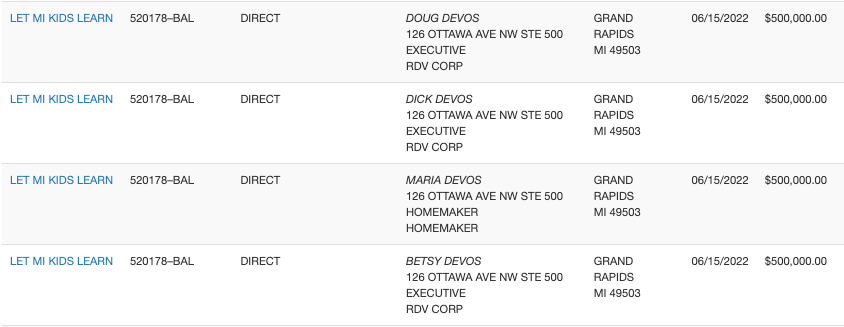
Despite failing to submit the required signatures by the deadline, Betsy DeVos herself gave an extra $500,000 on June 15, records show. So did Dick DeVos. And Maria DeVos. And Doug DeVos. The DeVos-funded American Federation for Children also pitched in another $250,000.
Let MI Kids Learn’s funding also stood out among a sea of other petition drives because of its backing from prominent national groups and Michigan billionaires—and an abnormally high amount of spending, especially considering its ultimate failure to actually meet the deadline. It spent more than $7.4 million in signature-gathering efforts, paid to National Petition Management. If the initiative received only the minimum requirement of signatures—340,047—it would have, in essence, paid $22 per signature.
The group had only 22 donations of less than $100 from individual donors throughout the campaign, and tallied 38 donations of $10,000 or more—including more than $1 million from the dark-money PAC Get Families Back to Work, a 501(c)4 which is registered at the same address as the Republican Governors Association in Washington, DC, two blocks from the White House. The right-wing PAC, which doesn’t have to disclose its funders, has also run campaign ads for conservative gubernatorial candidates in Kansas and Alabama.
Michiganders for Fair Lending, a 2022 ballot proposal to cap the interest rates that collectors charge on payday loans, brought in $7.3 million and paid only $6.4 million in a campaign that submitted more than 400,000 signatures—though it still fell short of this year’s ballot, following a recent Bureau of Elections review, which revealed fraud in more than 130,000 signatures.
Raise the Wage Michigan, a 2022 proposal to raise the minimum wage to $15, submitted 610,000 signatures on July 26 to the Michigan Department of State in an attempt to qualify for the 2024 ballot. It raised and spent only $3.2 million as of the latest signature submission deadline, records showed.
2020’s Unlock Michigan paid National Petition Management nearly $1.7 million on signatures of about $1.8 million in contributions—about five times less than what Let MI Kids Learn paid for its campaign to attempt to collect the same number of signatures, records showed.
How does a campaign like this get pulled off? That’s Part 3.