Cryptocurrency companies have a stake in who writes their rules in Washington.
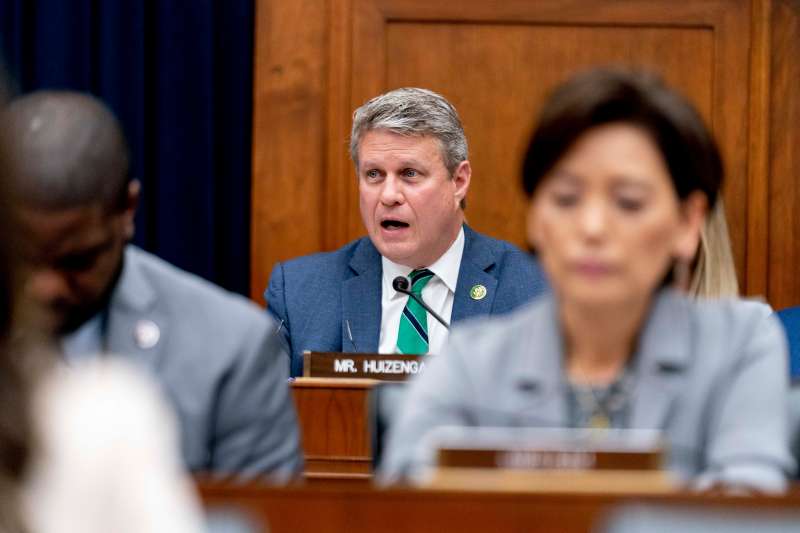
US Rep. Bill Huizenga, who represents Michigan’s 4th Congressional District, helps write them. And the industry is spending to help keep him there.
The Republican congressman from West Michigan is poised to benefit from more than $1 million in crypto-industry spending in his reelection race against Democratic state Sen. Sean McCann in the Nov. 3 election, according to an Oct. 22 report from POLITICO. Banking interests are separately spending more than $1 million to help him.
Huizenga is vice chairman of the House Financial Services Committee, which oversees both industries. Last year, he celebrated helping advance two major cryptocurrency bills through the House.
For Michigan voters, the stakes extend beyond campaign advertising. Cryptocurrency-related fraud is costing residents millions. Data centers raise questions about who pays for electricity and water infrastructure. And companies’ collection of personal information creates privacy concerns that lawmakers can address—or leave unresolved.
Here’s what the records show.
Who is funding Huizenga’s campaign?
POLITICO identified Huizenga as one of several lawmakers benefiting from overlapping spending by cryptocurrency and banking interests. All seven lawmakers receiving support from both industries sit on congressional committees overseeing financial policy. Topping the list of beneficiaries are Huizenga, Republican Sen. Pete Ricketts of Nebraska, and Democratic Rep. Janelle Bynum of Oregon.
“They’re both trying to win the favor of the same candidates,” Brendan Glavin, director of insights at the nonpartisan campaign-finance watchdog OpenSecrets, told POLITICO.
OpenSecrets’ database shows people and PACs tied to AI company Anthropic and cryptocurrency exchange and platform Coinbase among donors in Huizenga’s 2026 campaign. Contributors tied to at least three tech-focused investment firms—Andreessen Horowitz, Bluff Point Associates, and Winklevoss Capital Management—also gave to his campaign.
Among corporate-affiliated PAC donors, Huizenga is supported by Elon Musk’s SpaceX, the National Venture Capital Association—a group that advocates for federal preemption of state AI rules—along with financial tech giants like Stripe.
What crypto bills has Huizenga backed?
Huizenga serves on the House Financial Services Committee’s Subcommittee on Digital Assets, Financial Technology, and Artificial Intelligence—the panel that handles crypto legislation.
Huizenga has publicly embraced that role. In July 2025, his office announced that he had helped “shepherd” the Digital Asset Market Clarity Act (H.R. 3633), called the CLARITY Act, and GENIUS Act through the House. The CLARITY Act proposed a regulatory framework for digital assets, while the GENIUS Act set rules for a type of cryptocurrency called stablecoins.
“Today is a great day because it restores American leadership on digital assets,” Huizenga said at the time. He described the legislation as strengthening free markets, entrepreneurship, and consumer choice.
Are crypto ATM scams a problem in Michigan?
According to FBI data reported by the Detroit Free Press, 368 Michigan consumers reported losing more than $11.9 million through cryptocurrency kiosks in 2025. These machines allow people to convert cash into cryptocurrency. Many of those losses involved scams, although the FBI cautions that some complaints concern other transaction problems.
READ MORE: Michiganders are losing a lot more money to online scams than we thought
Scammers can direct victims to use the kiosks to send money. The Federal Trade Commission reported that victims who used bitcoin ATMs to send cash to scammers during the first half of 2024 reported a median loss of $10,000.
What is Huizenga’s record on data centers and energy?
Huizenga voted in favor of the Trump administration’s 2025 reconciliation package, which rolled back clean-energy incentives as the administration pursued its AI and data-center agenda.
He has also publicly supported keeping the J.H. Campbell coal plant operating in Ottawa County despite its planned retirement.
READ MORE: Rep. Bill Huizenga’s votes show he put data centers and coal plants over constituents
“We need to use addition, not subtraction, to assert American energy dominance,” Huizenga wrote on social media. “Now is not the time to close power generating facilities.”
Huizenga’s PAC donors in 2026 include committees affiliated with oil giant Chevron, the petroleum-refining conglomerate Koch, and electric and natural gas utilities DTE Energy, CMS Energy, and Southern Company, according to OpenSecrets.