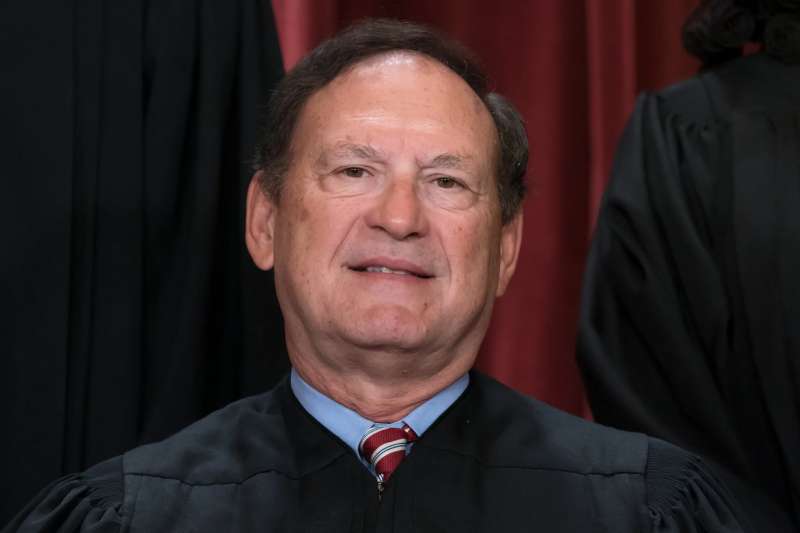
Justice Samuel Alito is the latest Supreme Court judge to come under scrutiny after a ProPublica report published Tuesday reveals that he went on an undisclosed luxury fishing trip with a prominent conservative donor more than a decade ago.
According to ProPublica’s investigation, in 2008, Alito accepted the trip from two wealthy Republican donors: billionaire Paul Singer, who provided the jet to Alaska’s pricey King Salmon Lodge, and Robin Arkley II, the owner of a mortgage company who had recently acquired the lodge.
The three-day trip included room and board, and Justice Alito did not disclose the trip as he is required to under federal law, even as the flights could have cost well over $100,000 each way had he chartered them himself.
Singer’s hedge fund has brought or appealed roughly a dozen cases to the Supreme Court to intervene on roughly a dozen cases since then, most of which had to do with a dispute between his hedge fund and the nation of Argentina.
In 2014, the Court ultimately issued a ruling in the case in Singer’s favor, ruling 7-1 that Argentina must pay his hedge fund $2.4 billion. Despite his ties to Singer, Alito did not recuse himself from participating in the case.
Arkley does not appear to have been involved in any cases before the court, according to ProPublica.
Alito defended himself preemptively in an op-ed published in the Wall Street Journal on Tuesday. He stated that he “had no obligation to recuse in any of the cases that ProPublica cites,” or to disclose the details of the fishing trip.
“My recollection is that I have spoken to Mr. Singer on no more than a handful of occasions, all of which (with the exception of small talk during a fishing trip 15 years ago) consisted of brief and casual comments at events attended by large groups,” Alito wrote. “On no occasion have we discussed the activities of his businesses, and we have never talked about any case or issue before the Court.”
Alito’s argument did not persuade legal or ethics experts and observers.
“Sam Alito. Corrupt to the core,” Norman Ornstein, an emeritus scholar at the American Enterprise Institute said on Twitter.
Leah Litman, a constitutional law professor at the University of Michigan, called Alito’s op-ed “beyond parody.”
“When you’re trying this hard to justify why you weren’t unethical, maybe just don’t,” Noah Bookbinder, the executive director of the watchdog group Citizens for Responsibility and Ethics in Washington tweeted about Alito’s op-ed. “Don’t accept the private flight to Alaska. Report it if you do. Do support a code of conduct so the rules are clear going forward and you don’t get into this situation.”
All federal judges are required to file annual financial disclosure reports, according to federal regulation. But even though Supreme Court justices are federal judges, they are not subject to a binding code of conduct, like lower court judges are, and as the Associated Press notes, this gives “individual justices latitude to write and enforce their own rules.”
The ProPublica report also revealed that Leonard Leo, then a leader of the conservative legal group The Federalist Society, was also involved in making arrangements for the trip, specifically inviting Singer—a major donor to Leo’s political organizations—to join and securing a spot for Alito on his jet.
Leo—who also helped get Alito confirmed to the Court and later went on to serve as Donald Trump’s “judge whisperer”—exited his full-time role at the society in 2020. He now runs a network of “dark money” groups funded by anonymous wealthy donors that have spent more than $500 million as they seek to overhaul every aspect of American society in order to make them radically conservative.
Leo denied any wrongdoing in a statement and insisted that there was no chance the trip impacted Alito’s judgment, claiming without a hint of irony that the ProPublica story was “bait for reeling in more dark money from woke billionaires who want to damage this Supreme Court and remake it into one that will disregard the law by rubber stamping their disordered and highly unpopular cultural preferences.”
The revelation about Alito’s acceptance of this trip is the latest development in an ongoing national discussion about issues of ethics within the Supreme Court, including justices’ obligation to disclose the details of expensive trips paid for by other individuals.
In April, ProPublica published a report that detailed Supreme Court Justice Clarence Thomas’ failure to disclose a 2014 real estate deal between himself and Republican mega-donor Harlan Crow, in violation of federal law.
“The transaction marks the first known instance of money flowing from the Republican mega donor to the Supreme Court justice,” ProPublica said in its report.
Another report from ProPublica detailed their investigation into Thomas and his wife’s luxury travel with the Crows. These trips included trips on the Crows’ yacht and private jet. Thomas did not disclose this travel either.
The cascade of stories surrounding Thomas and the Court’s increasingly conservative rulings in recent years have damaged its reputation among Americans.
A new poll from Quinnipiac University—conducted days before the report about Alito was published—found that 58% of Americans disapprove of the Court’s performance, while only 28% approve. Sixty-eight percent of Americans also think the Court is mainly motivated by politics, while only 25% think it’s mainly motivated by the law.
The ProPublica reports have also prompted responses from Democrats in Congress. U.S. Senate Majority Whip Dick Durbin and Sen. Sheldon Whitehouse announced on Wednesday that the Senate Judiciary Committee would try to advance new Supreme Court ethics legislation when the Senate returns after the July 4 recess.
“The highest court in the land should not have the lowest ethical standards. But for too long that has been the case with the United States Supreme Court. That needs to change,” Durbin and Whitehouse told the Washington Post in a joint statement.
Advocacy groups have also responded.
“Is justice truly blind, or is it simply a commodity to be bought and sold by those with deep pockets?” Tiffany Muller, president of the End Citizens United and Let America Vote Action Fund said in a statement. “These scandals should serve as a wake-up call for Congress to implement and enforce a strict code of ethics. Anything short of this will empower the extremist conservative justices to continue to engage in this reprehensible behavior.”