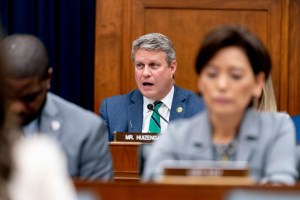
Rep. Tom Barrett’s district just lost its Planned Parenthood clinic.
On July 30, Planned Parenthood of Michigan closed its Lansing, Livonia, and Warren locations, citing a $4.2 million drop in patient care reimbursement and family planning funding tied to federal cuts. The Lansing clinic sat inside Barrett’s 7th Congressional District. “The funding infrastructure that supported that network has fundamentally changed,” said Paula Thornton Greear, president and CEO of Planned Parenthood of Michigan.
The closure followed earlier closures in Jackson, Petoskey, and Marquette in 2025, the last of which left some Upper Peninsula patients as much as a five-hour drive from the nearest provider.
“Just a couple of weeks ago, it was announced that the Lansing clinic was closed because of those cuts,” Shanay Watson-Whittaker, director of Michigan campaigns for Reproductive Freedom for All, told the ‘Gander in an interview.
“People who depend on Planned Parenthood, sometimes that’s their primary source of care, no longer have the closest clinic to them. They have to travel, and that’s not fair.”
Barrett’s votes on healthcare and the Medicaid cuts
Barrett voted twice for the federal cuts that led to that closure. In May 2025 and again in July, he voted for H.R. 1, the reconciliation package known as the One Big Beautiful Bill Act. Tucked into it was a one-year block on Medicaid reimbursement for any provider that also offers abortion care, a provision that applied almost exclusively to Planned Parenthood.
President Trump signed the act into law on July 4. Barrett’s statement afterward didn’t mention Planned Parenthood. Instead, it credited the bill with protecting the integrity of Medicaid and SNAP for those who need them most.
Reproductive Freedom for All gives Barrett a zero percent score on its legislative report card, the group’s lowest possible mark. Watson-Whittaker said that record goes back to his first weeks in office. In January 2025, Barrett voted for the Born-Alive Abortion Survivors Protection Act, one of the first bills the new Republican majority brought to the floor. Abortion rights advocates and medical groups, including the American College of Obstetricians and Gynecologists, call the bill misleading, arguing that existing law already requires doctors to treat any infant born alive the same as any other newborn. ACOG’s president said the bill is “not based in science or medicine” and imposes up to five years in prison on providers who don’t comply. In December, he voted for a healthcare package that barred federal cost-sharing subsidies from covering abortion services. Democrats offered an amendment to strip that provision out. Barrett voted against it, and the amendment failed.
Just a few weeks after that vote, on Dec. 17, Barrett voted for H.R. 6703, the Lower Premiums for All Americans Act. The bill made it easier for small businesses to band together to buy insurance and covered some costs for insurers, but it didn’t touch the ACA subsidies that actually lowered people’s monthly premiums. Those subsidies were set to expire two weeks later. Barrett said in a press release that the bill delivered “more transparency, more accountability, and real reforms.”
On Jan. 8, the House got a real chance to fix the problem it had just walked past. A bill to extend the enhanced ACA subsidies for three years came up for a vote, forced onto the floor by a discharge petition after GOP leadership had refused to schedule it. It passed 230 to 196. Seventeen Republicans crossed over to vote yes. Barrett wasn’t one of them. In his own statement, he called the extension “blank checks to big insurance companies” and argued it would benefit wealthier households at working-class Americans’ expense.
The numbers in his own district cut against that framing. A KFF analysis found roughly 23,000 marketplace enrollees in MI-07 facing an average premium increase of 61% once the subsidies lapsed. Those aren’t top earners. They’re small-business owners, self-employed workers, and people who buy their own coverage because their job doesn’t offer it.
What the Medicaid changes mean for Michigan
Amber Bellazaire, a senior policy analyst at the Michigan League for Public Policy, said the bigger threat to Michigan families is quieter than any single vote.
“Uninsured folks don’t stop getting sick, or stop giving birth, or stop breaking bones,” Bellazaire said. “Their care, if they are not insured, becomes uncompensated care, and that does ultimately have spillover effects for the rest of the system, even those who have private insurance.”
In Michigan, Medicaid covers more than a third of all births in the state, she said. When hospitals absorb too much unpaid care, they start cutting service lines. “They can’t keep their labor and delivery ward open anymore. They can’t provide psychiatric services at that location anymore,” Bellazaire said. In the worst cases, rural hospitals close entirely, something Michigan has already seen happen at Sturgis Hospital.
The Healthy Michigan Plan, the state’s Medicaid expansion, covers roughly 700,000 people. Starting Jan. 1, 2027, most will need to prove they’re working at least 80 hours a month or earning at least $580 to keep their coverage. The state estimates as many as 200,000 people could lose coverage once that requirement and new six-month eligibility checks take effect.
Bellazaire said a lot of that loss likely won’t come from people who are actually ineligible. It’ll come from paperwork, the same pattern the state saw when it re-checked Medicaid rolls after the pandemic wound down. She’s also watching for what she called an “unwelcome mat” effect: when parents lose coverage over missed forms, their eligible kids often lose it too, even though children aren’t subject to the work requirement at all.
For families of color, advocates say the stakes compound further. In a statement, Danielle Atkinson, executive director of Mothering Justice Action Fund, said Black and brown families are absorbing these changes on top of a system that already fails them.
“Black women are three times more likely to die from pregnancy-related complications than white women, and in Michigan, three-quarters of pregnancy-related deaths are preventable,” Atkinson said. “For a lot of Black and brown families, this is about far more than a doctor’s appointment. It’s about whether you can afford care, find a provider you trust, and access support before, during, and after pregnancy.”
Barrett’s record before Congress
Barrett’s record on reproductive rights predates his time in Congress. As a state senator in 2019, he introduced legislation that would have made second-trimester abortion procedures a felony, with no exception for rape or incest. “He also supported a six-week ban in Michigan too,” Watson-Whittaker said, referring to a 2019 bill based on the disputed claim that fetuses have detectable heartbeats at that stage. Barrett has described himself as “100% pro-life, no exceptions” since at least his first congressional run in 2022. Watson-Whittaker said that record hasn’t softened in office.
“Tom Barrett is a threat to women’s reproductive freedom,” she said. “We know that he voted in favor of cuts that take away from thousands of Michiganders, including people in his own district.”
Watson-Whittaker said MI-07 voters are already responding. “Our most ardent supporters are in the seventh congressional district,” she said. “They understand what’s at stake.” Her organization has been going door to door across the district ahead of the midterms, signing up new members and talking with voters about what’s on the line.
In 2022, 56.6% of Michiganders voted to put abortion rights in the state constitution. For Watson-Whittaker, that’s the standard Barrett’s record has to be measured against.
“If one freedom is taken away, what’s next?” she said. “If access is taken away, what’s next?”