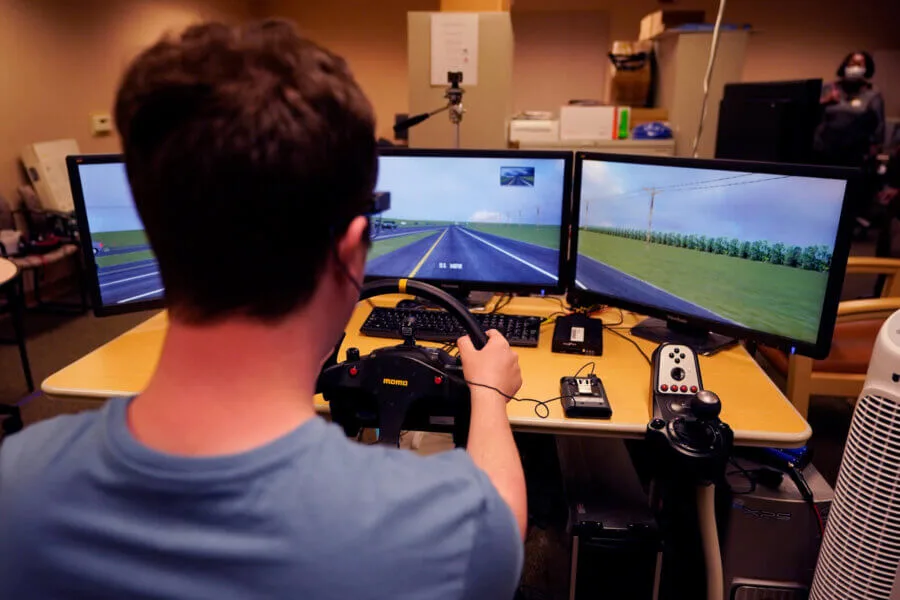
Tate Ellwood-Mielewski test drives on a simulator at the University of Michigan, Friday, April 29, 2022. (AP Photo/Carlos Osorio)
ANN ARBOR—University of Michigan researchers are studying how well people with autism spectrum disorder can detect road hazards, and plan to assist the young motorists in sharpening their driving skills.
The upcoming effort will be the second phase of a project funded by Ford Motor Co. that teams the Ann Arbor university with a local driving school.
During phase one of the study, researchers found that students with autism spectrum disorder detected fewer hazards than control participants during simulated drives.
But, according to lead researcher Elise Hodges, some extra work behind the wheel did the trick.
“Those folks that underwent training improved in two-thirds of hazards in the simulated drive,” said Hodges, a clinical associate professor in the University of Michigan’s neuropsychology program.
Tate Ellwood-Mielewski, who was diagnosed with autism spectrum disorder at age 3, is among those who plan to get back in the driver’s seat for phase two of the study.
“I do want to be able to drive … and get places where I want to go,” said Ellwood-Mielewski, a 23-year-old from Ann Arbor whose mother, Debbie Mielewski, was instrumental in pulling together the partners to make the study happen.
Mielewski had been harboring a growing concern about how her son would fare in the future with no driver’s license and his parents no longer around.
So, Mielewski, a technical fellow of sustainability at Ford, approached her boss in 2018 “and just blurted out: “Would you support a program to help autistic spectrum kids to learn how to drive?”
“And he immediately said, ‘Yes!'”
Ann Arbor Academy, a school for students with learning and social differences, hosted driving lessons. Hodges designed the simulated drives and oversaw the study. Ford footed the bill.
The goal, in part, was to provide an opportunity for those with autism spectrum disorder to improve their driving skills.
“Many of them … would like to drive, but getting from wanting to drive and being able to drive are two different things,” Hodges said.
Indeed, the first phase of the study found that, in addition to detecting hazards, students with autism tended to slow down and “stop short” in front of stop signs.
Hodges said she hopes the individualized driving sessions planned for phase two will bear fruit.
Either way, programs like this can go a long way toward helping those with autism overcome their doubts, Debbie Mielewski said.
“If we can just free them to think that they can do anything, I really think they can,” she said. “They need support. We should support them.”
Hodges said she hopes similar programs appear elsewhere.
“In the best-case scenario, I would hope that parents would learn that their teens or young adults who have ASD actually may be able to drive successfully,” she said. “And there may be some tools out there that they may not have been aware of.”
The second phase is expected to start in a month or two, Hodges said.
Author


VIDEO: Trump isn’t the only republican facing charges for alleged financial crimes
https://www.tiktok.com/@gandernewsroom/video/7361494909938978090 A whole lot of Michigan Republicans and lobbyists are facing criminal charges for...

VIDEO: It’s expensive to be poor in Michigan
https://www.tiktok.com/@gandernewsroom/video/7361154790300060974 Ever heard of predatory payday loans? Here’s how new laws could help protect...

Here’s everything you need to know about this month’s Mercury retrograde
Does everything in your life feel a little more chaotic than usual? Or do you feel like misunderstandings are cropping up more frequently than they...

The ’Gander wins multiple 2023 Michigan Press Association awards
MICHIGAN—The ’Gander Newsroom has earned multiple awards in the 2023 Michigan Press Association Better Newspaper Contest. The awards were announced...

Michigan Republicans ask Supreme Court to restrict medication abortion access
A lawsuit supported by Republicans could disrupt access to the most common form of abortion—even in Michigan, where reproductive rights are...