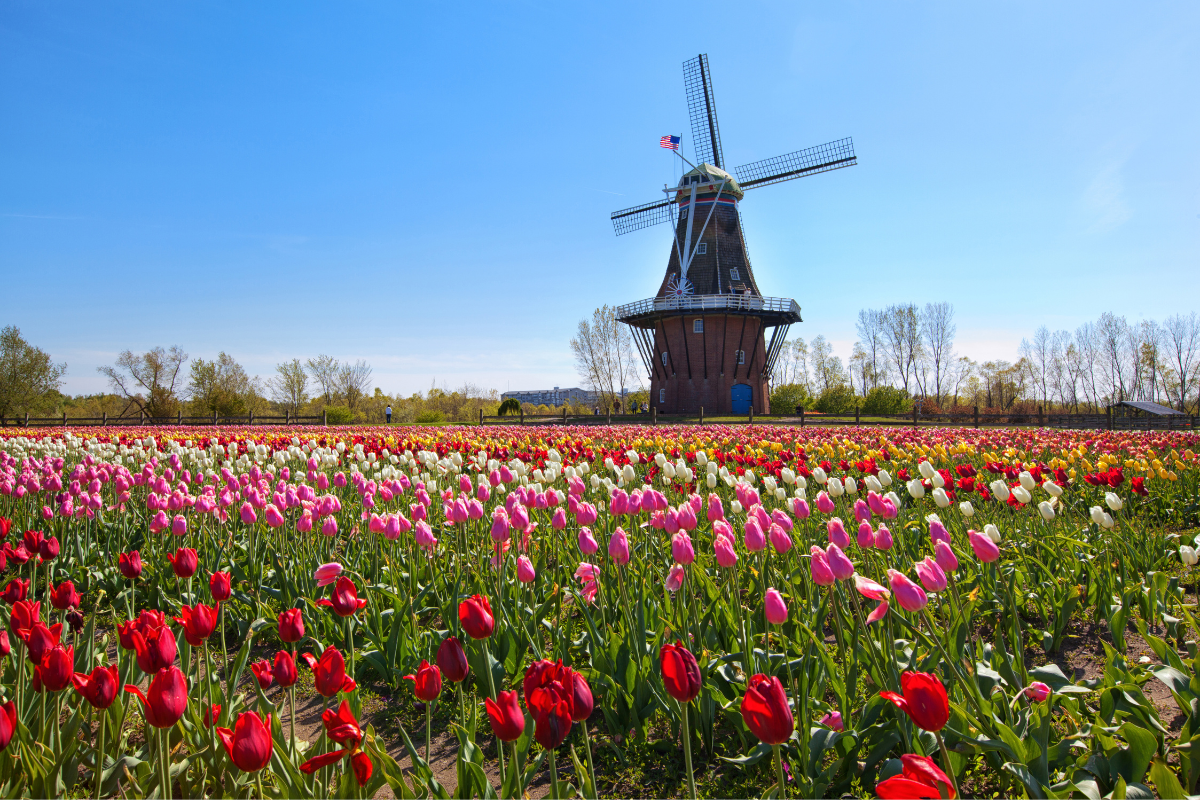
A windmill stands behind a field of tulips in Holland, Michigan, during the springtime. (Photo courtesy of Canva)
The founding of Holland and Tulip Time.
Over on Michigan’s western coast, there’s a community known for its beaches, festivals, and cultural heritage.
If you’ve been in Michigan long enough, there are probably a few places springing to mind now. But one place in particular wears its heritage on its sleeve. It’s in its name, after all.
Here’s a quick history of Holland, Michigan, and its Tulip Time Festival.
Establishing Holland

Drawing of the First Reformed Church building in Holland, Michigan, sometime between 1847 and 1856. (Photo courtesy of Hope College Library, Archives and Special Collections)
Like many communities founded in Michigan during the 19th century, religion was a main driver for establishing Holland.
For centuries, what is now present-day Ottawa County—where part of Holland is located—was home to the Potawatomi and Odawa people. The first traces of Europeans arriving in the general area began in 1806 with French Canadian fur traders Joseph and Magdelaine La Framboise, who established a trading outpost. The pair were originally from Mackinac Island and were devout Roman Catholics.
Several decades later, in 1846, Presbyterian Reverend George Smith—who had been working to spread Protestantism to the local indigenous communities—built the Old Wing Mission, which remains the oldest house in Holland.
Not long after, Dr. Albertus van Raalte, a Dutch Calvinist separatist, led a group from the Netherlands to settle in the area near the Old Wing Mission. He would go on to found the First Reformed Church of Holland in 1847.
According to historians, while Smith’s group wasn’t very successful in converting the local indigenous population—many were already practicing Catholics—they still got along well.
However, this was not the case with Raalte’s group, says historian Robert P. Swierenga—the group’s relationship was marred by “mutual mistrust.”
Upon their arrival in 1847, the native community was welcoming of the Dutch. But that summer, when the Odawa villagers left for their traditional summer fishing grounds further north, the Dutch settlers believed that they had left for good. The Odawa returned shortly after to a ransacked village.
In 1848, facing a large influx of thousands of new settlers in the area, strained relations, and a smallpox epidemic, Odawa Chief Peter Waukazoo and Rev. Smith led the Odawa villagers to establish a new community further north.
Less than 20 years later, on March 25, 1867, Holland was officially incorporated as a city. It’s name, of course, a direct nod to the roots of many of its citizens.

Image of River Street in Holland, Michigan, sometime during the Civil War. (Photo courtesy of Hope College Library, Archives and Special Collections)
Cultivating Tulip Time
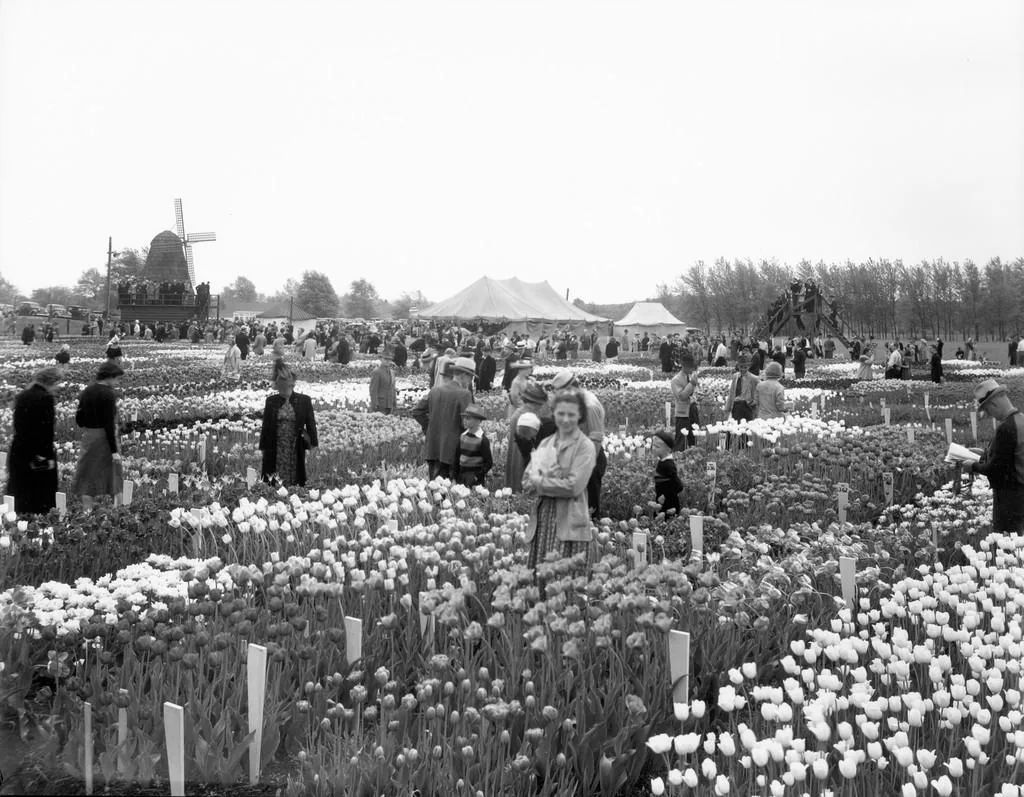
Nelis Tulip Farm in Holland in an undated photograph. (Photo courtesy of Hope College Library, Archives and Special Collections)
Holland’s economy was centered on agriculture and manufacturing throughout the city’s early years. But it would become known for something else following the founding of a new tradition: Tulip Time.
The roots of Tulip Time date back to 1927 when Lida Rogers, a biology teacher at Holland High School, suggested that the city adopt the tulip as its official flower—a nod to its Dutch heritage. She also encouraged the creation of a festival. A year later, Holland Mayor Ernest C. Brooks approved funds to buy 100,000 tulip bulbs from the Netherlands. The bulbs were planted in city parks and also made available for purchase to residents at one cent a piece. In May of 1829, the town experienced the blooming of thousands of tulips and invited guests to visit the town to enjoy the sights. And thus, Tulip Time was born as an annual event.
The festival also became known for highlighting Dutch traditions, especially emphasizing Dutch costumes and wooden shoes.
While World War II marked a brief end to the festival, it returned in 1946—with organizers adding more features to the event in the years since.
In 2001, changing weather trends led organizers to move the festival up a week, to better coincide with the blooming of the tulips.
In the present day, the festival has grown to be a significant event in the state that is about much more than just tulips (although they’re still a huge a part of it, of course). It’s now a week long, and offers loads of daily attractions. The festival saw another brief hiatus during the COVID-19 pandemic, but the people keep coming—organizers estimate that upwards of 350,000 visit the event annually.
Tulip Time takes place from May 4-12 in 2024.
 |
|
That One Time in Michigan is a special edition of our weekly newsletter. It runs every other Tuesday. Know a story we should explore or want to send me a note about the newsletter? You can write to me by clicking here! |
Author


That one time in Michigan: When marijuana was legal for 22 days in 1972
Explore the unique history of cannabis in Michigan, from a star-studded Ann Arbor rally to a three-week reprieve from marijuana laws in the 1970s. ...

That one time in Michigan: When it was the first English-speaking government to abolish the death penalty
In Michigan, a death penalty ban was established before official statehood. Here’s how this restriction came to be and what it means for modern...

‘The legend lives on’: Wreck of the Edmund Fitzgerald still resonates 50 years later
MARQUETTE, Mich. (AP) — Spend enough time along the shores of Lake Superior and it won’t be long before there’s some reminder of what happened “when...

New book shows how Mackinac Island became tourism gem
By Isabella Figueroa Nogueira, Capital News Service LANSING – Horse-drawn carriages clatter down car-free streets. The mouth-watering smell of fudge...

That one time in Michigan: When an ancient, Stonehenge-like structure was discovered in Lake Michigan
Journey beneath the waves of Lake Michigan to learn about a centuries-old secret—from Stonehenge to the Great Lakes. If you’ve ever visited...