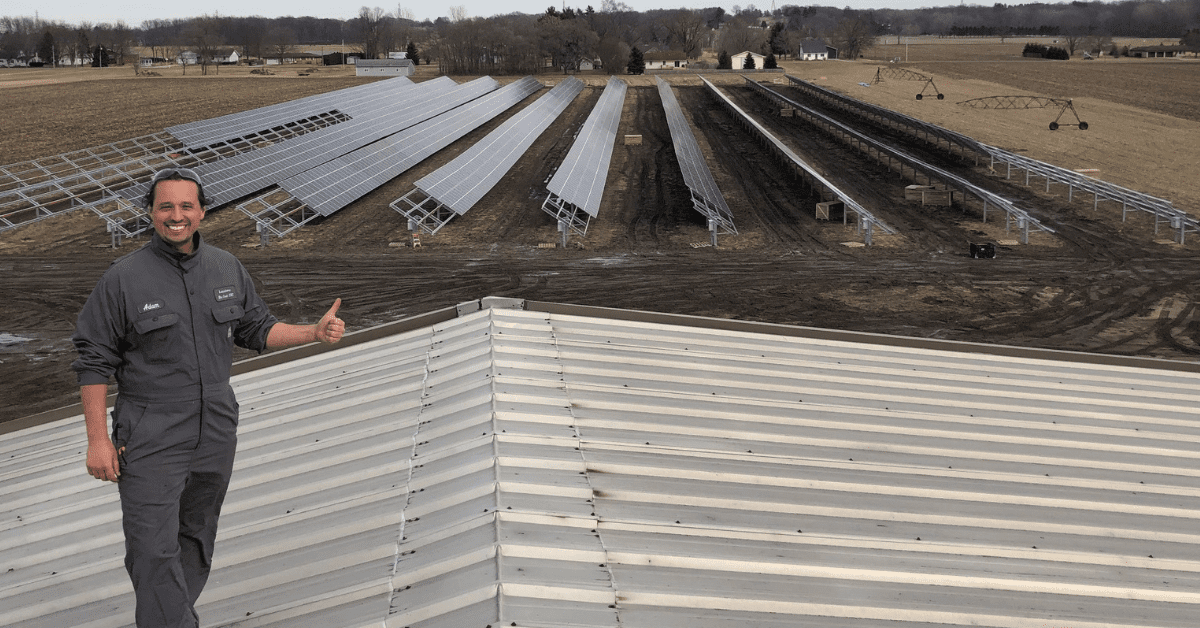
Adam Schaller shows off the solar array outside his shop in Baroda. (Courtesy/Solar United Neighbors)
A grant from the US Department of Agriculture will help a small, rural school district in southwest Michigan save millions of dollars to put back into local public education.
MICHIGAN—About three years ago, Adam Schaller stopped receiving electric bills at his family-owned diecast company in southwest Michigan. Nowadays, they send him checks.
Schaller, the owner of Lakeshore Die Cast in Baroda, said he was able to flip the script on his utility provider after he installed two large solar arrays outside his shop—effectively turning his net energy usage into a surplus that he now sells back to his local power company for profit.
It’s an arrangement that has allowed Schaller to completely break free from his monthly utility bill, and, in doing so, phase out one of the largest fixed costs attached to his small business, which molds metal parts for the automotive, medical, construction, and aerospace industries.
It has also given his company an edge over the competition, translated to higher wages for his employees, and ultimately helped his business to keep growing, Schaller told The ‘Gander.
And this summer, with federal grant funding and other tax incentives provided through President Joe Biden’s Inflation Reduction Act, Schaller is turning his attention toward his alma mater, and trying to help Bridgman Public Schools install some new solar panels of its own, slash its electricity bill, and in the process, save millions of dollars to put back into local public education.
“I was saving myself so much money doing these solar projects, so I wanted to take what I’ve learned and try to help out the local community with it,” Schaller explained. “If everything goes to plan, I’m just going to build this solar array for the district and give it to them.”
‘One Step Closer to Reality’
Last year, for a robotics competition, a group of fifth- and sixth-graders at Bridgman Elementary School came up with a plan to convert the district to renewable energy—namely by installing a new solar array somewhere near the middle school and harnessing the power of the sun.
Superintendent Shane Peters said the students won a statewide award for their concept, and were subsequently invited to pitch their plan to the district’s Board of Education. Any opportunity to save cash, particularly at a small, rural district, was something worth considering, Peters said.
“They really did a great job presenting, and the board was actually interested because it offered significant savings over time for the general fund,” Peters explained. “So, now we’re considering pursuing this option, and with this federal grant, it’s all really just one step closer to reality.”
This summer, Peters said the district plans to accept bids from contractors interested in installing the solar array for the district and curbing its electricity costs—to the tune of about $3 million in savings over the next 25 years, according to initial estimates from district officials.
And after receiving a $250,000 grant last year from the US Department of Agriculture’s Rural Energy for America Program to put the plan into motion, Schaller, so far, is the first (and perhaps the only) person in town lining up to help the school district get the job done.
“As time goes on, the cost of stuff just goes up. The same is true with electricity,” Schaller said. “If you spend money now, you can save money in the future. I brought solar to my business for my own reasons, but I think this is something that can be really good for the community, too.”
‘Tangible Benefits’
The Rural Energy for America Program provides guaranteed loan financing and federal grant funding to agricultural producers and rural small businesses, specifically for renewable energy systems or to make energy efficiency improvements. The program has been in place for years, but was turbocharged with an extra $1 billion in funding through Biden’s Inflation Reduction Act.
Through the program, projects in rural communities—like Schaller’s solar operation at Lake Shore Die Cast—can apply for grants and loans that cover up to 75% of the total project costs, which helps to make solar arrays, wind turbines, and other projects much more affordable.
Last year, the program awarded $145 million in funding for 700 loan and grant awards nationwide, including the $250,000 award for Lakeshore Sales Corporation, another company Schaller formed to pursue grant funding for the new solar array for Bridgman Public Schools.
The school district still needs to complete a formal bidding process for the project, but Schaller said the recent federal grant funding will all but ensure that his proposal is an affordable one—namely by offering a $250,000 discount on a project slated to cost up to about $900,000.
“Saving money at small, rural schools really seems to have more tangible benefits,” Schaller said. “When you have a budget that’s not so big, any savings can mean hiring a new teacher in a classroom or affording supplies. Money in smaller districts tends to be more closely watched.”
Officials said the potential savings from switching to solar energy—up to $30 million over a 25-year span—is equivalent to about 25% of the district’s annual budget. And any money saved on electricity will translate to more funding for the broader mission of educating local students.
“Money that isn’t spent on electricity will free up more money for everything else,” Peters said.
Schaller also told The ‘Gander that he doesn’t want to churn a profit on the deal—only give back to his community and pass along a cost-saving opportunity for the public school district. And if all goes as planned, both Peters and Schaller anticipate the project will be finished this year.
“For me, this is an opportunity to use what I’ve learned to help out my local school district,” Schaller said. “That’s really what’s most important to me as a member of this community.”
READ MORE: Michigan lawmakers want to make it cheaper to install solar energy
For the latest Michigan news, follow The ‘Gander on Twitter.
Follow Political Correspondent Kyle Kaminski here.
Author

Support Our Cause
Thank you for taking the time to read our work. Before you go, we hope you'll consider supporting our values-driven journalism, which has always strived to make clear what's really at stake for Michiganders and our future.
Since day one, our goal here at The 'Gander has always been to empower people across the state with fact-based news and information. We believe that when people are armed with knowledge about what's happening in their local, state, and federal governments—including who is working on their behalf and who is actively trying to block efforts aimed at improving the daily lives of Michigan families—they will be inspired to become civically engaged.

Why Michigan’s rural residents are reluctant to drive electric vehicles
By Bauyrzhan Zhaxylykov, Capital News Service LANSING—Only about 5% of rural Michigan residents say they would choose an electric vehicle as their...

Michigan is last state without a septic system code. Will that change?
By Justin Fox Clausen, Capital News Service LANSING—A new Senate bill would address the regulation, inspection and re-evaluation of septic systems....
Will Michigan get a north-south passenger train line? Where the idea stands
A nonprofit working on a long-term plan to create a passenger rail line that would run from Petoskey to Detroit is seeking additional public input...
Winter makes curved roads dangerous; researchers seek solutions
By Eric Freedman, Capital News Service LANSING—Winter—skid season—is almost upon us, making curves slipperier and more dangerous. Now a new study...
Upper Peninsula communities join forces to push back against Big Tech
From Keweenaw to Sault Ste. Marie, communities across the Upper Peninsula are working together as AI data centers and bitcoin mining operations...