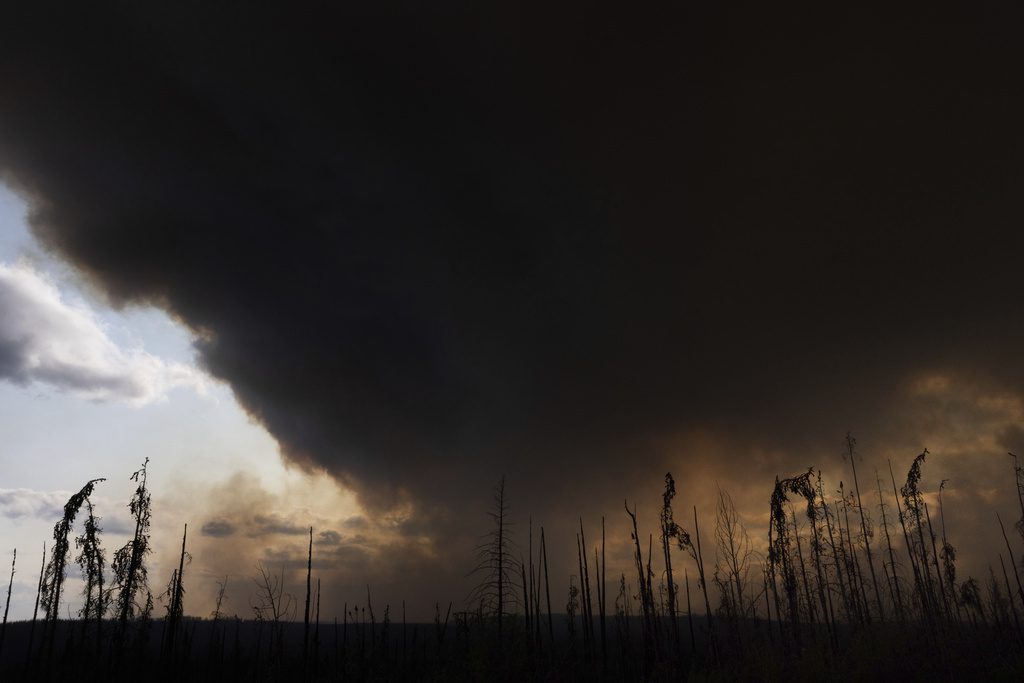
FILE - Wildfire smoke hangs in the air above Highway 97 north of Buckinghorse River, British Columbia, May 30, 2025. (Nasuna Stuart-Ulin/The Canadian Press via AP, File)
PORTLAND, Maine (AP)—Smoke from Canadian wildfires worsened air quality in the eastern U.S. on Wednesday as several Midwestern states battled conditions deemed unhealthy by the federal government.
The fires have forced thousands of Canadians to flee their homes and sent smoke as far as Europe.
In the U.S., smoke lingered on the skylines of cities from Kansas City to Minneapolis, and a swath of the region had unhealthy air quality Wednesday, according to an Environmental Protection Agency map.
In Stoughton, Wisconsin, Nature’s Garden Preschool was keeping its kids indoors Wednesday due to the bad air quality, which interferes with the daily routine, said assistant teacher Bailey Pollard. The smoke looked like a coming storm, he said.
The 16 or 17 kids ages 12 weeks to 5 years old would typically be outdoors running or playing with water, balls and slides, but were instead inside doing crafts with Play-Doh or coloring. The situation was unfortunate because kids need to be outside and have fresh air and free play, Pollard said.
“It’s something where we’ve got to take precaution for the kids,” he said. “Nobody wants to stay inside all day.”
Iowa issued a statewide air quality alert through early Thursday, urging residents to limit certain outdoor activities and warning of possible health effects due to the thick smoke. Wisconsin officials made similar suggestions as the smoke drifted southeast across the state.
In Michigan’s Upper Peninsula, authorities advised people shut windows at night, avoid strenuous activity outside and watch for breathing issues.
Parts of Maine, Vermont, New Hampshire and New York had areas of moderate air quality concern, and officials advised sensitive people to consider reducing outdoor activity.
Unhealthy conditions persist in Midwest
The Minnesota Pollution Control Agency issued an alert for almost the entire state into Wednesday, but the Twin Cities area got the region’s worst of it Tuesday.
Children’s Minnesota, a network of pediatric clinics and hospitals in the Twin Cities area, has seen a “modest increase” increase this week in patients with symptoms that doctors attributee to polluted air, Dr. Chase Shutak said.
Their symptoms have included breathing problems, including asthma and other upper respiratory issues, said Shutak, who stays in close touch with other pediatricians in his role as medical director of the Minneapolis primary care clinic at Children’s.
The Iowa Department of Natural Resources warned that air quality in a band from the state’s southwest corner to the northeast could fall into the unhealthy category through Thursday morning. The agency recommended that people — especially those with heart and lung disease — avoid long or intense activities and to take extra breaks during strenuous activity outdoors.
Conditions at ground level are in the red
The U.S. Environmental Protection Agency’s AirNow map showed a swath of red for “unhealthy” conditions across Wisconsin and northern Iowa. Conditions in northern Michigan also reflected many unhealthy zones. The Air Quality Index was around 160 in many parts of the upper Midwest, indicating poor conditions.
The Air Quality Index , or AQI, measures how clean or polluted the air is, indicating which health effects might be experienced within a few hours or days after breathing polluted air. It is based on ground-level ozone, particle pollution, carbon monoxide, sulfur dioxide and nitrogen dioxide. Particulates are the main issue from the fires.
The index ranges from green, indicating satisfactory air quality that poses little or no risk, to maroon, which is considered hazardous. That level comes with health warnings of emergency conditions, which are more likely to affect everyone.
There were areas of reduced air quality all over the U.S. on Wednesday, with numerous advisories about moderate air quality concerns as far from the fires as Kansas and Georgia.
The air quality was considerably better Wednesday in Minnesota, where only the barest hint of haze obscured the downtown Minneapolis skyline. The city experienced some of the worst air in the country on Tuesday. But the air quality index, which had reached the mid-200 range, or “very unhealthy” on Tuesday, was down to 60, or “moderate,” by Wednesday afternoon.
The Canadian fire situation even reaches Europe
Canada is having another bad wildfire season. Most of the smoke reaching the American Midwest has been coming from fires northwest of the provincial capital of Winnipeg in Manitoba.
Canada’s worst-ever wildfire season was in 2023 and choked much of North America with dangerous smoke for months.
The smoke over western Europe is expected to keep moving eastward, according to the National Oceanographic and Atmospheric Administration. It’s causing hazy skies, but not expected to affect surface-air quality. However, it could rise high enough to be carried that far, indicating the immense size and intensity of the fires, according to Copernicus.
___
Karnowski reported from Minneapolis. Associated Press writers Jack Dura in Bismarck, North Dakota; Kathy McCormack in Concord, New Hampshire; Tammy Webber in Fenton, Michigan; and Scott McFetridge in Des Moines, Iowa, contributed to this report.
Author


OPINION: Ending the EPA’s Endangerment Finding would kill pollution protections
President Donald Trump and Lee Zeldin are taking steps to roll back the EPA’s Endangerment Finding, which is essential for protecting us against...
La Niña is coming, experts warn. Is lake-effect snow in Michigan’s forecast this winter?
NOAA's Climate Prediction Center is calling for a warmer-than-normal, more mild fall in Michigan, but the return of La Niña could complicate the...

To get that perfect ear of corn, weather has to cooperate. But climate change is making it dicier
PAW PAW (AP)—Robb Rynd and his brother grew up farming and wanted to do more of it outside their day jobs, so they went in together on what's now a...

Empowering environmental stewardship: barn sanctuary champions compassion and conservation
By Donté Smith, Capital News Service LANSING — The Great Lakes, a vital freshwater expanse for millions, face an ongoing environmental crisis....

Can Michigan’s forests survive climate change? One researcher is finding out
By Emilio Perez Ibarguen, Capital News Service LANSING – As Michigan’s climate warms, tree species like red pine and eastern white pine may no...