Jon King/Michigan Advance
BY JON KING, MICHIGAN ADVANCE
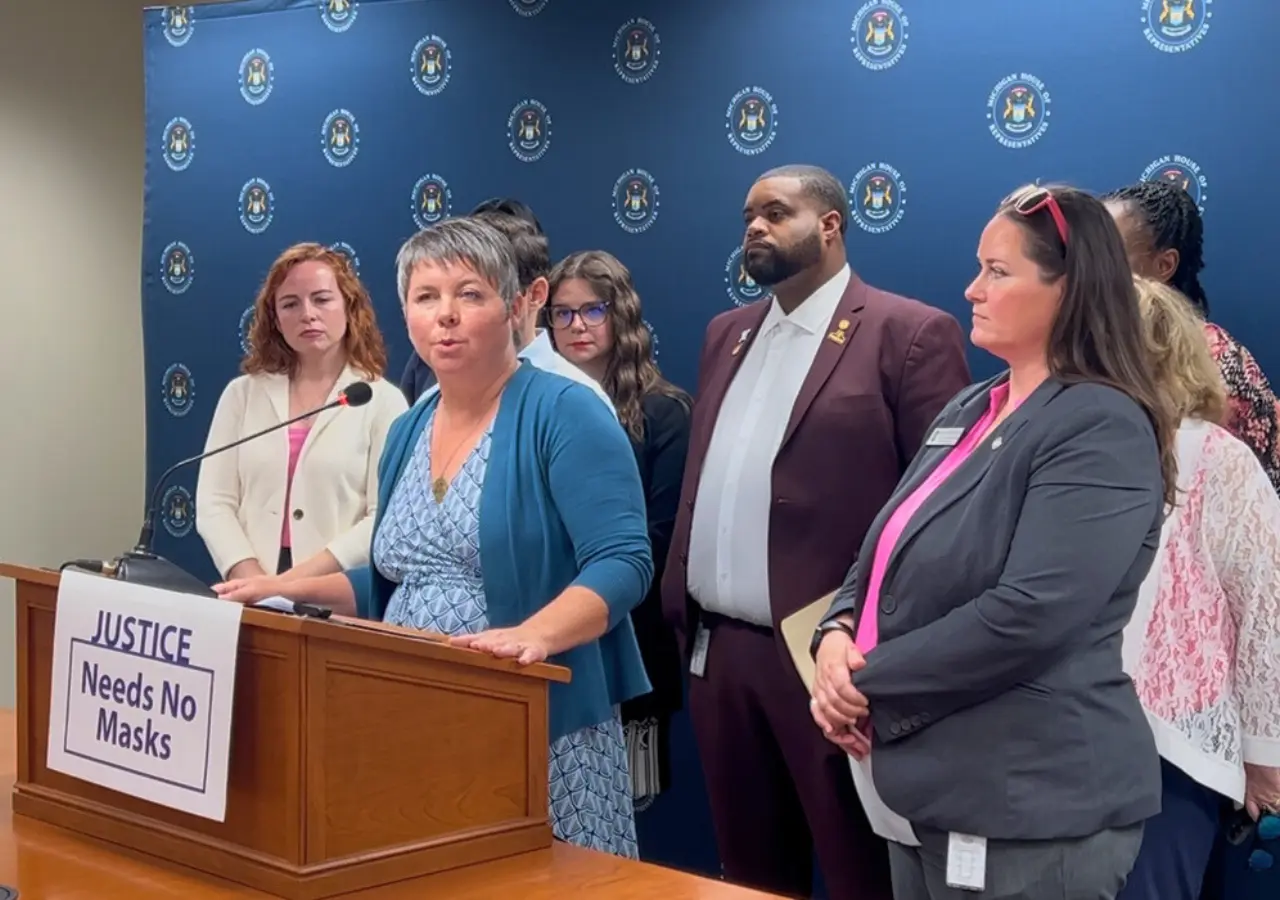
MICHIGAN—In a fiery press conference in Lansing, state Rep. Betsy Coffia unveiled Thursday new legislation aimed at banning the use of face masks and requiring clear identification for all law enforcement officers interacting with the public in Michigan.
The “Justice Needs No Mask” bill comes in response to growing public concern over masked, unidentified federal agents conducting immigration raids and detentions across the country.
Coffia, who represents a largely rural district in Northern Michigan with a strong agricultural presence, said that the fear among migrant farmworkers and their families was just one factor behind the legislation, which is expected to be introduced Thursday.
“They are living in fear today. They are living in fear of being targeted by masked, unidentified armed men in unmarked vans,” said Coffia (D-Traverse City). “If we want safe communities in Michigan, this bill is a key piece of the conversation because justice needs to wear no mask, not in a free society, not in America.”
Coffia described how disturbing it has been to see reports of masked agents snatching individuals—often without explanation or identification—from schools, workplaces, hospitals, and even courtrooms.
“To the average person, these incidents look like violent kidnappings. There is no way for the public, the people being accosted and grabbed, or even local law enforcement and local and state elected leaders to know who these folks are. That secrecy is at issue here. It creates a dangerous situation for those being snatched for our community and for local police as well.” Coffia said.
The legislation, which echoes federal legislation introduced by US Sen. Elissa Slotkin (D-Holly), would prohibit law enforcement officers at any level from wearing face coverings or obscuring their identity when engaging with the public.
However, Coffia noted there were clear exceptions. Officers would still be permitted to wear protective gear for disease prevention, or if they are in hazardous environments, or working undercover or conducting counterterrorism operations. The bill also mandates visible identification—such as a name or badge number—and clear display of the agency the officer works for.
While Coffia stressed that Michigan State Police and most local police agencies already adhere to transparency measures, she said the increasing use of masked federal agents implementing President Donald Trump’s mass deportation plan is what prompted this legislative push.
Coffia cited recent incidents, including impersonations of ICE agents, that led to sexual assault and attempted detentions, as evidence that the practice is being exploited by criminals. She cited the assassination of a Minnesota lawmaker and her husband by a man allegedly dressed as a police officer and wearing a mask.
Joining Coffia at Thursday’s press conference were several co-sponsors of the bill, including Rep. Noah Arbit (D-West Bloomfield), who called the policy of masked detentions a fundamental breach of the contract between citizens and the state.
“This policy shreds the rule of law and shreds the contract that we have as citizens with law enforcement; to know why we are being apprehended and what law that we have broken,” Arbit said. “When you don’t know whether someone who is apprehending you is part of the state or not, it gives license to anyone who’s not part of the state to also commit violence, ideologically motivated violence, terrorism. That’s what this is, truly.”
Rep. Carrie Rheingans (D-Ann Arbor) compared the federal agent actions to historical authoritarian regimes, invoking the memory of the Gestapo, Nazi Germany’s secret police.
“We said ‘never again,’ and we meant it. ICE agents refusing to show their faces or identify themselves is not only wrong—it’s un-American,” Rheingans said.
Rep. Stephanie Young (D-Detroit) said the actions of ICE agents under the Trump administration evoke the dark side of America’s past, linking masked law enforcement today to the Ku Klux Klan’s history of racial terror—often perpetrated, she noted, with the complicity or direct involvement of local police.
“Justice wears no mask,” Young said. “People used to show up at Black families’ homes wearing hoods. Some of them were law enforcement. And now here we are in 2025, with masked agents scooping up people in our communities.”
Young warned that this issue goes beyond race or immigration status, arguing that all citizens are at risk when secrecy becomes the norm in policing.
“If it’s happening to brown people today, it can happen to anyone tomorrow,” she added.
Coffia acknowledged that passing the legislation may be challenging in a politically divided legislature. When asked by Michigan Advance if any of her Republican colleagues in the state House had expressed support, she said some have privately shared concerns but stopped short of committing to public endorsement.
“I know some of them are deeply disturbed by what’s happening,” Coffia said. “Whether that will translate into co-sponsorship—I can’t say.”
She said she has discussed the bill with Michigan Attorney General Dana Nessel, who has joined other attorneys general in pushing for a similar federal standard. Coffia said she believes there is strong support for transparency and accountability, even if the political path forward remains uncertain.
Young, however, hoped that Michigan could become a model for how states can push back against what they see as a dangerous and authoritarian federal overreach.
“We cannot be silent, because silence means complicity. And we refuse to be complicit in injustice,’ said Young.
Once introduced, the bill is unlikely to get a committee hearing in the GOP-led House.
READ MORE: Should ICE agents be unmasked?
This coverage was republished from Michigan Advance pursuant to a Creative Commons license.
Author


Michigan OKs landmark regulations that push up-front costs to data centers
Michigan regulators on Thursday adopted landmark standards for the booming data center industry with a plan they say tries to protect residents from...
Q&A: Why this 29-year-old Detroiter thinks he can make Michigan government work again
Democratic state Senate candidate Justin Onwenu says he wants to rebuild trust, invest in neighborhoods, and help deliver a new generation of...
Michigan state budget 2026: 7 things to know about the bills
LANSING — Lawmakers on Oct. 2 and Oct. 3 voted to approve a 2026 budget plan that makes cuts to many state agencies while boosting funding...

Michigan Legislature passes eight day continuation budget, votes expected Thursday
BY BEN SOLIS AND KYLE DAVIDSON, MICHIGAN ADVANCE LANSING—In the thick of a government shutdown that lasted just one hour, the Michigan House and...
Michigan budget crisis averted: Legislature, Whitmer announce deal days before shutdown
BY BEN SOLIS, MICHIGAN ADVANCE LANSING—The respective leaders of the Michigan Legislature and Gov. Gretchen Whitmer on Thursday evening announced...