By Clara Lincolnhol, Capital News Service
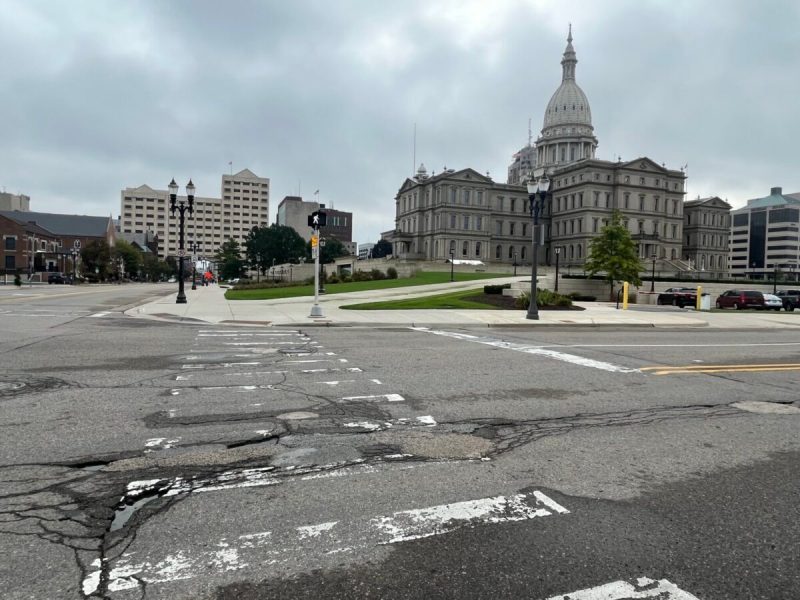
LANSING — Michigan is anecdotally famous, or some might say infamous, for the poor quality of its roads.
Famous enough to warrant Michigan Pot Hole ice cream from a Ludington company.
And serious enough to cost state and local taxpayers money.
Over a quarter of the roads in the state are considered “rough,” and Michigan has the tenth-highest percentage of rough roads nationwide, according to the World Population Review.
Roads are assessed by the international roughness index or IR, a standard used to determine how smooth a ride over the pavement is. The rougher the road, the bumpier the ride.
Major contributors to the rough roads are potholes. The biggest reason is the state’s climate, said Emin Kutay, a professor of civil and environmental engineering at Michigan State University.
“There are many factors that play into pothole formation: construction, material and climate,” he said. “Michigan unfortunately has this climate that really doesn’t help.”
Potholes form when water from rain or snow trickles into tiny cracks on the surface of the asphalt. When the water freezes, it expands slowly and pushes the pavement apart, he said.
Tiny pieces, or aggregates, of the pavement chip away, enlarging cracks. More water fills the crack, and when the water freezes again, the hole gets larger.
Cars driving over these cracks then chip away even more pavement, Kutay said.
“The sides of that little hole keep collapsing and collapsing and then you’ve got yourself a pothole,” he said.
Preventing pothole formation boils down to many factors. Using higher quality aggregate materials to build roads could help, but they’re more costly, he said.
“On local roads you might see more potholes than on highways because there are more stringent aggregate requirements on highways,” Kutay said.
Improving construction practices could also help, but ultimately Michigan’s climate means potholes will always be developing, he said.
“It’s like weeds in your grass – you may never be able to get rid of all those dandelions but you might be able to control and minimize them,” he said.
Last year 2,362 potholes on state highways were reported to the Michigan Department of Transportation, said Jocelyn Garza, the agency’s director of communications.
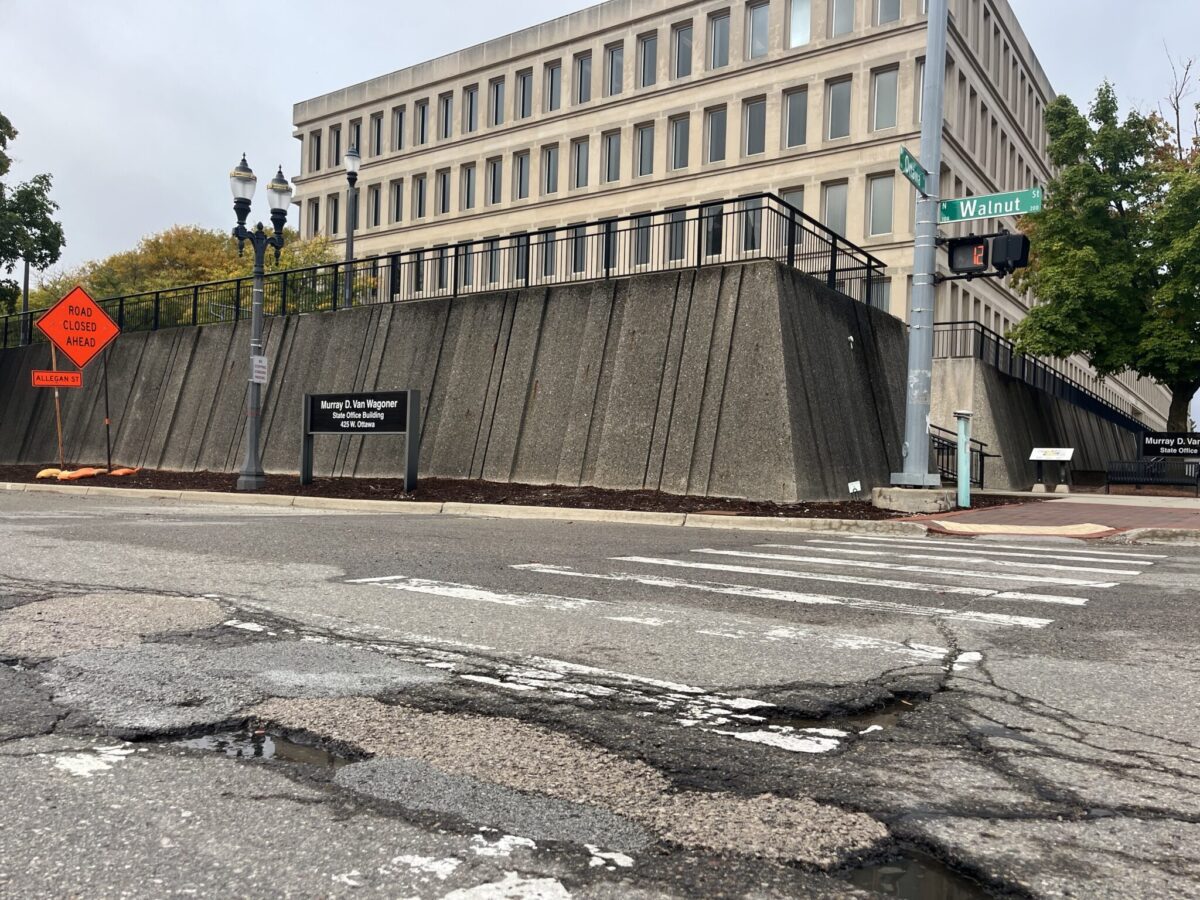
Potholes can damage vehicles. In 2024, 141 claims for pothole damage on state highways were submitted to MDOT. Of them, 13 received payments, she said. That’s fewer than 10% of claims. The total paid out was $5,952.85.
Under state law, no government agency is liable for injuries or damage from potholes unless the agency knew about the pothole, should have reasonably known about it or had a reasonable time to fix it before the injury occurred, Garza said.
The law states that knowledge of the pothole and time to repair it are presumed when the pothole was readily apparent to an “ordinarily observant person” for 30 days or longer before the injury took place, she said.
“Claims of less than $1,000 can be submitted to the correct MDOT office where the damage occurred,” she said.
People can file claims online by visiting the department website. MDOT will also direct people to the correct departmental office or local road agency to address their concerns, she said.
Typically, counties fill potholes on their local roads with a cold asphalt mix. It’s a quick and temporary fix.
The best way is to reconstruct the section of the road but that depends on how much money the county has, said MSU’s Kutay.
For local roads, sometimes the most effective means of getting a pothole fixed is talking about it, he said. “Oftentimes, the more complaints the residents have, the more chance of getting the road repaired.”
Pothole notoriety has established itself in the cultural zeitgeist of the state.
Gov. Gretchen Whitmer successfully campaigned in 2018 saying she’d “fix the damn roads.”
And bumpy roads even led Ashby’s Sterling Ice Cream to invent a flavor in 2015 with the namesake: Michigan Pot Hole.
Dianne Tunison, Ashby’s division manager and inventor of the flavor, said the idea came to her a decade ago when she was bouncing across a bridge in Auburn Hills.
“I got a call that said, ‘Hey we have these fudge cups that we need to use and put them in ice cream. What can you do with it?’ And I’m like, well, we need a name with pothole in it for one,” Tunison said.
Usually vanilla is an ice cream company’s top seller by a huge margin, but Michigan Pot Hole is so popular that it’s neck and neck with vanilla – and in some years, outsells it, she said.
The flavor is made with chocolate ice cream with chocolate fudge cups – coined “chunks of asphalt” – and fudge swirl with ground-up chocolate cookies deemed “thick black tar fudge,” she said.
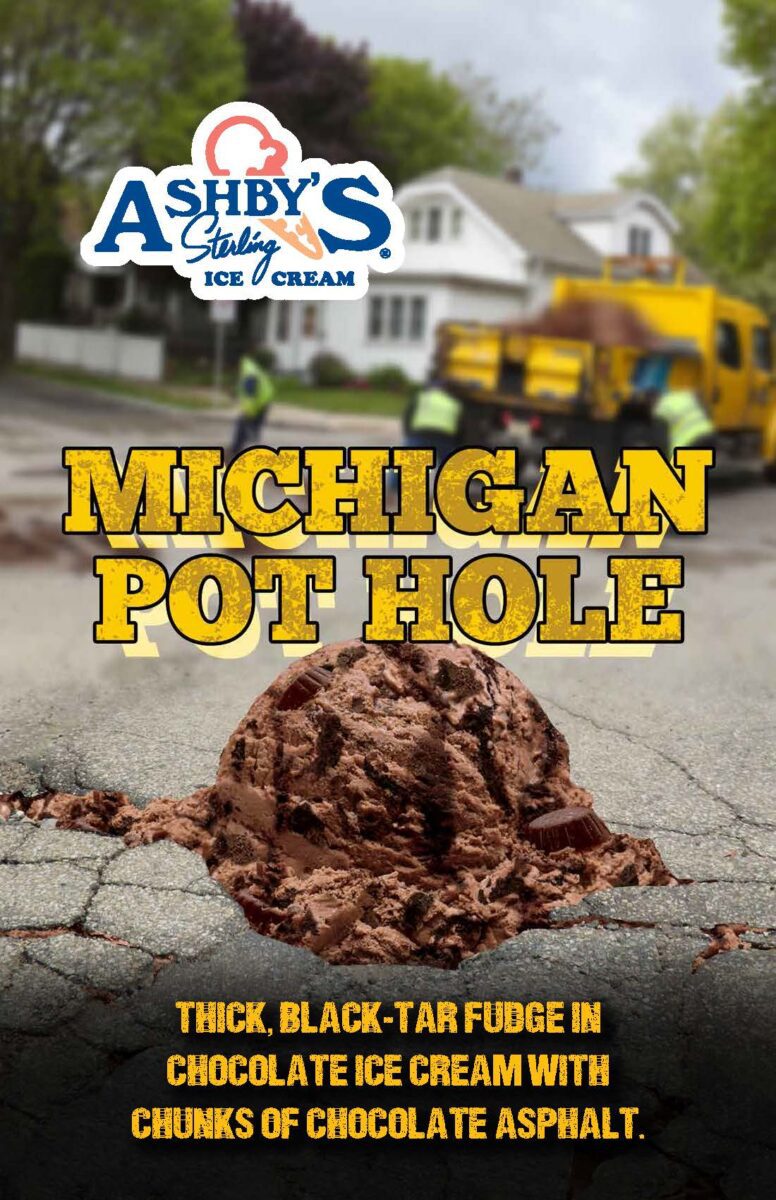
Ashby’s partnered with MDOT so 1% of the proceeds from sales of Michigan Pot Hole a year after it was first released went to fixing the roads.
“We presented them with the giant check, which wasn’t all that giant money-wise, but it was physically giant,” she said.
A decade later, the flavor is still hugely popular and – and still relevant to the state’s road conditions, she said.
“It had a lot of press, but it’s also just a great flavor,” Tunison said. “People really like the combination of chocolate, chocolate and more chocolate.”