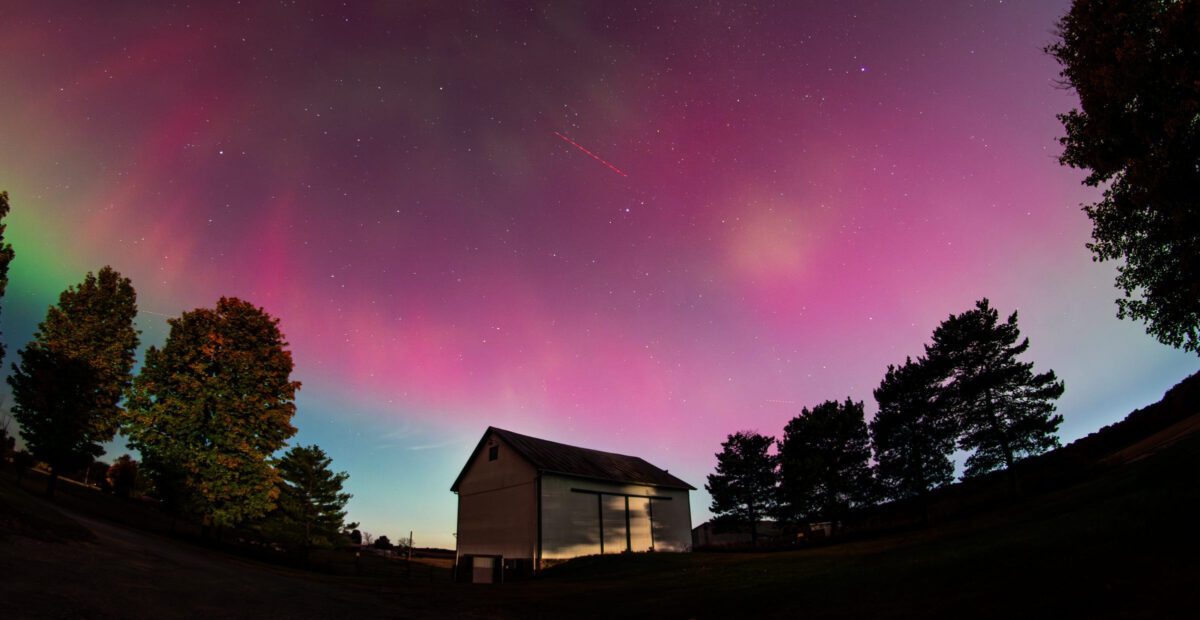
A brilliant sky seen Thursday evening, Oct. 10, 2024, in Alaiedon Township, Michigan. (USA TODAY Network)
The entirety of Michigan is predicted to see another stunning northern lights display Wednesday night, Nov. 12, according to NOAA’s Space Weather Prediction Center (SWPC) forecast — and this time, clear skies in many areas will offer a chance to beat the clouds and view the dazzling auroras.
The view line on SWPC’s dashboard map shows people in up to 17 states could see the northern lights, or aurora borealis, Wednesday night. All of Michigan may be able to see the glowing lights in the night sky to the north, NOAA says.
While clouds and snowy, rainy weather blocked much of Tuesday night, Nov. 11’s impressive aurora displays, Michigan sky gazers could have better luck Wednesday night, Nov. 12. Skygazers as far south as Texas, Georgia and Florida shared images online of Tuesday night’s aurora where there were clear skies.
Local National Weather Service offices forecast some areas of clouds and potential rain and snow across northern Michigan and the Upper Peninsula, though other parts of the region, along with areas in southern and mid-Michigan will offer clearer skies overnight Nov. 12. Best viewing occurs in a dark, open area under clear skies, experts advise.
NOAA says a G2 geomagnetic storm, a worldwide disturbance of the Earth’s magnetic field, is expected to produce a Kp index of 6 on Wednesday night. Storms this week have reached as high as G4 severity. The Kp index early Wednesday reached 8.67, NOAA said.
Kp is an index used to indicate the severity of the global magnetic disturbances in near-Earth space, NOAA said. Kp ratings increase from zero to 9. An index of 5 or greater typically means the northern lights may be visible across Michigan.
NOAA is predicting minor geomagnetic storm impacts.
Kp is an index used to indicate the severity of the global magnetic disturbances in near-Earth space, NOAA said. Kp ratings increase from zero to 9. An index of 5 or greater typically means the northern lights may be visible across Michigan.
NOAA is predicting minor geomagnetic storm impacts.
Here’s what to know about the northern lights forecast.
When will the northern lights be visible?
The northern lights could be visible over all of Michigan Wednesday night, Nov. 12, though you’ll want to move to areas with clear skies for best visibility, according to the NWS and SWPC forecasts.
Where can I see the northern lights?
Much of southern Michigan will have clear or clearing skies Wednesday night, Nov. 12, from Grand Rapids and Holland in west Michigan to Jackson and Battle Creek, and Ann Arbor and Detroit in southeast Michigan, the NWS forecast shows.
In mid-Michigan, areas around Big Rapids, Saginaw and Mt. Pleasant will offer decent viewing chances with partly cloudy skies, the weather agency said.
In the UP, Escanaba will have partly cloudy skies and skies will be mostly clear in Iron River, Iron Mountain and Ironwood, according to the NWS, so consider driving west for best viewing conditions.
What are the northern lights?
The northern lights, or aurora borealis, are waves of light created when the solar wind strikes the atmosphere, creating a display of moving lights in the night sky.
Auroras typically appear in a range of colors, including greens, pinks and reds, often featuring several shades of these colors.
Which states could see the northern lights?
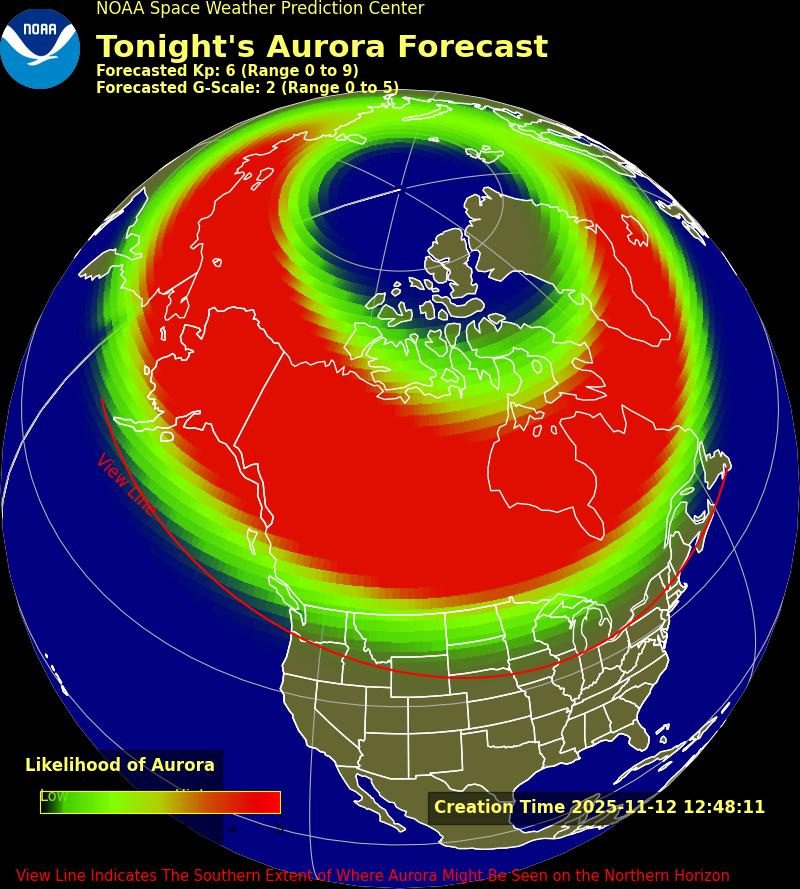
Northern lights view line for Nov. 12, 2025. (USA Today Network)
The NOAA says the red view line marks the southernmost extent where aurora might be seen on the northern horizon.
The view line for Nov. 12 includes parts of the following states:
- Idaho
- Illinois
- Iowa
- Maine
- Michigan
- Minnesota
- Montana
- Nebraska
- New Hampshire
- New York
- North Dakota
- South Dakota
- Oregon
- Vermont
- Washington
- Wisconsin
- Wyoming
Why do the northern lights have different colors?
The color of the aurora depends on which gas is being excited by the electrons and on how much energy is being exchanged, NASA said.
Oxygen emits either a greenish-yellow light (the most familiar color of the aurora) or a red light; nitrogen generally gives off a blue light. The oxygen and nitrogen molecules also emit ultraviolet light, which can only be detected by special cameras on satellites.
Where are Michigan’s best spots for dark sky viewing?
Look for a clear, open area to best view the aurora borealis in Michigan’s skies. Michigan is home to six dark sky state parks, three international dark sky parks and an international dark sky sanctuary.
- The Alpena area has three Dark Sky Preserves: Rockport State Recreation Area, Thompson’s Harbor State Park and Negwegon State Park.
- In Mackinaw City, Headlands International Dark Sky Park, 15675 Headlands Road.
- In Empire, Sleeping Bear Dunes National Lakeshore, 9922 Front St.
- In Munising, Pictured Rocks National Lakeshore.
- In Paradise, the Great Lakes Museum and Whitefish Point Light Station, 18335 N. Whitefish Point Road, and Tahquamenon Falls State Park at 41382 W. M-123.
- In Port Austin, Port Crescent State Park, 1775 Port Austin Road.
- In Clayton, Lake Hudson Recreation Area, 5505 Morey Hwy.
- In Carp Lake, Wilderness State Park, 903 Wilderness Park Drive.
- Keweenaw Dark Sky Park in Keweenaw County and Dr. T.K. Lawless Park in Cass County are international spots. And, finally, the Beaver Island State Wildlife Research Area is an international sanctuary.
What is the corona?
The corona is the sun’s outermost atmosphere. The name comes from the Latin word for crown. The area of plasma, or highly ionized gas, extends thousands of kilometers above the sun’s visible surface, called the photosphere. The region is much hotter than the sun itself with temperatures ranging from 1 million Kelvin (1.7 million degrees Fahrenheit) to more than 10 million degrees K, the National Solar Observatory said.
Can’t see the northern lights? Use your phone
If you’re having trouble seeing the northern lights with the naked eye, try using your phone camera in night mode and hold still while capturing the photo. You might be surprised at what’s dancing in the sky.
The Lansing State Journal contributed.
Contact Jenna Prestininzi: [email protected].
This article originally appeared on Detroit Free Press: Will northern lights shine again? When to see the aurora borealis
Reporting by Jenna Prestininzi, Detroit Free Press / Detroit Free Press
USA TODAY Network via Reuters Connect
Author

America’s No. 1 destination for fall colors is right here in Michigan
Michigan's Upper Peninsula is getting the love it deserves as America's best destination for fall colors, according to the results of the USAT...
EPA grant will fund barrier to stop spread of sea lamprey in Grand River
By Rachel Lewis, Capital News Service LANSING – The Great Lakes Fishery Commission will receive a $2.1 million grant from the Environmental...
How Michigan is trying to stop the box tree moth
By Rachel Lewis, Capital News Service LANSING – Boxwood shrubs are popular in Michigan. Gardeners like them because their evergreen foliage brings...
This is your sign to head to Michigan beaches & hear the singing sand
Several Michigan beaches are home to “singing sand,” and while several legends attribute the noise to ghostly causes, there’s a perfectly logical...
Michigan’s fight against Lake Erie pollution didn’t work. What happens next?
By Emilio Perez Ibarguen, Capital News Service LANSING – Michigan and its neighbors have missed a 2025 deadline to curb the farm pollution that...