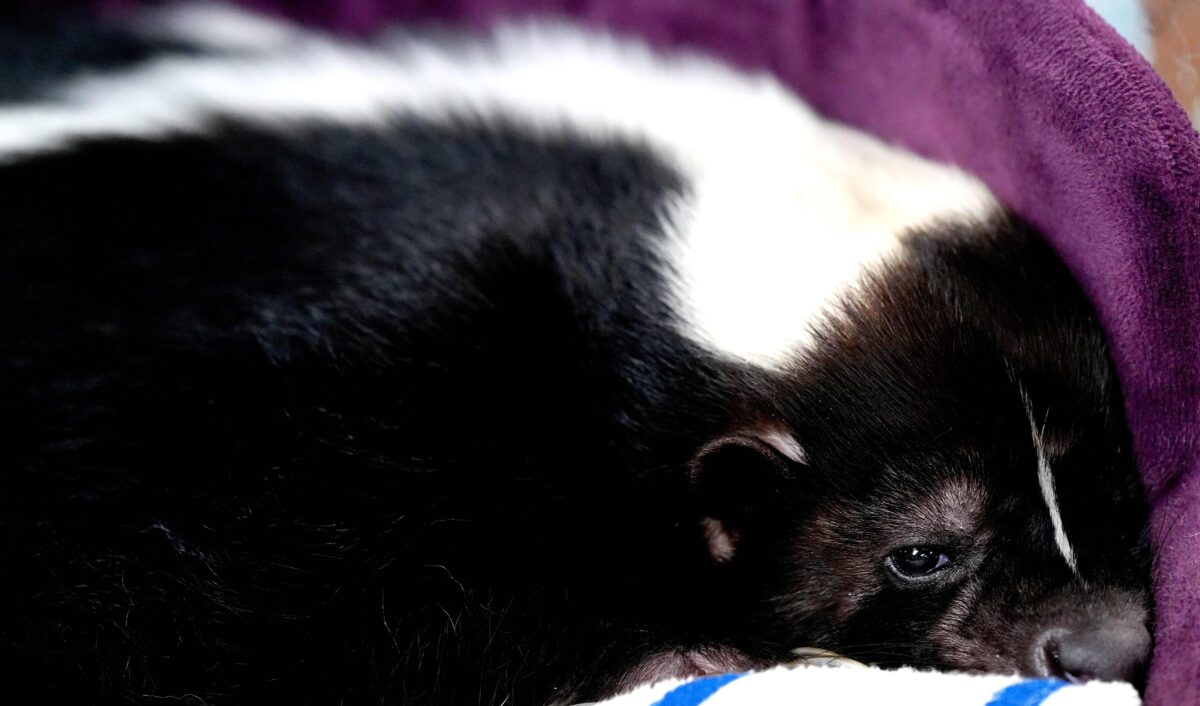
A striped male skunk. (USA Today Network)
A Michigan man who received a kidney transplant in late 2024 died from rabies, transmitted from the donor’s organ, weeks later, the Centers for Disease Control said in a report issued this month.
“(The) diagnosis of rabies in a kidney transplant recipient with no recognized animal exposure resulted in a multistate public health investigation to ascertain whether the kidney donor had undiagnosed rabies, identify other donor organs and tissues, and identify rabies-exposed persons,” the CDC said in its Dec. 4 Morbidity and Mortality report.
The transplant rabies infection was just the fourth in the U.S. since 1978, the CDC said. The previous cases resulted in 13 infections and seven deaths. Rabies is almost always fatal without prompt treatment.
The Michigan transplant recipient died at the end of January 2025. After his death, an investigation located kidney biopsy samples in which the CDC detected rabies virus RNA consistent with a silver-haired bat rabies virus variant.
In later interviews with the donor’s family members, investigators discovered the person had been scratched by a skunk weeks before their death while protecting a kitten, and had exhibited rabies-like symptoms before their death. The CDC believes a bat bit the skunk, which then scratched the donor.
In addition to the kidney recipient, three people, one each from California, Idaho, and New Mexico, received cornea grafts in December 2024 and January 2025, the CDC said. All three recipients had their grafts removed after the Michigan man was diagnosed and received rabies treatments. None developed rabies.
A planned fourth corneal graft to a Missouri patient was cancelled.
The CDC said tests detected rabies virus RNA consistent with a silver-haired bat rabies virus variant in one of the implanted corneal grafts.
In addition, 370 health care workers and others exposed to either the kidney donor or recipient were interviewed, and 46 underwent rabies treatment as a precaution, the CDC said.
The CDC said none of the donor’s other organs were transplanted, but some tissue and organs was used in training in Maryland, although none remained for testing by the time of the discovery.
Here’s what we know about the case.
When did the kidney recipient die?
The kidney donor died on about Dec. 12, 2024, according to the CDC and their organs were removed and transplanted on about Dec. 13.
The recipient began showing symptoms in mid-January, and died at the end of the month. The recipient was found to have virus RNA in their saliva, skin, and brain tissue samples.
How did the donor get rabies?
The donor was an Idaho resident. Interviews after the transplant death with the donor’s family revealed information not previously disclosed, the CDC said.
In late October 2024, a skunk approached the donor as he held a kitten in an outbuilding on his rural property. During an encounter that rendered the skunk unconscious, the donor sustained a shin scratch that bled, but he didn’t think he had been bitten. According to the family, the donor attributed the skunk’s behavior to predatory aggression toward the kitten, the CDC said.
About five weeks later, in December 2024, the donor became confused, had difficulty swallowing and walking, experienced hallucinations, and had a stiff neck, the CDC reported. Two days later, he was found unresponsive at home after a presumed cardiac arrest. He was resuscitated and hospitalized, but never regained consciousness. He was declared brain dead and removed from life support. His left kidney, heart, lungs, and both corneas were recovered.
Why wasn’t the donor screened for rabies?
Rabies is excluded from routine donor pathogen testing because of its rarity in humans in the United States and the complexity of diagnostic testing, the CDC said.
In the United States, potential donors’ family members often provide information about a donor’s infectious disease risk factors, including animal exposures. In this case, hospital staff members who treated the donor were initially unaware of the skunk scratch, the CDC said.
Where did the organ transplant take place?
The CDC said the transplant took place at a hospital in Ohio, but did not identify the facility in the report.
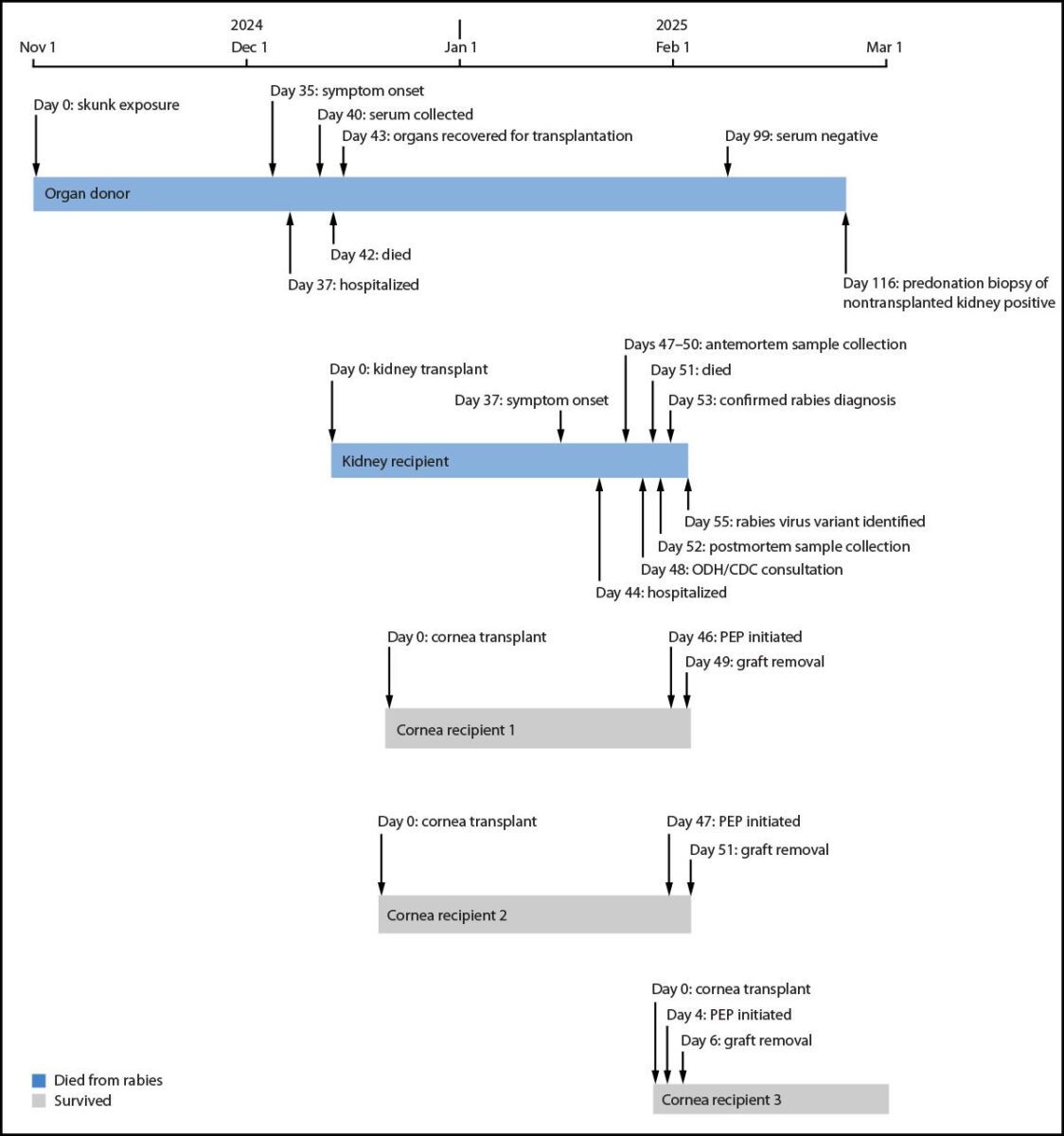
A timeline of when an Idaho kidney donor was infected with rabies, and when a Michigan recipient died from the disease in 2025. (USA Today Network)
Did anyone else receive contaminated organs?
According to the CDC no other organs were transplanted, but four cornea grafts were prepared. Three patients, one each from California, Idaho, and New Mexico, received grafts in December 2024 and January 2025. The cornea recipients underwent precautionary graft removal and received rabies treatment. A planned transplantation of the fourth corneal graft to a Missouri patient was cancelled.
The heart and lungs of the donor were not transplanted, but were used in training procedures at a Maryland medical research facility.
What symptoms did the kidney recipient experience?
The recipient experienced tremors, lower extremity weakness, confusion, and urinary incontinence, the CDC said. Seven days after symptom onset, he was hospitalized with fever, hydrophobia, dysphagia, and autonomic instability.
What are symptoms of rabies to watch for?
The first symptoms of rabies may be very similar to those of the flu and may last for days, the Mayo Clinic warns.
Later signs and symptoms may include:
- Fever
- Headache
- Nausea
- Vomiting
- Agitation
- Anxiety
- Confusion
- Hyperactivity
- Difficulty swallowing
- Excessive salivation
- Fear brought on by attempts to drink fluids because of difficulty swallowing water
- Fear brought on by air blown on the face
- Hallucinations
- Insomnia
- Partial paralysis
Which animals get rabies?
Rabies is often found in bats, raccoons, skunks and foxes, but any mammal can be infected. Pets and people can be protected by vaccination. People usually receive the vaccine after exposure, but those in high-risk situations may receive it before exposure.
This article originally appeared on Lansing State Journal: A Michigan man got a new kidney, then died from rabies. What happened
Reporting by Dan Basso, Lansing State Journal / Lansing State Journal
USA TODAY Network via Reuters Connect
Author


America’s No. 1 destination for fall colors is right here in Michigan
Michigan's Upper Peninsula is getting the love it deserves as America's best destination for fall colors, according to the results of the USAT...
EPA grant will fund barrier to stop spread of sea lamprey in Grand River
By Rachel Lewis, Capital News Service LANSING – The Great Lakes Fishery Commission will receive a $2.1 million grant from the Environmental...
How Michigan is trying to stop the box tree moth
By Rachel Lewis, Capital News Service LANSING – Boxwood shrubs are popular in Michigan. Gardeners like them because their evergreen foliage brings...

This is your sign to head to Michigan beaches & hear the singing sand
Several Michigan beaches are home to “singing sand,” and while several legends attribute the noise to ghostly causes, there’s a perfectly logical...
Michigan’s fight against Lake Erie pollution didn’t work. What happens next?
By Emilio Perez Ibarguen, Capital News Service LANSING – Michigan and its neighbors have missed a 2025 deadline to curb the farm pollution that...