Ben Solis/Michigan Advance
BY BEN SOLIS, MICHIGAN ADVANCE
DETROIT—Restoring worker power is becoming a focal point in Abdul El-Sayed’s campaign for the US Senate, and he tapped one of Michigan’s stalwart labor figures—former US Rep. Andy Levin—to help convey a new policy platform centered on ending exploitation.
El-Sayed, who is seeking the Democratic nomination along with US Rep. Haley Stevens (D-Birmingham) and state Sen. Mallory McMorrow (D-Royal Oak), on Tuesday morning released a five-point labor policy agenda that he said would also strengthen collective bargaining and would help rebuild the nation’s economy in a way that works for everyone, not just a wealthy few.
The candidate said he would demand strong antitrust enforcement and empower the Federal Trade Commission to stop harmful consolidation to protect wages, working conditions, and union contracts; ban corporate stock buybacks by repealing SEC Rule 10b-18, ensuring corporations invest in workers rather than executive bonuses; mandate employee-elected board representation for publicly-traded companies; and protect retirement security, especially multi-employer pensions, by defending the Butch Lewis Act and supporting the Protecting Employees and Retirees in Business Bankruptcies Act.
El-Sayed added that guaranteeing health care for every American through Medicare for All, so unions and their members can choose between bargaining for higher wages or add-on health insurance, was also imperative to envision a more labor-friendly nation.
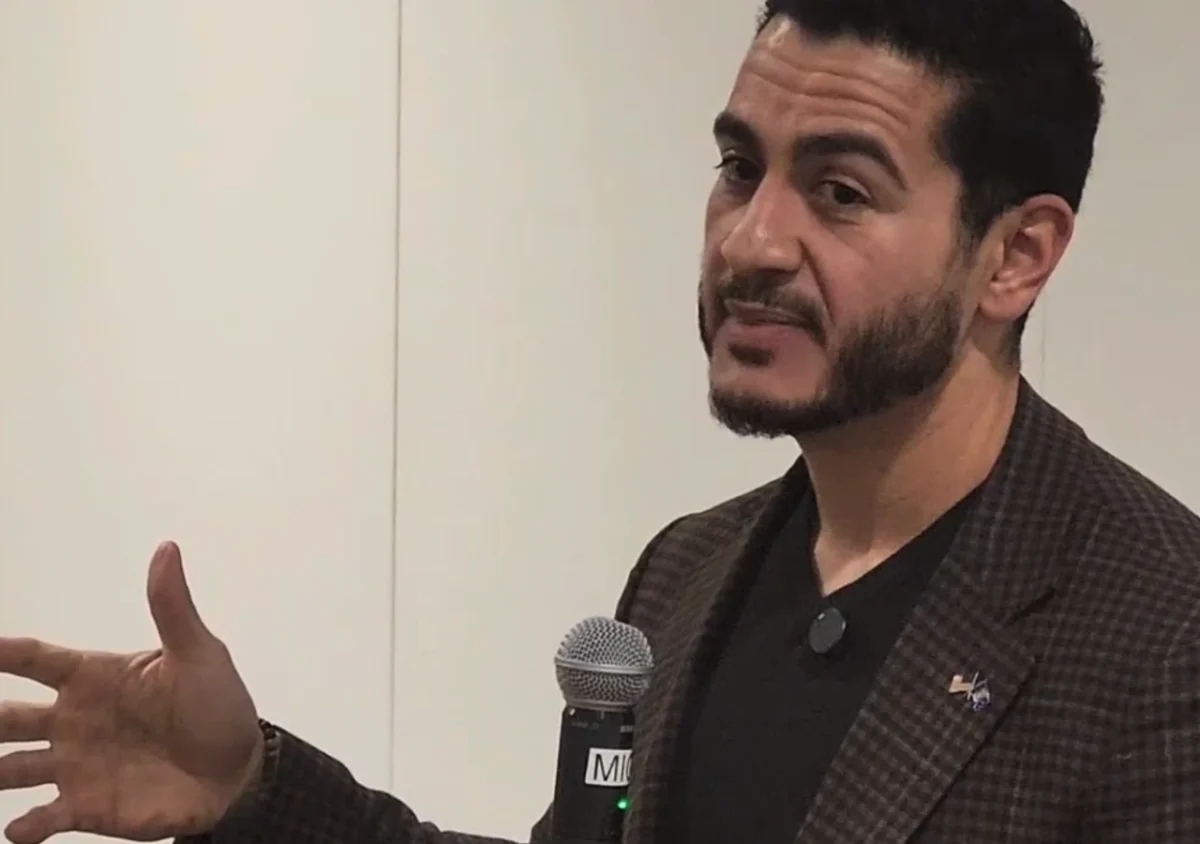
On Tuesday evening, El-Sayed hit those points home in a town hall featuring Levin in Detroit at Wayne County Community College. It was there that the candidate also shared his belief that the labor movement can teach important lessons on how to fight tyranny and state-sponsored violence against American citizens, much like what has been playing out in Minneapolis with federal Immigration and Customs Enforcement and Border Patrol agents.
Balancing domestic production with the right to unionize
One attendee at the town hall noted that decades ago, executives started pushing production offshore with the promise of lower prices, but those actions left the American worker behind. El-Sayed was asked about what he would do to ensure that domestic production of goods and services returns while also ensuring that workers have the right to choose their working conditions, and to have the best conditions possible.
El-Sayed responded by saying that in the mid- to late-20th Century, the ratio between what CEOs made and what workers made was more relative, but the U.S. wasn’t nearly as permissive about global trade contracts. By proxy, there was also higher union membership and with it a productive economy.
Global trade agreements that left workers behind, much like NAFTA, President Donald Trump’s rewrite of that agreement as the USMCA, and the Trans Pacific Partnership, spelled disaster for the American worker, he said.
“I think they’ve been a bit of a cancer on the American economy,” El-Sayed added. “We make a deal with the devil, and then we watch as our jobs get offshore, engineers abroad copy out (expletive), and then make it without any protections for workers in their community, and then sell it back to ours. And we’re supposed to get real excited because we can get a big screen TV for less. … I remember when you are able to afford what you needed, with one job, a union job, in this country making stuff.”
Those trade policies, however, have made that harder and El-Sayed said his solution would be to protect unions and their power to bargain, but also to use tariffs wisely—and not the way Trump has.
“If NAFTA and these trade deals are cancer, you need some chemotherapy,” he said. “A bit of chemo targeted with a very clear goal can save your life, but as any doctor here will tell you, if you give the patient all the chemo all at the same time, you’re going to kill your patient. There are ways for us to be thinking about how we target the industries of the future: Use very specific tariff regimes to protect those industries, assure that companies that get the early investment are ones that dignify their workers.”
Banning corporate stock buybacks, board representation for employees and Right to Work
One way to dignify workers, aside from living wages with great working conditions, was to ensure employees have a say on the boards of the companies they work for. That could help, El-Sayed said, to prevent boards from making decisions that only boost their bottom lines or maximize their stock prices.
Another hedge against corporations making decisions only for fiduciary gains would be to ban stock buybacks entirely. El-Sayed said he believes stock buybacks should be illegal for publicly-traded companies.
Although El-Sayed is running for a national office, he was asked a question about the governor’s race from a newly unionized work at Corewell Health. She worried about a Republican taking the governor’s office this year and reinstating Right to Work laws, which stymied union membership and strength.
El-Sayed said he was also worried about that scenario, especially given the Republican caucus that currently controls the state House under the leadership of Speaker Matt Hall (R-Richland Township).
“That is a fear that all of us ought to have,” El-Sayed said. “Especially considering the way that this Legislature is operating and this speaker is operating. They are craven, they’re willing to go back on deals that they strike, and this has been the number one goal that they, on the behalf of their corporate overlords, have been wanting for a very long time.”
The candidate added that he thought the Legislature should preempt state labor law and that it should be illegal to have any sort of Right to Work across the country.
El Sayed’s opponents for the nomination have also outlined strong support for organized labor, with McMorrow having already rolled out a “Labor and Workforce Agenda” that prioritizes investment in certified apprenticeship and training programs, while Stevens has long touted her role as the chief of staff on former President Barack Obama’s automotive industry rescue effort and in September introduced legislation designed to “protect union jobs” and “strengthen labor standards”.
Call to abolish ICE takes personal tone
The situation in Minneapolis was now personal for El-Sayed because he said traveled there recently to see what the federal government’s enforcement looked like on the ground. He talked about what it was like seeing citizen patrols use whistles to highlight incoming raids, and how the situation has gotten so out of control.
“I want to tell you what it sounded like,” he said. “Imagine you’re at soccer practice … and you’ve heard that whistle … normally alongside children laughing. It’s a sound of joy. In Minneapolis, that whistle isn’t about joy.”
He said Renee Good and Alex Pretti, two Minneapolis residents who were killed by ICE and Border Patrol agents in the act of protesting their actions, were courageous and lost their lives because they were simply documenting the chaos.
“I worked with people like Alex. … This is a guy who worked at the VA taking care of people who were sworn to protect and serve our Constitution,” El-Sayed said. “He died protecting and serving our Constitution by holding accountable a military force that is being weaponized against that Constitution in our peaceful streets.”
He said the time was now to do something that he advocated for since running for the governor’s office in 2018: It was time to finally abolish ICE.
The candidate acknowledged that the town hall was about labor, but his call to dismantle the agency had much to do with standing in solidarity as unions do each day.
“They expect that the majority of us will be quiet and slink into the background, but in solidarity, there is faith,” he said. “If we’re serious about protecting our Constitution, it’s going to require us to learn the lesson that the union movement has been teaching us for a very long time. When we stand up together, we protect the most important things, and it’s going to take the same courage to face down what is ugly if we’re protecting the dignity of workers and protecting the dignity of our Constitution.”
“That fight is one in the same,” El-Sayed said.
READ MORE: Abdul El-Sayed releases plan to rein in data center expansion in Michigan
This coverage was republished from Michigan Advance pursuant to a Creative Commons license.
Author


Mid-Michigan nurses union cancels strike after securing better pay, benefits for workers
Thousands of union nurses and healthcare professionals at UM Health-Sparrow in Lansing have successfully negotiated for higher wages, better...

Nurses and other caregivers at UMH-Sparrow vote overwhelmingly for pre-strike authorization
BY JON KING, MICHIGAN ADVANCE MICHIGAN—Approximately 2,000 nurses and healthcare professionals at the University of Michigan Health-Sparrow voted...

Corewell nurses vote to join Teamsters union
BY JON KING, MICHIGAN ADVANCE MICHIGAN—With nearly 60% of the vote, nurses at eight hospitals across Southeast Michigan have voted to unionize....

Planning Commission takes step to prep land for massive new manufacturing project near Flint
The Mundy Township Planning Commission is clearing the way for what could become one of Michigan’s largest manufacturing operations—with reports...
Fain rallies with Stellantis UAW members at Trenton plant ahead of strike authorization vote
BY KEN COLEMAN, MICHIGAN ADVANCE MICHIGAN—Union members and elected officials rallied on Wednesday against Stellantis arguing that the automaker...