Photo Courtesy of Kyra Powers
This Michigander’s passion for a healthy community is driving her to the polls this year—and inspiring others to do the same.
Community advocacy has been part of Kyra Powers’ vocabulary for as long as she can remember.
“My dad was always really involved in local community engagement stuff. He’s our village president and he does a lot of work. So I grew up kind of seeing what it looked like to be engaged in your community,” said the Spring Lake native, in an interview with The ‘Gander.
Once Powers moved to East Lansing to attend Michigan State University, she wanted to continue the lessons she learned alongside her dad. She got involved with Spartan Street Medicine—a student-led medical group that collaborates with community partners to provide pop-up health clinics and outreach services for unhoused people in Ingham County. Powers also worked as a certified nursing assistant in several Lansing-area hospitals during the COVID-19 pandemic.
These experiences in and out of the classroom made Powers realize how social determinants of health—like a person’s age or where they live, learn, or work—make an impact on how they’re able to access health care resources.
“There’s such a huge intersection between public health and medicine. They’re intrinsic to one another—you can’t care about an individual without caring about the population. They go hand in hand and public policy is a part of that,” Powers said.
While health care professionals dedicate their careers to improving the health of their patients, most health outcomes are determined beyond clinical walls.
On one hand, for example, a physician can write a prescription for a patient with asthma. But there’s an equally critical component that’s connected to the patient’s asthma—voting for candidates who will represent their desire for cleaner air.
“What we vote on affects how we can give care to patients, how we’re able to learn in our educational careers, and what we can do with our licenses. It’s all really important and interconnected,” said Powers.
However, making time to help patients understand their civic power can be difficult for most medical students. After spending between six to12 hours every day either in class or studying, most medical students have minimal time for sleeping or socializing, let alone participating in advocacy or policy work.
Powers knows first-hand how exhausting medical school can be, but she also knows that as a physician, her ability to help patients depends on how civically engaged people in her community are.
“I think that as people who are going to be working in the health care field in the future, there’s a lot of stuff that we vote on in terms of health care and it feels far away from what we do day-to-day,” she said.
She and some of her classmates are even working with Vot-ER—a nonpartisan, nonprofit organization that has developed civic engagement tools and programs for every corner of the health care system, including medical schools. This fall, Vot-ER will host voter registration tables in MSU’s College of Osteopathic Medicine.
“We want to make it as easy as possible, so we’re hoping that with those voter registration tables, we’ll be able to provide important materials and resources to help people get engaged and excited about voting,” said Powers. She added that Vot-ER is also able to provide out-of-state students with resources on how voting works within their home states—making it that much easier for her peers to advocate for themselves.
“I think that voting is the best form of advocating for yourself, and to be [an] advocate for future patients.”
Author

Support Our Cause
Thank you for taking the time to read our work. Before you go, we hope you'll consider supporting our values-driven journalism, which has always strived to make clear what's really at stake for Michiganders and our future.
Since day one, our goal here at The 'Gander has always been to empower people across the state with fact-based news and information. We believe that when people are armed with knowledge about what's happening in their local, state, and federal governments—including who is working on their behalf and who is actively trying to block efforts aimed at improving the daily lives of Michigan families—they will be inspired to become civically engaged.


What happens next? A timeline of the process between voting and inauguration
My fellow Americans, we have reached the other side. Months of debate, campaign ads, unsolicited text messages, canvassers at the door, and a news...

Presidential race too close to call as vote counts continue in key swing states
Results in Michigan, Pennsylvania, and Wisconsin may not come in until Wednesday morning, and Arizona and Nevada are unlikely to see calls made...

Early results: Democratic-backed candidates win both seats on Michigan Supreme Court
Preliminary election results show that Democratic-backed candidates Kyra Harris Bolden and Kimberly Ann Thomas have defeated their Republican-backed...
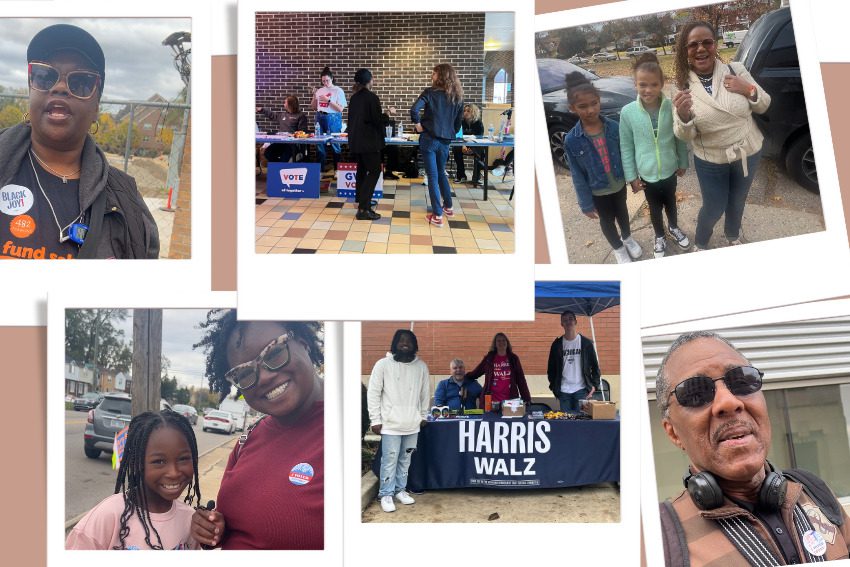
Reporter’s notebook: Here’s what the vibe was like at polling places across Michigan
Michiganders are showing up to elect the next president of the United States—and bringing the good vibes with them. MICHIGAN—Election Day is nearly...

On the eve of Election Day, Walz calls on Michigan voters to bring home a Harris presidency
BY KYLE DAVIDSON, MICHIGAN ADVANCE With the clock ticking down to Election Day, Michigan Democrats readied themselves for one last push as they...