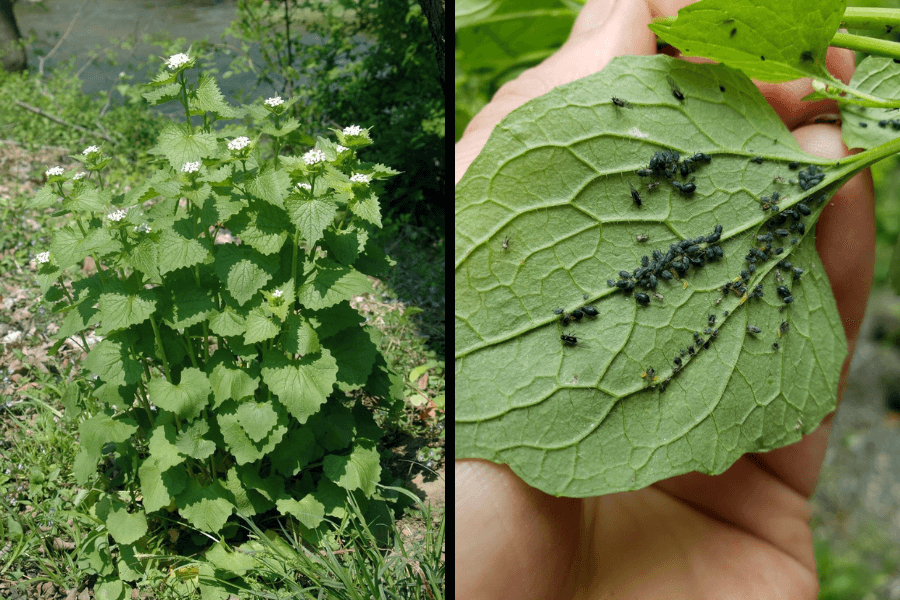
Left - A small patch of mature garlic mustard, showing its serrated, heart-shaped leaves and tiny, white, four-petaled flowers. Photo courtesy of Chris Evans, University of Illinois, Bugwood.org. Right - The underside of a garlic mustard leaf infested with garlic mustard aphids. Photo courtesy of Rebecah Troutman, Holden Forests and Gardens.
Scientists are looking for help spotting and removing invasive garlic mustard plants.
MICHIGAN—Around this time every year, one invasive species that springs up is garlic mustard—a plant with rounded, serrated leaves and four-petaled white flowers that quickly takes over roadsides, forest floors, and open ground.
The invasive plant was purposefully brought to the US in the 1800s by European settlers who used it for food and medicine. But like many invasive species, garlic mustard now does more harm than good by releasing a toxic chemical that suffocates the growth of native plantlife in its vicinity. Local biologists have been looking for ways to snuff it out, and a new troop appears to have joined their ranks.

This year, aphids—tiny pear-shaped insects—are part of the fight against the invasive plant. Garlic mustard aphids, which are known as “grenade aphids,” feast on the sap of invasive garlic mustard, leaving leaves wilted and seed pods warped.
“We’re seeing impacts like shorter plants, fewer and twisted seed pods, and less overall biomass at these sites. It appears that even a small number of aphids can affect plant growth,” Midwest Invasive Plant Network coordinator Michelle Beloskur said.
The bugs, also originally from Europe, were first spotted stateside in 2021, and there have been positive identifications in Michigan.
Officials are asking for help in learning more about the scope of garlic mustard aphids in Michigan. The bugs can be found on invasive garlic mustard plants and match the following characteristics: small, dark gray to green, and raised blotches on its back.
Information on the prevalence of invasive garlic mustard or aphids can be reported using these instructions. And if you feel so inclined, you can dispose of garlic mustard yourself by picking the plant, double-bagging it, and leaving it in the sun for several days to decompose.
Or, follow the aphids’ lead, and just eat it. The state Department of Natural Resources is reminding residents that invasive garlic mustard is also edible and can make for a tasty garnish in soups, meats, and sauces. When crushed, its leaves and stems release a distinctively garlic flavor.
Author


VIDEO: Trump isn’t the only republican facing charges for alleged financial crimes
https://www.tiktok.com/@gandernewsroom/video/7361494909938978090 A whole lot of Michigan Republicans and lobbyists are facing criminal charges for...

VIDEO: It’s expensive to be poor in Michigan
https://www.tiktok.com/@gandernewsroom/video/7361154790300060974 Ever heard of predatory payday loans? Here’s how new laws could help protect...

Here’s everything you need to know about this month’s Mercury retrograde
Does everything in your life feel a little more chaotic than usual? Or do you feel like misunderstandings are cropping up more frequently than they...

The ’Gander wins multiple 2023 Michigan Press Association awards
MICHIGAN—The ’Gander Newsroom has earned multiple awards in the 2023 Michigan Press Association Better Newspaper Contest. The awards were announced...

Michigan Republicans ask Supreme Court to restrict medication abortion access
A lawsuit supported by Republicans could disrupt access to the most common form of abortion—even in Michigan, where reproductive rights are...