By Anna Rossow, Capital News Service
LANSING–The popularity of a cheaper and environmentally friendly burial alternative is rising in the US, but Michigan has yet to legalize it.
Human composting transforms the body into soil, according to Earth Funeral, a human composting company with locations in Washington and Nevada.
Human composting, which accelerates the natural decomposition process, is legal in 12 states, according to Recompose, another company in the field, with Washington the first to legalize the practice in 2020.
Similar legislation has been introduced in other states, but not Michigan.
Haley Morris of Earth Funeral said Michigan residents still have access to human composting and the company often gets interest from people in Michigan.
“We can coordinate if people want to pre-plan, or even if they have lost a loved one and are in immediate need to transport their loved one to one of our facilities in Washington state or Nevada, and have their loved one undergo the natural organic reduction process there,” she said.
She said the company works with funeral homes in Michigan to coordinate transportation, such as shipping the bodies to its facility and the remains back to the family.
Mark Evely, the chair of the Department of Applied Health Sciences and the director of the Mortuary Science Program at Wayne State University, said the process takes between 30 to 60 days.

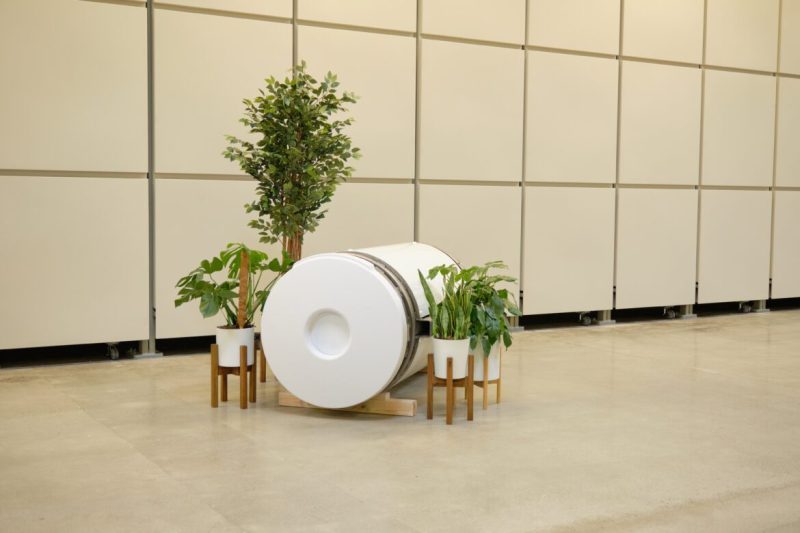
“The deceased is placed in a container, a chamber, along with organic materials like alfalfa, wood chips and sawdust,” he said. “The chamber is closed, heat and air are introduced, and that accelerates the natural process of decomposition.”
Evely said the remains make a cubic yard of soil, the equivalent of a 3’-by-3’-by-3’ cube.
“The family can choose to take all of that soil,” he said. “They can choose to take a small portion of it and donate the rest to forest use, or they can choose to take none of it and donate all of the soil.”

Human composting is different from a green burial, which is legal in Michigan.
According to the West Michigan Burial Forest in Newaygo County’s Brooks Township, green burial is the process of being buried directly into the earth or in an organic material – without a coffin.
Proponents say that green burials minimize the environmental impact of traditional burials and cremations and reduce carbon emissions.
As with green burials, human composting is a “net carbon neutral” way of burial and is the “most environmentally friendly option” available now.
According to Earth Funeral’s website, human composting creates zero carbon dioxide emissions, compared to cremation which creates 535 pounds of CO2 per person.
Cremation also uses fossil fuels.
Evely said studies on human composting and its effect on groundwater are underway.
As to why the practice is still not legal in Michigan, he said people “don’t know what it is. They don’t understand it. So there needs to be more education of the public on the matter.”
According to Return Home, another human composting company, reasons the practice may not be legal in some states include a preference for traditional burial practices, legislative frameworks and health and safety concerns.
With traditional burial as the status quo, it is difficult for eco-friendly alternatives to gain acceptance, according to the company’s website. The lack of a legislative framework is due to how new the practice it is and states lack clear guidelines for regulating the burial method.
However, awareness of eco-friendly burials is on the rise. According to a survey by the National Funeral Directors Association, 60% of Americans are interested in green or natural burials.
Morris said, “I hear of people wanting to become a tree after they’re gone, or to become a flower.”
“From the families that we talk to, they really like that their final act in this lifetime is something that is good for the earth,” she said.