By Aaron Jimenez, Capital News Service
LANSING — Michigan drivers are entering the most dangerous stretch of the year for deer crashes.
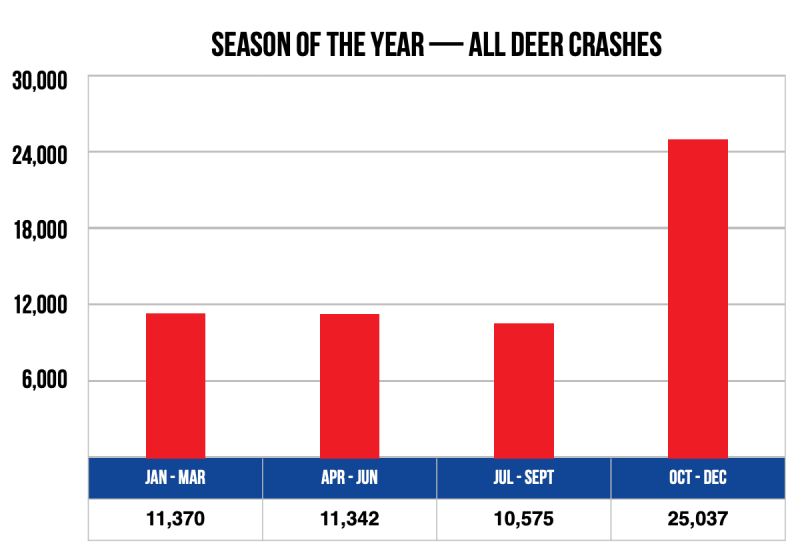
October through December accounted for more than 40% of the 58,324 vehicle-deer crashes reported statewide in 2024.
In those crashes, 1,816 people were injured and 14 were killed.
November saw the highest number of crashes with 10,017, followed by October with 9,428.
The data comes from a study by the Michigan Traffic Crash Facts, compiled by the Office of Highway Safety Planning and the University of Michigan Transportation Research Institute.
Matthew Saxton, the executive director and CEO of the Michigan Sheriffs’ Association, said several factors converge this time of year: Deer are in mating season, days are getting shorter, driving in the dark increases and clocks fall back on Nov. 1.
Darkness is a major factor. State data showed 53% of vehicle-deer crashes in 2024 occurred on unlit roads after dark. Nearly 14,000 occurred between 6 p.m. and 8:59 p.m.
Crashes are not limited to rural areas.
Saxton said officers also “see a lot of car-deer accidents in municipalities and within cities and populated areas as well.”
Southern Michigan experienced the most vehicle-deer crashes.
Kent County reported nearly 2,100 crashes in 2024, the most of any county, followed by Oakland County with a little more than 2,000. Calhoun County reported nearly 1,400 in 2024.
Saxton said that when he was the Calhoun County sheriff, there were typically 1,200 to 1,300 deer crashes a year there.
Brent Rudolph, the deer, elk and moose management specialist at the Department of Natural Resources, cited two main factors for the number of vehicle-deer crashes: deer population and the volume of traffic.
Rudolph said the department has no direct estimate of deer population size but tracks indicators of regional trends.
DNR data show reported crashes generally peaked around the early 2000s. However, since 2021, the numbers in most regions have been rising once more.
Southwest Michigan saw its crashes peak in 2003 with nearly 28,000. In 2024, there were an estimated 22,000, with a general uptick since 2014.
Southeast Michigan reported nearly 20,000 crashes a year from 2022-24, reaching higher than its 2003 peak.
“The Southeast is the only region with a long-term increasing trend,” Rudolph said. “This reflects continued growth of deer populations around the metro areas of the region, where it’s increasingly challenging to manage populations through hunting.”
The Upper Peninsula is the only region that has seen consistent decline from nearly 9,000 crashes in the early 2000s to about 4,000 in 2024.
The problem extends well beyond Michigan.
The AAA Foundation for Traffic Safety estimates that police-reported animal-related crashes in the U.S. average about 353,800 a year, resulting in about 49,725 injuries and 277 deaths.
The study analyzed 2020-24 data and said the true numbers are likely higher because many crashes go unreported. The national databases do not identify the animal involved, but the researchers say most of the crashes involve deer.
The Midwest has been hit hard. Animal-related crashes made up 15% of all police-reported crashes in the region over the study period, with 29% of those happening in November.
The Midwest accounted for half of all police-reported animal-related crashes and injuries, as well as one-third of all animal-related crash deaths.
Both Saxton and the AAA study caution drivers against swerving.
“It’s not recommended to swerve to avoid the animal because that could cause a more serious crash,” Saxton said. He recommends controlled braking instead.
Saxton said drivers should “slow down and pay attention to your surroundings because the deer are more active at this time of year,” especially at dawn, dusk and night.