CARSON CITY — Betty Kellenberger doesn’t remember the name of the novel that, in one sentence, summed up everything she is. It wasn’t a very good book, she said.
In fact, “it was just an awful thing, just a random book that I picked up,” Kellenberger said. One sentence, however, struck her.
“It described the main character by saying, ‘He read a map as if it was a novel,’” Kellenberger said. “And this is what it’s like for me.”
It tells her story so succinctly, she said, that those 10 words have stayed with her.
Kellenberger’s house is filled with maps. They hang on the walls of her living room and are pinned to the backs of doors. The largest, an image of the Appalachian Trail, is depicted atop a massive area rug in the center of her sitting room. Pictured is the nearly 2,200-mile path, which passes through 14 states and runs from Springer Mountain in Georgia to Mount Katahdin in Maine.
And Kellenberger, 81, reads that rug-turned-map like a novel she’s long-since finished and loved.
“I can remember what happened here,” she said on a Monday morning in late July as she gestured to one spot along the longest hiking-only footpath in the world. “I can remember this pass and when I look at this map, I revisit the trail again. When I look back on it, this is probably the hardest trip ever to let go of.”
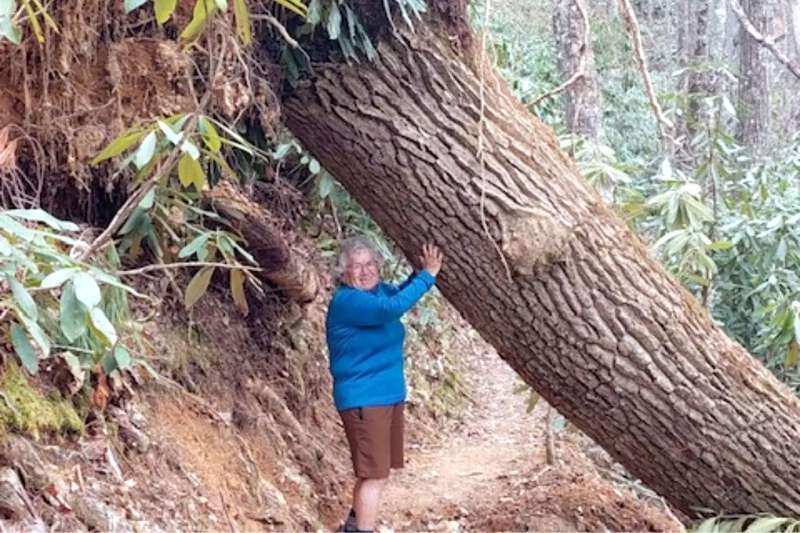
The retired Carson City-Crystal Area Schools middle school teacher, who stands 4 feet, 11 inches tall, has hiked all over the world. She’s traversed part of Europe, and hiked in Iceland, Scotland and Canada.
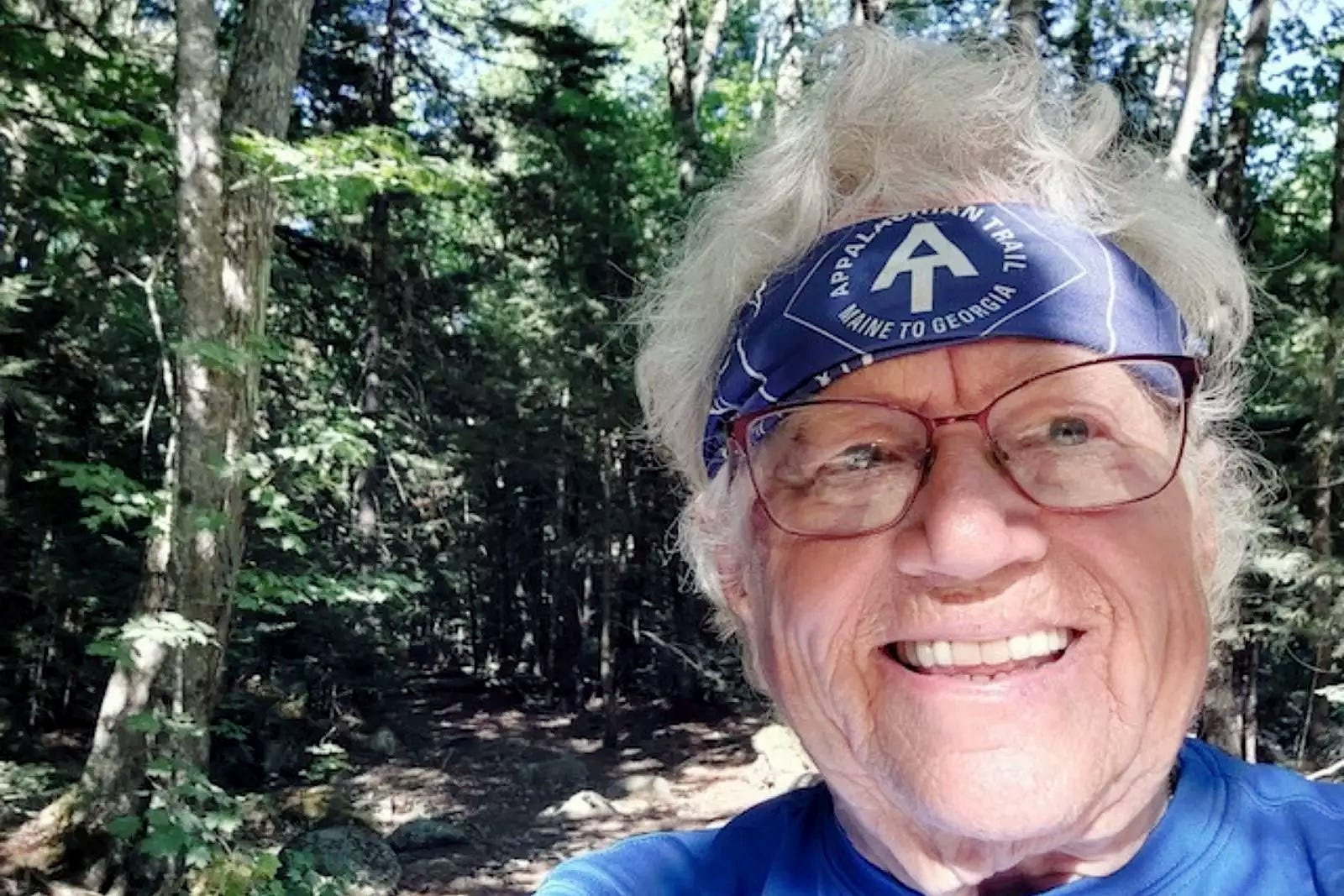
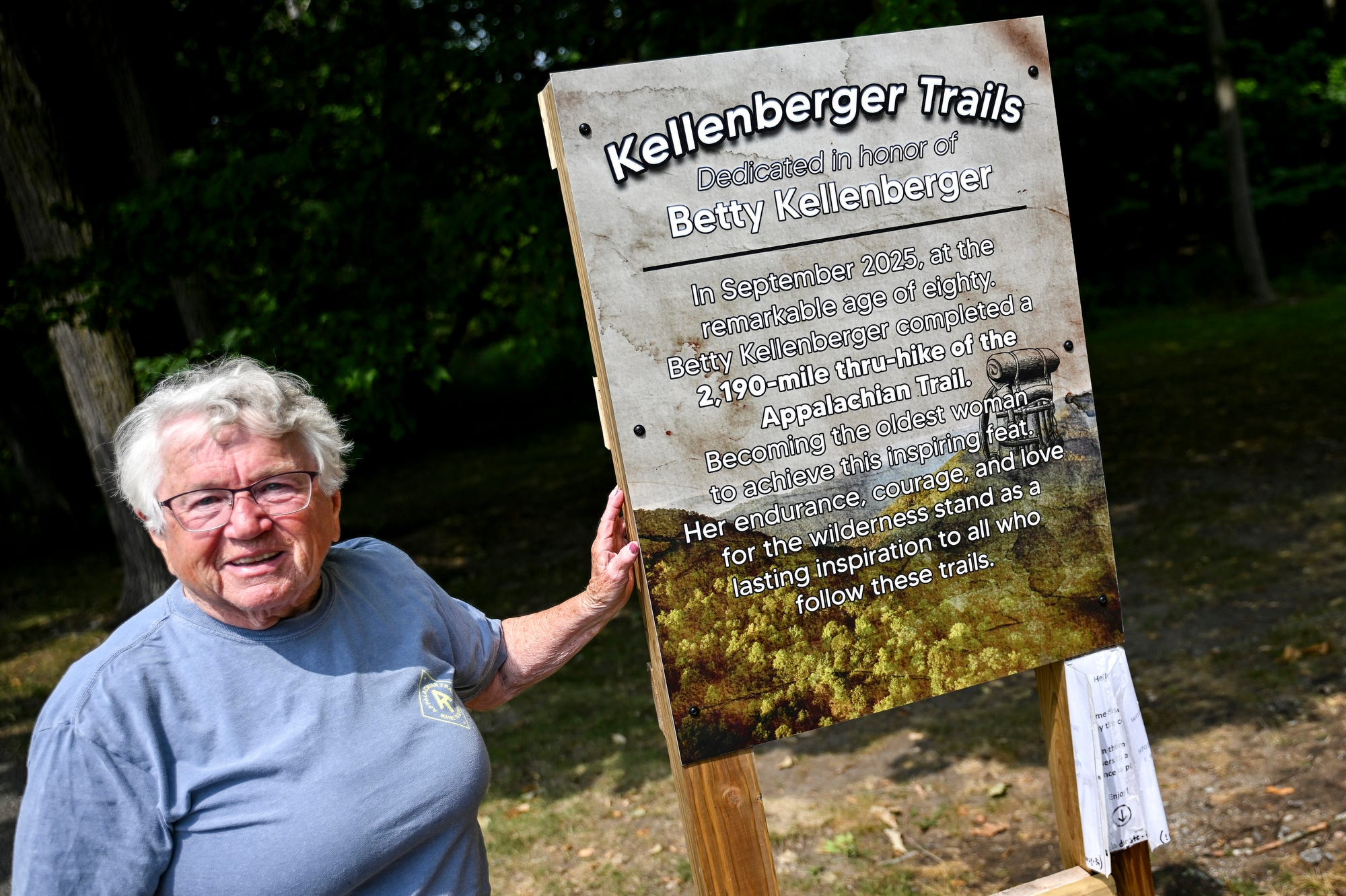
And last September, at age 80, Kellenberger became the oldest woman to complete a thru-hike of the Appalachian Trail.
Fellow trail goers call her Betty “The Legend” Kellenberger. It’s a nickname she’s accepted, despite the fact that she says she never meant to break any records when she set her sights on hiking the Appalachian Trail.
The trek was “the most profound event in my life,” Kellenberger said. “You never leave the trail. It just becomes a part of you.”
Not an ‘athlete’
Kellenberger has been active her entire life. She grew up on a dairy farm in Howell with five sisters. She started biking and running in her 20s, traveling solo every summer when she wasn’t in a classroom with students. Australia, New Zealand, China and the British Isles were among the stops.
She didn’t start hiking until after retiring in 2009.
She started training to hike the Appalachian Trail in 2020 during the pandemic, gradually increasing the length of local hikes and making regular trips to an area hospital to walk up and down a two-story block of stairs there.
“In the middle of winter when it was real hard to train, I’d go and do stair laps, which really trains your breathing and your legs, and you get a really good workout in a very short amount of time,” she said.
She walked a lot too, tacking on miles to each trip. “No one thing is going to cover everything so you have to kind of work on how you can train these other muscles,” she said.
Kellenberger may sound like an athlete discussing a training regimen, but she said she’s never thought of herself that way.
“I don’t consider myself an athlete, although I’ve done some things,” she said.
Her interest in travel, biking and hiking was born of a desire to do something worthwhile with her time.
“I’d ask people what they did in the summer, and they would say, ‘Well, I meant to paint the house,’ or ‘I meant to do this,’ or ‘I meant to do that,’” Kellenberger said. “They frittered that time away. They didn’t accomplish anything, and I thought, I want a story. When I come back, I want a story.”
‘…you’ve got to be careful’
Kellenberger had collected plenty of memorable, lively stories by 2022, and created another when she met fellow hiker and injured ex-Navy man Joe Cox in Georgia during her first attempt on the Appalachian Trail.
“I tripped on a rock and did a face plant on another rock,” Kellenberger said. She hadn’t known Cox was just behind her. “I mean, hiking is quiet, but when I went over, he saw me go. His story was, I was trying to plow all the Georgia soil with my face.”

Cox helped her tend to her cuts and bruises, around both eyes and on her nose. “He then eventually, not that day, but eventually became my trail partner,” she said.
They were an unlikely pair, him 6’3″ and her not quite 5 feet tall, but fell in step with one another when it became clear that their pace and temperaments were a match.
“It was fun and he had a tremendous sense of tease,” Kellenberger said. “Made his own jokes, most of them were short jokes. At my height, I thought I’d heard every short joke in the book, but he made them up as he went along and his were funnier.”
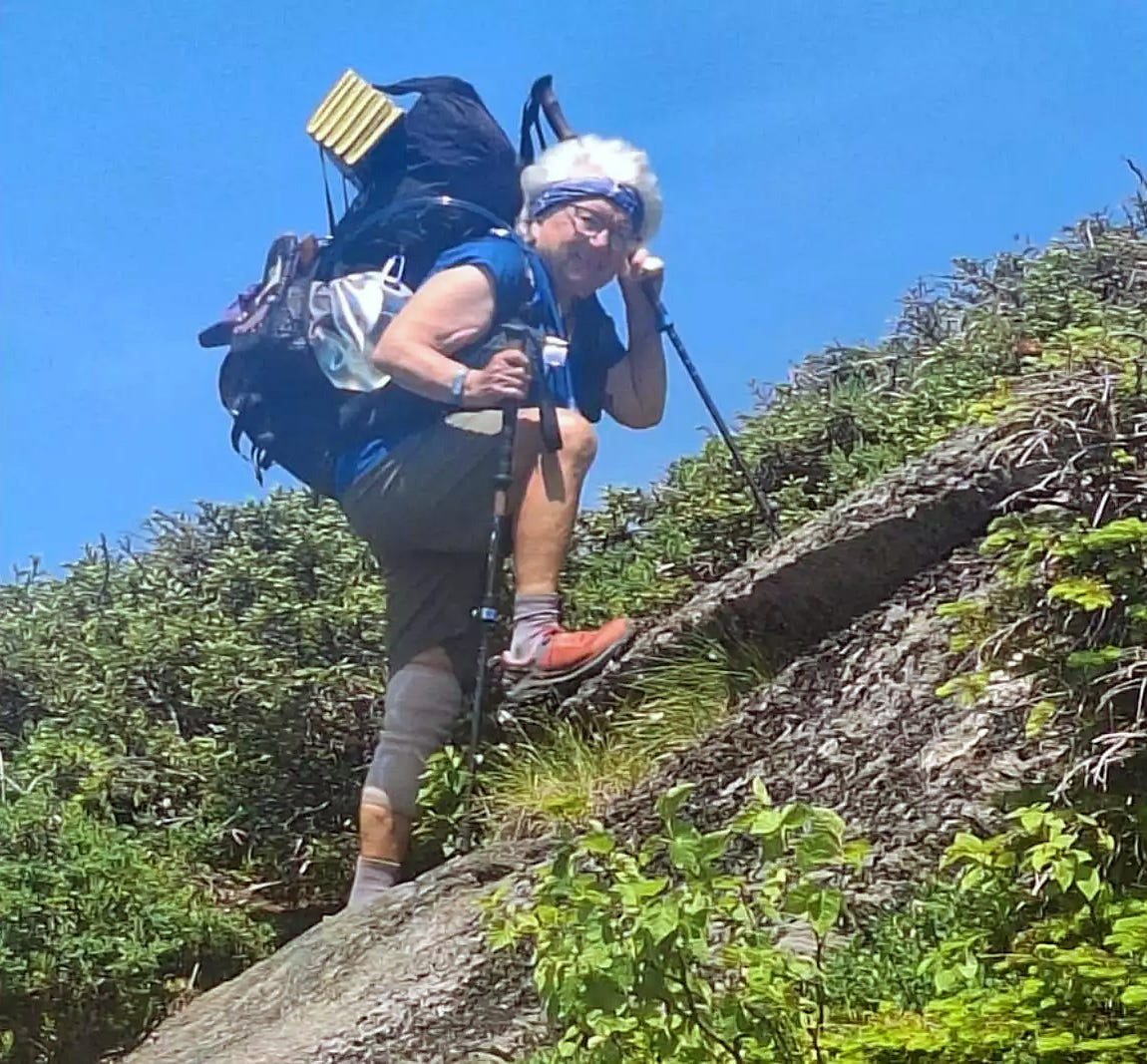
Hiking the massive trail is about waiting for the terrain to change, she said. At times the path is even, a walk through dirt or grass that’s easy to navigate, but it doesn’t stay that way. Parts of the trail are rocky, uneven, uphill, or up or down mountains, and in many cases, dangerous.
“I was hiking my first year with this young man for a while, and he said, ‘You know, it’s amazing we don’t all come out with broken ankles and broken knees and broken legs.’ That’s true. You don’t, but the potential is there, because you spend your day stepping from rock to rock, over rocks, so sometimes they’re big and they’re in place and you just have to step on them and go over, but sometimes they move when you step on them and they slide down the mountain so you’ve got to be careful.”
Kellenberger and Cox made it to Harpers Ferry, West Virginia in 2022 before deciding to fly to Maine to hike from the northern most tip of the trail south back to Harpers Ferry to avoid traversing Maine’s Mount Katahdin in the snow. Cox fell and sustained a serious injury when the pair came down the mountain and had to stop his hike. Kellenberger carried on.
‘…you gotta get off’
Kellenberger continued on her own into the Hundred Mile Wilderness, which runs from Monson, Maine, to Abol Bridge near Baxter State Park.
“It is 100 miles, actually 110 miles, of no roads, no houses, no farms, no towns,” she said. “You’re out there for 100 miles. You have three or four different mountain ranges to climb. It’s pretty isolated.”
Kellenberger didn’t know at the time that she had contracted Lyme disease. Three or five days into the desolate stretch, she doesn’t remember exactly, fellow hikers she encountered could see she was dehydrated and suffering.
“They got me off trail to a hostel,” she said. “The hostel got me into the hospital. The hospital staff said, ‘Yeah, you gotta get off,’ and so that ended the hike for me in ’22.”
By that point Kellenberger was more than halfway through the trail and had been hiking for four and a half months. As long as she completed the rest of the hike the Appalachian Trail Conservancy would give her credit for the hiking she’d finished.
In the spring of 2023 Kellenberger resumed the hike at Harper’s Ferry, heading north. She reached Massachusetts, nearly 200 miles down the trail, before falling as she hiked a mountain. “I ended up fracturing my ankle, my knee, and tearing my rotator cuff,” she said.
Kellenberger admits there were times when she thought about quitting but says most Appalachian Trail hikers feel the same impulse at some point.
“I think everybody, if you’re doing a 2,000-mile hike, is going to have a day or two or three when you want to quit,” she said.
In late June of 2023 Cox died. Then in March of 2024 Kellenberger underwent a total knee replacement.
Hurricane Helene
By August of 2024, about six months after her knee replacement, she had returned to the Appalachian Trail, determined to dedicate a thru-hike to Cox.
Kellenberger made it about 1,000 miles, nearly halfway, before getting caught up in Hurricane Helene. Hikers on the southern half of the trail were urged to leave it, and the trail conservancy assured them they could resume their treks in 2025.
“They said, when you come back, your first day on the trail will be day one, and you can bring whatever mileage you’ve accumulated,” Kellenberger said.
In March of 2025 she came back to the trail to finish her thru-hike. The final leg included navigating very steep terrain in New Hampshire that included hiking Mount Washington.
“By the time you get to the top, there’s snow and there’s wind and it’s a very dangerous situation by that point,” Kellenberger said.
She finished the trail in September of 2025.
Kellenberger had hiked an average of 12-15 miles a day on the trail. She met fellow hikers that became friends, rose early most days, packing up and setting off on her own. She learned along the way, carrying only the food and water she needed before she could restock both and, over time, making her pack lighter and lighter.
‘I don’t let other people’s fears stop me’
Setting a new record for the oldest woman to do a thru-hike on the trail brought with it attention Kellenberger wasn’t expecting. There have been appearances on national television and news articles, speaking engagements and a state proclamation recognizing her accomplishment.
There are also questions, about her age and what advice she’d give others who wanted to attempt to conquer something similar.
Kellenberger said she’s realizing what she did isn’t typical for an 80-year-old, but that doesn’t mean it can’t be.
“When I see people my age, you know, people I went to school with and graduated with or people around here, they do not have the mobility that I have,” she said. “And I don’t think about it as an issue because I haven’t had to think about it as an issue. Am I slower than I used to be? Yes. Do I get tired? Yes. But not being able to because of my age, that’s not been an issue.”
Kellenberger plans to keep traveling and hiking. She hopes to go back to the Appalachian Trail again.
“I’m looking forward to going back, maybe doing sections of it or being a part of it again,” she said.
She’s blessed, Kellenberger said, but she also chooses to ignore other’s concerns about her adventures.
“I don’t let other people’s fears stop me,” she said. “They would much prefer me to sit home on my couch. I can’t do that. That’s not who I am.”
This article originally appeared on Lansing State Journal: Lansing area woman, 81, is oldest to thru-hike Appalachian Trail
Reporting by Rachel Greco, Lansing State Journal / Lansing State Journal
USA TODAY Network via Reuters Connect