How one Michigan town enabled Black Americans to vacation during segregation.
For many of us, summertime is a chance to venture from the confines of our daily routines and escape into our state’s serene outdoors. But for a dark era in history, segregation meant that not everyone was free to experience these getaways.
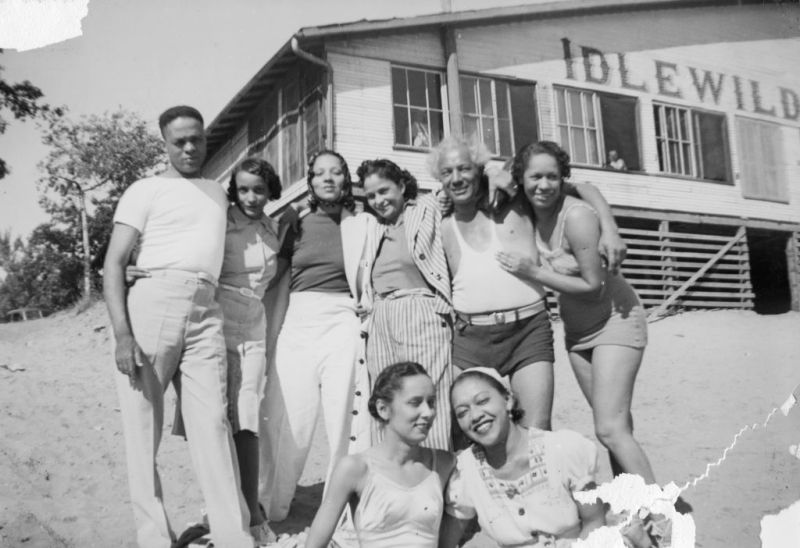
Enter Idlewild. During the early 1900s, this small Michigan resort community became a safe space for Black Americans to vacation and even buy property.
Here’s a quick history of Michigan’s “Black Eden.”
Building Idlewild
The year was 1912, and segregation was in full effect in the United States.
Despite social conditions at the time, a growing number of Black Americans—particularly in major cities across the country—were building wealth. Unfortunately, segregation meant that they simply weren’t allowed to do many of the things we take for granted, in this case, enjoying resort-style vacations.
However, four Midwest land developer couples—Erastus and Flora Branch, Adelbert and Isabelle Branch of Michigan, Wilbur M. and Mayme Lemon, and A.E. and Modolin Wright of Chicago—took notice and saw an economic opportunity.
That year, the developers founded the Idlewild Resort Company (IRC). Erastus Branch homesteaded a plot of land in rural northwestern lower Michigan, in Lake County, near the town of Baldwin, to secure land rights. Three years later, in 1915, the developers acquired 2,700 acres and Idlewild was born.
Soon after, the IRC began selling ads and organizing trips aimed at bringing Black professionals across the Midwest to visit Idlewild—billing it as a Black vacation resort.
As the Detroit Free Press reports, newspaper ads at the time advertised lots in Idlewild for $1 down and $1 per month. A 1919 pamphlet used by the IRC described the area as having “pure spring water” and “myriads of game fish.” More importantly, promoters spotlighted Idlewild as a town free of prejudice, where Black vacation-goers could feel like “American citizens.”
Idlewild’s peak
As word spread, the community of Idlewild continued to grow. In 1921, the original developers of Idlewild turned ownership of the resort over to a new entity, the Idlewild Lot Owners Association—run by Idlewild’s property owners.
By the mid-1920s, more than 6,000 people had bought more than 17,000 lots there, according to the Free Press. And it wasn’t just Midwesterners anymore. People from all over the country were flocking to what locals called the “Black Eden of Michigan.”
The Pere Marquette Railroad extended service to the town as shops, taverns, and entertainment centers began to pop up.
Some prominent figures who bought property in Idlewild included NAACP founder W.E.B. Dubois, Dizzy Gillespie, and Madam C.J. Walker, the first black female millionaire in America.
Thanks to continued word of mouth, Idlewild survived the Great Depression, and a post-World War II boom brought even more visitors to the area.
By the 1950s Idlewild would draw 25,000 visitors in a given weekend, according to Ronald Stephens, a Purdue University professor who has written two books on Idlewild.
Despite its size, Idlewild also drew some of the most famous Black entertainers of the time to perform at its venues, including Etta James, The Temptations, Aretha Franklin, and Jackie Wilson.
The Civil Rights Act and Idlewild’s future
Just as segregation created the need for Idlewild, the passage of the Civil Rights Act of 1964 severely diminished its draw.
Over time, demand dwindled as Black Americans began frequenting resorts that had previously been inaccessible to them. Over time, the town’s population dwindled, and many local businesses shuttered.
Despite being described as a “ghost town” by some, that’s not truly the case. Idlewild is still home to several hundred people who still hold fond memories of the town’s heyday, and even some newcomers.
In 2003, the Idlewild Historic & Cultural Center was built to allow visitors to learn more about the town’s vibrant past.
Local revitalization efforts include a film festival and a summer music festival.
Visitors can still tour the historic landmarks of Idlewild year-round and appreciate the history of this unique town.