The holidays are right around the corner, and gift recommendations—including a few unsavory ones—are flooding Kaity Hemgesberg’s social media feeds.
“All I see in my feed now is AI slop holiday decorations and gifts,” said Hemgesberg, a Lansing-based illustrator and the brains behind Sadsquatch, their online brand of stickers, magnets, cards, and keychains based on cats, cryptids, and pop-culture references. Sadsquatch merch is also available at other small businesses across North America.
Hemgesberg said seeing art created with artificial intelligence (AI) on shelves of stores is frustrating, especially given AI’s history of basing its results on art that has already been created, often by marginalized groups.
“There’s something just soulless about it. It’s almost disturbing,” Hemgesberg told The ‘Gander.
And competing with AI’s breakneck speed in creating new products isn’t the only thing small businesses have to worry about lately. They’re also fighting for shelf space after big corporations like Target and Walmart rolled back diversity, equity, and inclusion (DEI) workforce and merchandise initiatives—including supplier-diversity initiatives—following President Donald Trump’s 2025 executive order.
Without programs like those, building a small business can sometimes feel like a solo endeavor.
For Hemgesberg, who has felt that isolation while building their own business, that also means doubling down on advocating for local creators and shop owners, and encouraging Michiganders to shop at small businesses for this upcoming holiday season and beyond.
“When you shop at a small business, not only are you putting money into your community and keeping that place open, you’re also rejecting everything that corporate America is putting out regarding AI and discontinuing DEI policies,” Hemgesberg said, adding that small businesses are also more likely to give back to their communities by working with local charities and causes—and that choosing who to support isn’t a difficult decision.
“If your priorities are making your community better, it’s really as easy as just not going to Target, Walmart, or Meijer for Christmas gifts,” Hemgesberg said.
Research shows that when communities spend their money at a local small business, those dollars often stay in their local economy—and, ultimately, end back in the wallets of members of their own community.
With nearly 48% of Michigan’s workforce employed by small businesses, Kevin Heard, executive director of the Michigan Pride Chamber of Commerce, said supporting them can do more than keep their business afloat.
“Families need to eat, to send their kids to school, and they need to be able to go to the doctor,” Heard said. “One bad month in your business can really damage how you can maneuver through this world.” Organizations like Heard’s, he said, are helping uplift small businesses owned by underserved communities.
“Our mission is to connect, empower, and ensure that LGBTQ+-owned businesses have a seat at the table,” Heard said. This includes helping with the business certification process and offering networking opportunities and workshops.
“As a Black, queer, disabled founder, I finally have a network that sees all of who I am and shows up for small businesses like mine,” said Sydney Noble, a member of the chamber of Commerce and CEO of The Noble Brand, which handcrafts nontoxic, small-batch self-care items like soy candles and room mists in Detroit.
Noble said working with the chamber gave them opportunities to vend at different events in Michigan, allowing their sensory products and wellness services to be put in front of those who “might have never found us otherwise.”
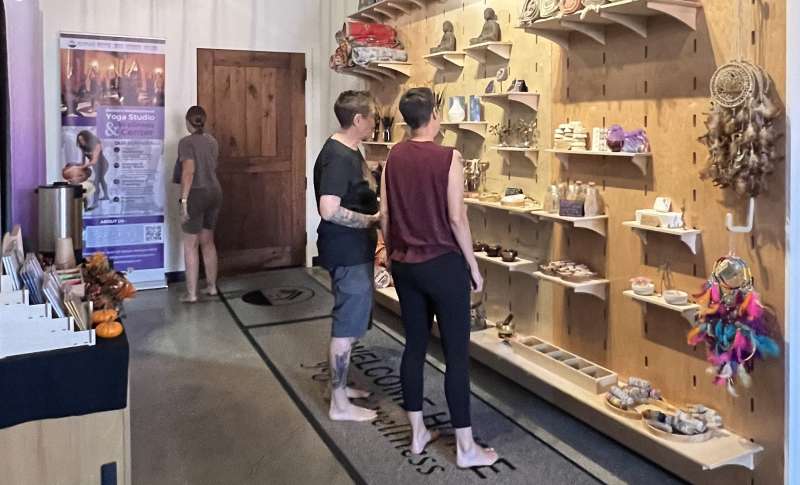
Other small business owners, like Robyn and Melissa Childers, co-founders and owners of Welcome Home Yoga and Wellness in Detroit, said that graduating from the chamber’s Queer Equity Impact Program (QEIP), a 12-week business accelerator course co-sponsored by the Michigan Economic Development Corporation, also made a difference.
“Through QEIP, we expanded our business plan and learned to clearly communicate the resources we need and how we would use them to make an immediate impact,” said the duo in a statement to The ‘Gander.
“As representation in major retail spaces becomes less certain, choosing to support LGBTQ+-owned small businesses is a direct investment in our livelihoods, our neighborhoods, and the people we serve. That support helps sustain local jobs, accessible wellness programming, and a space where people feel seen, celebrated, and connected,” they wrote.
To find more LGBTQ+-owned businesses in Michigan, check out the Michigan Pride Chamber of Commerce’s online business directory.
Related: Shop small, not small-minded: Over 30 local LGBTQ+-owned businesses to support in Michigan