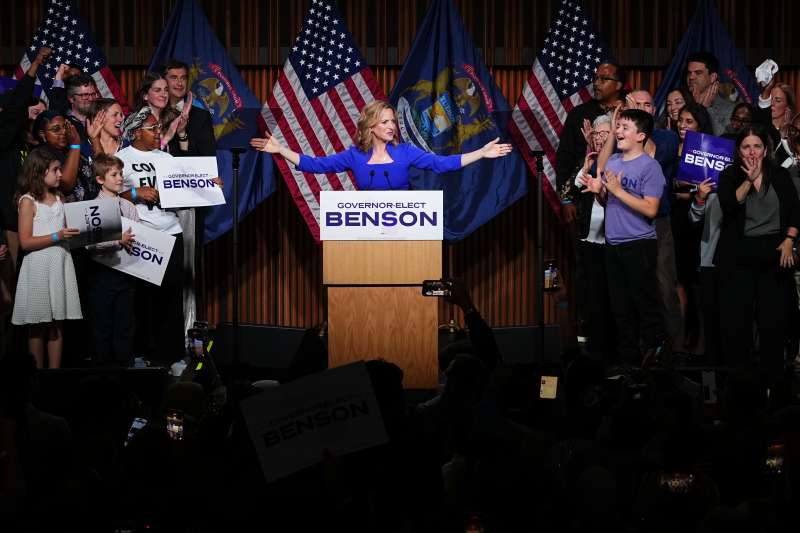
On Nov. 3, Michiganders voted in the midterm election in larger numbers than at least the last four elections. When the dust settled, Michigan Secretary of State Jocelyn Benson (D) defeated her opponent, Rep. John James (R), by a margin of nearly 11 points. That’s about half a million votes.
Three days later, Gov.-elect Benson announced her picks for her gubernatorial transition team. While transition teams are rarely subjects of controversy, several of Benson’s picks have received backlash from critics and fellow Democrats over potential conflicts of interest, influence over the governor’s office, and failing to meet a mandate given to Benson by voters.
So what does a transition team do—and why is Benson’s drawing such criticism? The ‘Gander spoke to Wayne County Prosecutor Kym Worthy, one of the chairs of Benson’s transition team, to get answers.
Transition team to shape Benson’s early days in office
Presidents and governors have so many responsibilities in office that they begin getting up to speed even before their terms begin. They do this with the help of a panel of advisors they choose who are experts in policy, law, operations, finance, and more. These advisors are the transition team.
For example, as the longest-serving elected prosecutor in Michigan, Worthy can offer expansive insight into the criminal justice system. She said that’s part of why Benson—who she has admired for many years—chose her for the team.
“Gun violence issues, domestic violence issues, child abuse issues, homicide issues—and so she knows I’m an expert in those areas,” Worthy said. “[Benson’s] very interested in keeping Michigan safe and trying to lessen gun violence, so I think because of my expertise and what I do for sexual assault and everything that I’ve done in my career, I think it dovetails nicely with some of the things she would like to do and get my expertise on.”
The transition team helps create an offramp for the previous team and an onramp for the new one. They work with the outgoing administration to ensure a smooth transition. And they vet and recommend candidates for key roles like chief of staff and cabinet commissioners, analyze the state’s budget to prepare the governor for their first budget proposal, and help the governor develop their policies and agendas.
In other words, a transition team ensures that the new governor hits the ground running. In addition to Worthy, Benson’s transition team includes former US Rep. Dan Kildee (D-Mich.) and Sen. Elissa Slotkin (D-Mich.). Kildee brings experience in Congress and community redevelopment, and Slotkin has experience in federal policymaking and national security.
Worthy said she aims to prioritize criminal justice reforms.
“One of my number-one priorities is letting people know about the lack of prosecutorial resources across the state,” she said. “If you want a fair criminal justice system, you have to properly fund prosecutors, because we’re the ones who decide which cases get into the system in the first place.”
In terms of vetting candidates for various roles, Worthy said she hasn’t done any interviewing herself but has been asked to recommend talent, which she has done. She hopes to continue to assist Benson throughout her time in office as governor.
“I want her to do extremely well, I want her to serve well, I want her to do the right things, and I know that she will, and with good guidance,” Worthy said. “I know she’s going to listen to people who know what they’re talking about and then decide what she wants to do.”
Controversial transition picks cause bipartisan backlash
According to The Detroit News, some transition team appointees have been criticized by State Reps. Dylan Wegela (D-Garden City) and Steve Carra (R-Three Rivers), as well as Detroit activist Keith Rodgerson, despite transition team spokeswoman Amber McCann saying“appropriate measures” have been taken to protect against conflicts of interest.
Huntington Bank Chair Gary Torgow, for instance, will serve as co-chair on the team. Torgow is also a board member on Detroit’s energy company DTE Energy, which is currently involved in a lawsuit attempting to block a ballot measure that was overwhelmingly popular among Michigan voters.
Essentially, in April, Benson said at a news conference in Saginaw that she wanted to ban regulated utilities like DTE from spending money to influence politicians. “We’re going to end the conflict of interest so that companies seeking to raise rates cannot influence making those rules and decisions, which are meant to regulate them,” she said.
And voters agreed, with 81% of Michiganders passing a proposal on Election Day to prohibit DTE and similar utilities companies from making certain campaign contributions to nominees for public office.
But now the law firm Miller Johnson is representing DTE Energy and Consumers Energy in a lawsuit about that very same measure. Attorney Fadwa Hammoud, who is a managing member of the Miller Johnson law firm, is also on Benson’s transition team.
Finally, Benson chose Christina Grossi for chief legal counsel. Grossi once served as chairwoman of the Michigan Economic Development Corporation (MEDC) Executive Committee.
Yet Benson criticized the MEDC as recently as October, calling for “significant reforms” at the organization in light of its own controversies. For example, another ex-MEDC Executive Committee chairwoman, Fay Beydoun, has been arraigned on 19 felony charges for “the alleged theft and fraudulent administration of grant funds” totaling $20 million. The state claims Beydoun used some of the funds for personal gain.
Grossi was committee chair at the time and declined to answer press questions about the charges against Beydoun.
Worthy expressed her faith in Benson’s decision-making, leadership skills, and ability to manage working with the controversial members of her team.
“I’m sure that she’ll handle that in the way she should handle it,” Worthy said. “I’m not going to second-guess her choices on who she thinks that she can work best with to make Michigan better. She can handle just about anything; she’s a strong woman, and she can handle any criticism that comes her way.”
Read more: Michigan asked for lower bills. In January, Lansing has to deliver