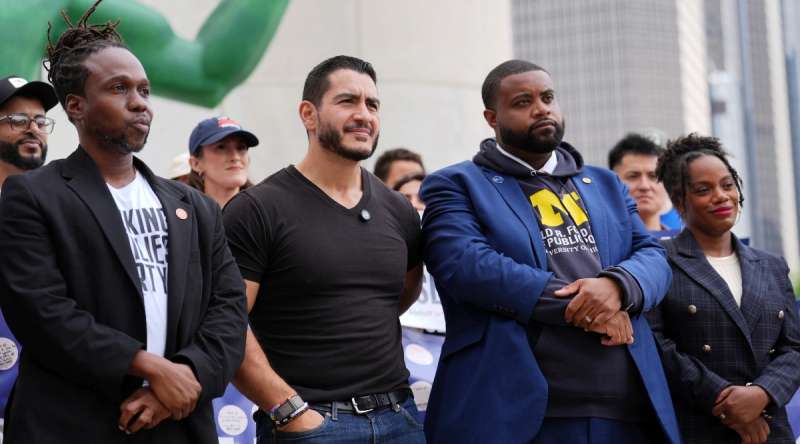
MICHIGAN—Democratic US Senate candidate Abdul El-Sayed’s new agenda for Black Michiganders touches housing, healthcare, water, schools, small business, and voting rights.
And it puts specific numbers on most of his goals: 90 days to house a family, 50 gallons of clean water per person per day, water bills capped at 2% of household income, and double the share of federal small business loans reaching Black- and Latino-owned firms within five years.
That level of detail is the whole point.
El-Sayed says that Black communities in Michigan have spent decades dealing with broken promises—and the only way to break that cycle is to put the specifics in writing first.
On Tuesday, El-Sayed released what he calls his “THRIVE” agenda, an acronym for Transforming Housing, Resources, Infrastructure, Value and Economic Opportunities.
It’s essentially a detailed outline of the types of federal legislation he would introduce or support in the US Senate to directly address the priorities of Black communities across Michigan.
“For generations, Black communities in Michigan have received promises of federal investment that never fully arrived, or arrived without any way to track whether it actually improved people’s lives,” El-Sayed said in a statement. “This policy agenda is a commitment to keeping the priorities of Michigan’s Black communities centered in all of the work that I do.”
What’s in the THRIVE agenda?
Here’s a closer look at what he’s proposing:
On small business, El-Sayed wants to expand federal lending to minority-owned firms through the Small Business Administration and community development lenders, with a goal of doubling the share of SBA-backed loans reaching Black- and Latino-owned businesses within five years.
He’d also require federal lending data to be published by census tract and race.
On housing, he’d expand the low-income housing tax credit, change how the federal government calculates area median income so it reflects local rather than regional incomes, and widen down payment assistance and federally backed loan access in majority-Black and majority-Latino neighborhoods. He also called for a 90-day deadline from application to move-in for veterans and families using federal housing vouchers, with wait times reported publicly.
On healthcare, El-Sayed would fight for Medicare for All, paired with shorter-term fixes—including a multi-year funding program for community health centers, permanent telehealth reimbursements, and grants to bring full-service grocery stores into neighborhoods without them. He also called for legislation that would lock in 12 months of postpartum Medicaid coverage, expand Medicaid reimbursement for doulas and midwives, and expand RxKids, the state’s cash assistance program for new and expecting mothers, to the rest of the country.
On water, the plan guarantees 50 gallons per person per day, caps water bills at 2% of household income, and bars shutoffs for families who can’t pay. El-Sayed also wants to speed up lead service line replacement and expand funding to clean up more PFAS contamination.
The rest of the agenda covers schools and job training—fixing school infrastructure funding formulas, building toward tuition-free higher education, investing in historically Black colleges and apprenticeships—and voting rights, where El-Sayed said he’d push for the John Lewis Voting Rights Advancement Act and a federal automatic voter registration standard.
Click here to read the plan in its entirety.
What about his opponent?
Former US Rep. Mike Rogers—El-Sayed’s Republican opponent in the Nov. 3 election—has not put forward any similar plans or policy goals. The ‘Gander reviewed his campaign’s published materials and found no comparable agenda for Black communities in Michigan.
What’s not in the THRIVE agenda?
One thing El-Sayed’s latest agenda doesn’t address is reparations.
He told a town hall in Detroit this summer that Black Americans are owed them, and said he’d support policies to enact them if elected. THRIVE doesn’t mention the subject.
READ MORE: John James’ running mate Jay DeBoyer floats 12-week abortion limit
Don’t miss Michigan’s biggest stories—follow The ‘Gander on Instagram.