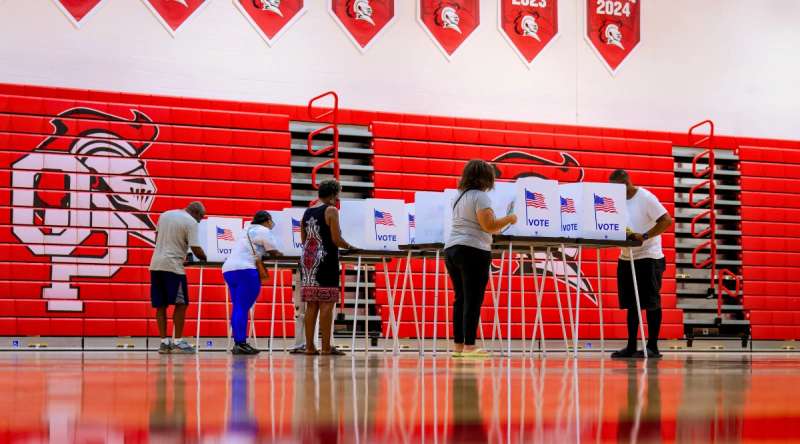
MICHIGAN—Michiganders have a lot of choices to make in this year’s general election.
Millions of voters will choose a new governor, a new secretary of state, a new attorney general, and a new US senator. Thirteen congressional races are on the ballot. And all 148 seats in the state Legislature are up for grabs, along with two seats on the Michigan Supreme Court.
Not since 2018 have all three of Michigan’s top statewide offices been open at once. The US Senate seat is open too, with no incumbents running in the four biggest races on the ticket.
And most Michiganders won’t be inside a voting booth when they decide any of them.
About 60% of Michigan voters cast a ballot before Election Day in 2024—39% by absentee ballot, many at their own kitchen tables, and another 21% at early, in-person voting sites. Michigan also shattered voter turnout records in the August primary election this year, with more than 1.4 million absentee ballots cast and more than 139,000 voters choosing to vote early.
Still, surveys suggest a lot of Michiganders have real questions about the process that takes place behind the scenes on Election Day. Recent polling shows 57% of adults are concerned (at least a fair amount) about their ballots being improperly handled, counted or secured.
The first ballots hit mailboxes in late September. And between now and November, Michiganders will be asked to judge a lot of claims about how those ballots get handled.
Some of them will be intentionally misleading.
So, here are 12 things worth knowing about our elections and how Michigan counts your vote:
1. It all starts with your local clerk.
Michigan runs its elections through two layers of local officials, and they do different jobs.
County clerks program the tabulators and print the ballots. City and township clerks hire the election staff, issue and process absentee ballots, check signatures, and run the tabulators.
“Michigan has 83 county clerks. Most of them are Republicans. Over 1,500 city and township clerks, local clerks—most of them are actually Republicans,” Ingham County Clerk Barb Byrum told The ‘Gander. “And they’re the ones that administer the election.”
Michigan has one of the most decentralized election systems in the country. No votes are counted anywhere but locally and the authoritative record is always on paper. There is no central switchboard in Lansing (or anywhere else) where results can be changed.
The flow actually runs the other direction.
“When polls close and all 100% of unofficial results have been posted on my website, I then provide the unofficial totals to the Secretary of State’s office,” Byrum explained. “So they don’t have a way to get [election results] other than the county clerk providing it.”
2. Registering means clearing three separate checks.
When people register to vote in Michigan, they certify under penalty of perjury that they’re a US citizen, a Michigan resident who will have lived in their city or township for at least 30 days by Election Day, and, if they’re under 18, that they won’t vote unless they’re 18 by Election Day.
Lying on that form is a felony.
Michiganders who register in person will be asked to show a photo ID. Without one, they can sign a sworn affidavit. False information there can also result in a fine, imprisonment, or both.
Michiganders who register online must provide their driver’s license or state ID number and the last four digits of their Social Security number. Michiganders who register through the mail must provide a license or state ID number or the last four digits of their Social Security number.
Without either of those numbers, Michiganders who are registering to vote by mail for the first time are required to provide an additional form of identification before they’re allowed to vote.
And it gets stricter close to Election Day. Anyone registering within 14 days of an election has to show up in person at their local clerk’s office with some form of proof they live in the jurisdiction.
3. The voter rolls get cleaned constantly.
When any mail from a local clerk’s office—including the voter information cards—comes back as “undeliverable,” the clerk is required to begin the process of canceling the voter’s registration.
With no response, the voter is marked “inactive.” If they stay inactive through two federal election cycles without voting or contacting their clerk, the voter’s registration is cancelled.
The Bureau of Elections says it has cancelled more than 800,000 inactive registrations since 2019, with more than 600,000 others queued up for cancellation in 2025 and 2027.
That waiting period is why names will sometimes linger on the voter rolls after someone moves or dies. Federal law requires it, in part, to stop people from being kicked off the rolls when they’re away for a work assignment, a semester at school, or a military deployment.
4. Your vote is on paper—and it stays on paper.
Nearly every Michigan vote is cast on a paper ballot in every election.
Voters in the military and living overseas are the only exceptions.
When polls close, ballots come out of the tabulator and go into an approved storage container, which is sealed with a State of Michigan seal and stored securely until the count is finalized. The seals are tamper-evident, meaning nobody can open one without leaving behind evidence.
Printed vote tallies are retained alongside the ballots. State and federal elections carry a 22-month retention requirement, and ballots stay secured under the state’s retention schedule after that. Voting equipment is stored in facilities only trained election personnel can access.
It’s worth noting: Almost every step in the process requires two or more trained workers.
5. Absentee ballots get a signature check—twice.
Clerks can only issue one absentee ballot per voter, no matter how many applications arrive. And when Michiganders request one, their city or township clerk compares the signature on their application against the one in their registration file before mailing anything.
When the ballot comes back, they check the signature on the return envelope, too. Both checks are done by human eyes—the clerk or a designated staffer, trained by the Bureau of Elections.
That’s also the step voters ask about most, according to Byrum, who trains election inspectors for the county’s smaller jurisdictions. She said the state keeps more than one version of every voter’s signature on file—just because signatures change with age.
“My signature when I was 16 years old is significantly different from my signature nowadays,” Byrum said. “So there are multiple examples in the qualified voter file of my signature—just like there would be for other voters. And a voter can ask for their signature to be updated.”
Once a signature checks out, the envelope waits for absentee processing, which runs like an assembly line staffed by workers from both parties. The envelope is opened. The number printed on the ballot is matched against the number issued to the voter. Then, the numbered stub is removed, detaching names from the ballot before anyone sees how anyone voted.
Only then does it come out of the secrecy sleeve, get flattened, and go through the tabulator.
6. Dropboxes aren’t just unattended mailboxes.
Under Proposal 2, passed by Michigan voters in 2022, the state funds a ballot dropbox for every jurisdiction and an additional box for every 15,000 registered voters in bigger cities. They have to be accessible 24/7 for the 40 days before an election, and open until 8 p.m. on Election Day.
Voters can use them to return completed absentee ballots and absentee ballot applications.
The dropboxes themselves must be clearly labeled, securely locked, bolted to the ground or another stationary object, and built so nothing can be pulled back out while locked. Only people expressly authorized by a local clerk’s office can open a dropbox or handle what’s inside.
Separately, Michigan law requires clerks to monitor every dropbox location with a video recording device and to keep the site lit well enough for that camera to record. The Secretary of State’s office pays for the boxes, their installation, and the required video monitoring.
7. You can only vote once—and the system checks.
Michigan’s voter rolls live in the Qualified Voter File, or QVF, a custom-built state database that all clerks and Bureau of Elections staff use to track registrations and ballot activity statewide. Access requires multifactor authentication and is limited to authorized election officials.
The system is continuously monitored.
The QVF updates as ballots come in and flags issues for poll workers. Someone who mails an absentee ballot and then votes early in person will have the absentee ballot rejected.
Voters who change their mind can also request in writing that their absentee ballot be spoiled and a new one issued, or surrender their unreturned absentee ballot at the polls.
It’s not an honor system. It’s a database check that happens before any ballot is accepted. And it works. Michiganders who have voted twice in the same election have faced criminal charges.
8. The machines that count ballots aren’t on the internet.
Michigan law requires machine counting—which is far more accurate, faster, and cheaper than hand counting millions of ballots. Those machines are essentially just scanners that read ballots. They cannot be connected to the internet while ballots are being tabulated.
It’s worth noting: Before any votes are cast, every tabulator is run through a public logic and accuracy test, a set of pre-marked test ballots fed through the machine to confirm it reads them correctly. These tests are open to the public. Your local clerk must announce them in advance.
And sometimes, they catch mistakes.
“Sometimes you’ll find something, and that’s why there’s public accuracy testing,” Byrum said. “Something has to be fixed. And then there has to be another round of testing.”
State officials have repeatedly emphasized that there is no evidence that voting machines in Michigan have ever been compromised or that votes have been illegally changed.
9. Nobody has a running total before 8 p.m.
Large jurisdictions may begin processing absentee ballots the week before Election Day. Everyone else can start the day before. Processing means verifying the signature, recording that a voter voted, opening the envelope, and running the ballot through the tabulator.
It does not mean totaling votes. Clerks are barred from calculating or reporting results until polls close at 8 p.m. Even at an early voting site, the tabulator does not display a running count.
This is also why results can shift late on election night. Big cities process large volumes of absentee ballots and those often report after smaller townships have finished. That’s normal.
Absentee ballots can be returned up until 8 p.m. on Election Day—and they still have to be taken to the local clerk for signature verification. They’re often then driven to a different site to be processed and tabulated. The more voters in a jurisdiction, the longer the process can take.
10. Bipartisan boards must certify the results.
County boards of canvassers review the election results, and the four-member, bipartisan Board of State Canvassers has sole authority under state law to certify the results for statewide and federal offices, legislative districts crossing county lines, and most judicial races.
Certifying isn’t a judgment call. It’s a legal duty and the Legislature has strengthened it with penalties (including civil or criminal charges) for canvassers who refuse to do their jobs.
Afterward, the state also conducts a risk-limiting audit, a statistical method the Bureau of Elections describes as the leading method for confirming results. Using a formula, auditors in each locality randomly pull paper ballots and compare them against what the tabulators reported. Michigan ran full statewide audits after the 2020 and 2022 elections.
The state also conducts audits to confirm election tasks were completed properly. And results can be recounted from paper ballots that are still sitting in sealed containers.
11. No one person controls the election.
As secretary of state, Jocelyn Benson is Michigan’s chief election official.
She is also running for governor in an election that she is overseeing.
That’s legal. And Michigan secretaries of state have administered elections they were competing in before; Benson did it in her own 2022 re-election. Still, a governor’s race is a bigger prize, and several Republicans have already raised concerns of conflicting interests.
In May, Benson released what she calls a “firewall” policy—a letter to the Board of State Canvassers handing seven categories of decisions to the state’s director of elections, Jonathan Brater, through the November election. That includes reviewing affidavits of identity, processing and filing nominating petitions, submitting recount petitions, post-election audits, declaratory rulings, campaign finance complaints, and any move to strip a local official of election duties.
“Michigan secretaries of state have a long history of simultaneously running for office while successfully administering Michigan’s elections in partnership with the Board of State Canvassers,” Benson said in a statement. “These processes largely reflect how the Bureau of Elections and I handled potential conflicts of interest during my reelection campaign in 2022.”
It’s important to note: Under Michigan law, the secretary of state does not certify results. That’s the Board of State Canvassers’ job. They also decide which candidates qualify for the ballot.
The board’s Republican chair, Richard Houskamp, has said he doesn’t see any conflicts of interest at play, telling Bridge Michigan that Benson is nowhere near candidate petition signatures. Its Democratic vice chair, Mary Ellen Gurewitz, put it less diplomatically.
“That’s just bullshit, and they know it,” she said.
12. You have a right to vote without being harassed.
Proposal 2 wrote a fundamental right to vote “without harassing conduct” into the Michigan Constitution. State law backs it up by prohibiting electioneering within 100 feet of a polling place.
Candidates, campaign materials, and anyone soliciting votes must stay outside that line. Candidates can only cross it to vote. Violators can face criminal charges.
Those rules bind observers as well. It’s a crime for anyone—including poll watchers and challengers—to threaten or intimidate a voter in Michigan. Under law, they also can’t approach or question voters, offer them assistance, or photograph or record inside the polling place.
Still, polls show 52% of adults are concerned about voter intimidation near polling places, and 40% are concerned about being personally confronted, followed, or recorded while voting.
Attorney General Dana Nessel sent guidance to law enforcement agencies across Michigan in June, preparing officers to protect voters’ rights and enforce election law on Election Day. Her office is actively taking reports of voter intimidation or harassment at mi.gov/agelections.
“Every eligible Michigan voter has the right to cast their ballot safely and securely,” Nessel said in a statement. “Despite recent attempts to muddy the waters, Michigan’s voting rules haven’t changed since 2024. … We remain committed to safeguarding the right to vote and holding accountable those who try to intimidate voters or interfere with our electoral process.”
Voters can also reach the election protection hotline at 1-866-OUR-VOTE.
Check things for yourself.
You don’t have to take anyone’s word for any of this.
Track your own ballot. Visit Michigan.gov/vote to confirm your voter registration, see whether your absentee ballot was mailed, received, and counted, find your clerk’s contact information, and look up your early voting site. You can also register to vote through our online form.
Work an election. Clerks are hiring poll workers and state law requires them to come from both major political parties. It’s the best behind-the-scenes look you’ll be able to get on Election Day.
Watch the count. Michigan lets any member of the public serve as a poll watcher at a polling place, an early voting site, or an absentee ballot processing facility. If you want to get even closer to the action, you can also apply to be an election challenger. Challengers can sit or stand behind the processing table, inspect poll books and other election materials, and formally challenge an inspector’s actions on Election Day. County canvassing meetings are also public, as are Board of State Canvassers meetings, and both are announced in advance.
Ask your clerk. Just walk into your local clerk’s office and track down the answers for yourself. Those offices (usually located inside city or township halls) are open to the public, too.
Byrum says most clerks will make the time: “I call out misinformation when I see it and I am definitely open to talking about election administration. It’s a passion of mine,” she said. “Most clerks are equally as open to talk about it. … Our elections are being run by our neighbors. Our clerks all really work tirelessly to make sure our elections are accurate, safe, and secure.”
READ MORE: Benson wants Whitmer’s job—but not her playbook
Don’t miss Michigan’s biggest stories—follow The ‘Gander on Instagram.