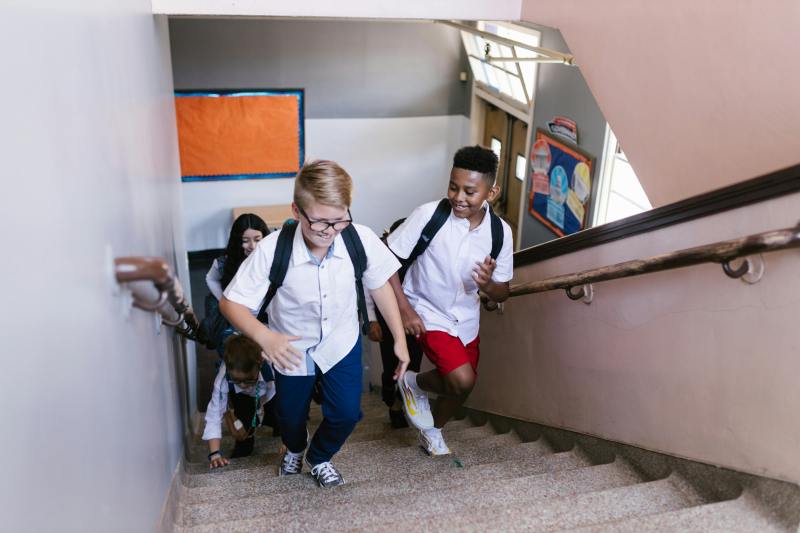
In 2023, Michigan’s largest school district, the Detroit Public Schools Community District, had a pretty good year. Students showed improvements in reading and math—including reaching an 11-year high in reading—and graduation rates rose almost to the levels of other districts in Michigan.
And you didn’t have to live in the Motor City to notice other big changes in public education. Not only have more kids been graduating across the state, but Michigan has ensured students are ready to learn by providing universal free meals for K-12 students—no more lunch debt, no students facing the stigma of being “the free lunch kid,” and more money saved at the grocery store for families.
“That obviously affects our academic outcomes because when children are fed and not hungry, they’re going to do better in school,” said Tali Faris-Hylen, Vice President of the East Lansing School Board, whose district also saw improved academic outcomes in the post-pandemic years.
Students statewide have also had more access to counselors, resulting in fewer class disruptions. Bus driver shortages have decreased, helping more parents get to work on time and more kids get to school without incident. And students who were behind are starting to catch up earlier, reducing the likelihood of long-term struggling and a reluctance to be in school.
Something else happened in 2023: For the first time in nearly 40 years, voters had elected a Democratic trifecta to Michigan government. The state Senate, House of Representatives, and governor’s office all had a Democratic majority.
For a state that’s been trying to do better by its kids for decades, things were looking up.
Now those gains are at risk. In 2024, Republicans re-took control of the Michigan House, and since then they’ve proposed budget cuts to the very programs that made so much growth possible.
In response to Gov. Gretchen Whitmer’s proposed 2026-27 budget, Michigan House Speaker, Republican Matt Hall, has already countered with a demand to cut $800 million, including the local assessment that funds K-12 education.
Drastic cuts like these may or may not be approved by the state legislature.
“I think it also really depends on who becomes our governor,” said Imani Foster, Communications and Research Deputy Director at 482 Forward, a Detroit education justice coalition. “That plays a role into what is going to happen with the budget. I don’t think Dems will go for an $800 million cut.”
Had last year’s House-proposed budget passed, the gains made over the last three years in Michigan’s public education system—from higher graduation rates to better futures for Michigan students—could have been erased.
And they still could be.
Detroit Students Have Improved in Test Performance and Reading
The 2024 Michigan Student Test of Educational Progress (M-STEP) showed that Detroit students outperformed on tests in reading and math compared to the previous year, including performing up to 4% better on math tests.
“Nearly every grade in (the Detroit Public Schools Community District) had higher proficiency rates in math and English language arts […] on the M-STEP since the exam was first administered in 2014-15,” a study by Chalkbeat found.
In other words, Detroit children are learning more and performing better in school than they were before the major setbacks from the COVID pandemic. Students are now less likely to repeat a grade and are better prepared for middle and high school than they ever have been.
Detroit graduation rates are now catching up to the rest of the state, too, reaching their highest point since the state started its current method of measuring graduation rates.
“We do have some state representation that has been really helpful in us moving forward certain campaigns,” Foster said. She mentioned Rep. Regina Weiss (D-5th District) and Sens. Darrin Camilleri (D-4th District) and Stephanie Chang (D-3rd District) as proponents of 482 Forward’s work promoting Michigan public education.
Weiss and Camilleri are both former teachers, and all three lawmakers have played significant roles representing public education in House and Senate committees.
Read More: Michigan voted in favor of public education in the midterms
Graduation Rates Are Also Up Statewide…
Graduating high school means a better future for Michigan students and their families. They’re more likely to continue on to college or hit the job market, removing undue burden from parents. Thanks to education funding, in 2025, Michigan’s high school graduation rate reached an all-time high of over 84%—that’s five out of six Michigan schoolchildren walking the line to receive their diplomas.
In Lansing, the graduation rate is a staggering 94%, which is more than 30 points higher than its 2021 level.
…So Why Is Educational Funding Under Attack?
When the Republican-controlled Michigan House proposed its 2025-26 budget in June, representatives tried to make huge cuts to several public-school programs and their sources of funding. Fewer free meals, fewer buses, and fewer counselors to help students with mental health or to intervene with students who need it most.
Leading that charge as Speaker of the Republican-controlled House, Rep. Matt Hall—who represents Michigan’s 42nd District, including parts of Allegan and Kalamazoo counties—backed and led passage of the proposed budget. He also championed the House’s opposition to Democrat budget items, causing the state legislature to miss its July 1 budget deadline and forcing school districts to plan for the 2025-26 school year in the dark.
This was part of the reason one in 10 Michigan school districts had to lay off staff, unable to take Hall’s advice of “waiting it out.” Layoffs mean larger class sizes, teachers taking on roles for which they have no training, and more students falling behind and staying behind.
“It was just a frustrating time,” East Lansing’s Faris-Hylen said. “They were using our children and our educators as pawns in this political game, and it never sat right–and it shouldn’t.
“That’s why we continue to advocate for public education and for people to understand the value of it as the cornerstone of our democracy.”
Meanwhile in Washington, all Republican US Representatives for Michigan voted in favor of President Donald Trump’s “One Big Beautiful Bill Act,” including Bill Huizenga (R-4th Congressional District), John James (R-10th Congressional District), and Tom Barrett (R-7th Congressional District). The One Big Beautiful BIll Act included a piece of legislation that could have serious impacts for public education—a federal school voucher program.
Titled the Educational Choice for Children Act (ECCA), the voucher program offers big tax credits to anyone who donates to approved organizations. Then, those organizations award scholarships to help pay private school tuition. It’s modeled on the Betsy DeVos voucher scheme Michiganders rejected in 2022. States must opt in to the federal program, and Michiganders have been making their opinions on the matter known to Whitmer since the One Big Beautiful Bill passed.
Voucher programs steer funding away from public schools over time, putting Michigan’s recent education gains at risk on a federal level.
“Vouchers are just a scheme to get public money into private schools, which our constitution bans,” Faris-Hylen said. “They’re not good for our most vulnerable populations—low-income children, children that need special education services—and through a voucher system, they’re just putting more money into the hands of the wealthy people in power.”
Foster agreed. “We think it’s pretty clear that it’s not something Michiganders want,” she said.
As for the three Republicans who support Trump’s voucher program—Huizenga, James, and Barrett—they all attended private high schools.
The bill they voted for also tightened restrictions on Medicaid eligibility and verification, making it more difficult for 2.6 million Michiganders to get affordable health insurance. Since Medicaid is also a top funding source for public schools, school health staff like nurses and speech therapists face pay cuts or layoffs.
Along with the budget itself, the strides that Michigan public education has made—from climbing graduation rates to record-high student performance—are again on the chopping block. Michiganders can find the most effective ways to get involved by visiting the websites for the Michigan Education Justice Coalition and 482 Forward, which advocate for public education on the state level and in Detroit, respectively.
Read More: 100 days later—What happens when voters put Democrats in charge of the state government?