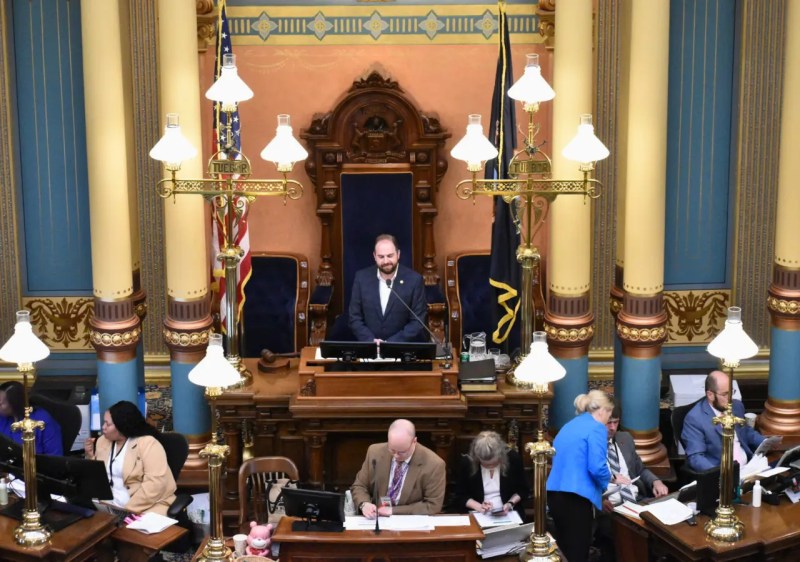
LANSING—Unlike the fiasco that was the 2025-26 budget process, both the Michigan House of Representatives and the Michigan Senate have completed their 2026-27 fiscal year budgets and advanced them out of their respective chambers.
The House cleared that hurdle last week, while the Senate did so on Wednesday afternoon, passing Senate Bill 878 along strict party lines, 19-18.
Senate appropriators are proposing a government spending plan at $88.12 billion with $14.15 billion coming from the state general fund.
Education spending for K-12 schools, community colleges and universities would come in at $25.1 billion under the Democratic-led Senate’s plan, with $1.46 billion coming from the general fund. Senators intend to pass the education spending plan on Thursday.
Other government spending set by the Senate, which the omnibus bill addresses, would also be funded at $63 billion with $12.68 billion coming from the state general fund.
Following passage of the omnibus bill, state Sen. Sarah Anthony (D-Lansing), the chamber’s Appropriations chair, told reporters that the Senate’s budget focuses on lowering costs for Michigan families, while also protecting residents against federal budget cuts, feeding school children with free breakfast and lunch, fixing failing infrastructure and alleviating the impacts of recent natural disasters.
“That’s really important,” Anthony said, noting money put into the Michigan Department of Health and Human Services to shore up healthcare, food assistance and housing. “Those are the things I think people really rely on.”
Anthony said all of that work was done against the backdrop of Michigan facing a hard budget year.
“We are facing a $1.6 billion deficit, so there weren’t a lot of new investments,” Anthony said. “We’re continuing to try to invest in things that we’ve invested in over the last few years, things like maintaining the working families tax credit and the repeal of the retirement tax. Those have significant impacts on our balance sheet, but we want to make sure to continue those investments, as well as our $50 million ongoing investment in affordable housing.”
Anthony said some of those items likely won’t get a lot of headlines, but they were resources for people who are either looking to start a business or buying their first home.
“Not a lot of new, flashy things,” she added.
The senator from Lansing was asked what she thought of the House budget proposal and how it compared to theirs. Anthony said she was concerned about the House budget’s boilerplate language affecting marginalized communities, which she added contains “divisive language that ultimately just divides our state.”
“That’s not something that we really want to address. We also are a little bit concerned about some of their disinvestments in higher education,” Anthony said. “We believe in building up the next workforce. They’re cutting higher education by hundreds of millions of dollars. We’re investing in scholarships for young people. So, there are some key contrasts that we’re looking at.”
Ultimately, many of those issues and more will be hammered out at the negotiating table.
All things considered, both the Senate and the House having their budgets completed in late April sets the negotiation phase up for far greater success compared to the stalled budget process seen this time last year — when the state lapsed its constitutional deadline to have a budget completed, resulting in a brief government shutdown.
“It is helpful,” Anthony said to Michigan Advance, knowing that both chambers have ponied up their spending plans in reasonable time. “We in the Senate have now a four-year track record of getting our budgets out of our chamber on time and sitting at the negotiation table ready to go. The fact that the House is now doing the same, it’s important. It means that we can start these conversations earlier and hopefully get the budget done before our statutory deadline.”
The statutory deadline is July 1, but that is a self-imposed timeline that lawmakers created during former Gov. Rick Snyder’s tenure to move the process along. A budget must be passed by the constitutional deadline of Sept. 30 before the new fiscal year begins Oct. 1.
Last year, the chambers worked late into the evening on Sept. 30, 2025, but still could not compromise on a budget deal as the clock struck midnight. Into the early hours of Oct. 1, 2025, the chambers and Gov. Gretchen Whitmer agreed to a stopgap plan that kept the government open as it worked on finalizing a deal. A budget was signed within the following weeks.
The ramifications of that process going sideways are still being felt well into the current fiscal year.
In a separate interview with state Rep. Jason Morgan following the House’s action to move its budget last week, the Democrat from Ann Arbor said counties were still waiting on road funding that was an essential cog in the deal brokered last year — an example of how a late budget affects the downstream funding of the state.
Anthony, House Appropriations Chair Rep. Ann Bollin (R-Brighton Township) and Whitmer’s team are hoping to avoid the same situation, especially as a costly election season looms.
Anthony also noted that because the state was facing a crisis, and because the state is still trying to insulate itself from the effects of President Donald Trump’s “One Big Beautiful Bill” tax and spending cut bill approved last year, the chambers don’t have time to waste fighting over funding.
“We have to get to the table and start showing our work,” Anthony said.
The governor has proposed several tax increases revolving around new “sin taxes,” like online sports betting, nicotine vaporizers and cigarettes. Anthony said the budget doesn’t include those taxes because “people are hurting right now.”
“We didn’t want to start negotiations talking about raising taxes,” she said. “That feels a little tone deaf when folks are worried about whether their healthcare will be addressed, or whether they can put food on the table. We want to be sure that we’re being mindful of what revenue options are there, and whether they impact working families.”
READ MORE: Michigan State House threatens public school funding for second straight year
This coverage was republished from Michigan Advance pursuant to a Creative Commons license.