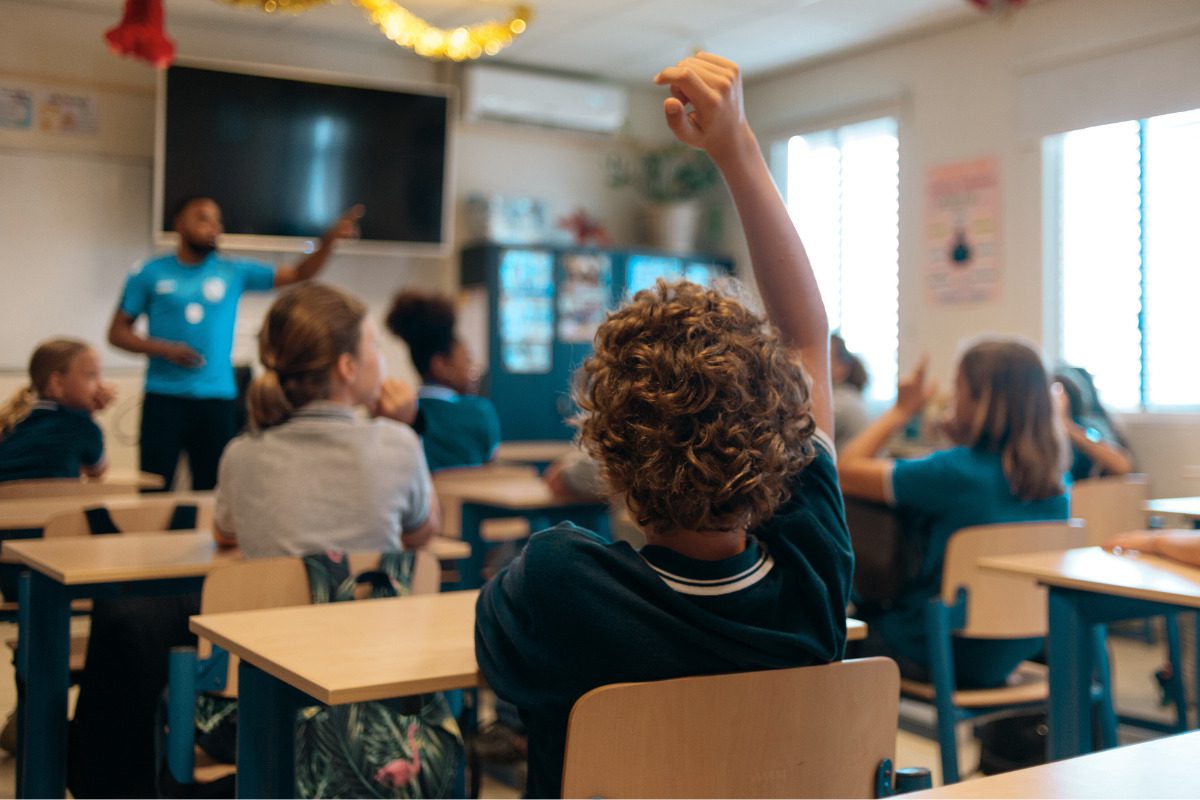
Michigan’s School Aid Budget must commit to closing opportunity gaps, funding special education, and supporting educators.
In the back of my white cinder block classroom hung a huge poster with three goals for my high school students:
- “Big Goal- Each class will score at least an 80% average on every unit exam.
- Bigger Goal- Scholars will use the knowledge and skills they gain to practice history as historians do, as scholars will be expected to do in college.
- Biggest Goal- Scholars will apply historical knowledge, skills, and thought processes to more intelligently engage with the wider world.”
The first goal was one my school required me to make, but it wasn’t what got me out of bed in the morning. What I really wanted for my students, as reflected in the last two goals, was to set them up for success—however they chose to define that for themselves.
Today, I lead Teach Plus’ work in Michigan, developing and empowering highly-effective educators to create better opportunities and outcomes for students. The teacher leaders I work with are similarly focused on setting students up for success. These educators teach across classrooms in Michigan and see firsthand what their students, from the youngest learners to high school seniors, need in order to get where they want to be in school and in life.
As the Governor and lawmakers craft next year’s School Aid Budget to fund Michigan schools, the teachers and I believe they should prioritize four efforts that will help give their students and all students across Michigan a choice-filled future.
Firstly, we must create the conditions to help all students reach their highest aspirations. Right now, some Michigan students have broad access to postsecondary-focused courses such as Advanced Placement, Dual Enrollment, and Career and Technical Education, while others don’t. Tragically yet predictably, economically disadvantaged students and students of color have less access to the kinds of advanced courses that have the potential to put them on a pathway to success, however the student defines it. That is why lawmakers must focus on closing those opportunity gaps in access to postsecondary-focused courses. Teach Plus Michigan is building a coalition of teachers and stakeholders to identify the policies and investments that will help us close the gaps, and we look forward to partnering with lawmakers to enact those measures.
To make sure all students, including those in special education, can meaningfully engage in advanced coursework that will set them on a meaningful postsecondary pathway, lawmakers must adopt the recommendations laid out in the The MI Special Education Finance Reform Blueprint (MI Blueprint) report. The report, informed by an impressively large and diverse coalition of Michigan stakeholders, lays out a path for our state to move from an underfunded, unfair, and overly complex funding system for special education, to one that is student-centred, needs-based, transparent, predictable, and flexible. Back in that white cinder block classroom, I saw how a lack of resources for some of my students led to poor outcomes like the ones we’re currently seeing in Michigan. Ensuring that students in special education have the resources they need is both a practical and moral imperative, and the first step in helping all students reach their full potential.
Thirdly, Michigan must remain committed to recent investments we’ve made in improving early literacy, and expand the scope of those efforts. In October 2024, Governor Whitmer signed Public Act 146 into law which, when fully implemented, will broadly ensure that the way we teach students to read in Michigan is evidence-based. Now, Michigan must expand the focus of our efforts around literacy to include upper elementary, middle, and high school students. While our state has rightly focused on “reading by grade 3,” we can’t afford—literally, in terms of economic outcomes—to ignore the literacy needs of older students. The reading level of many of the high school students I taught was well below their grade level, and it negatively impacted both their ability to engage with the lessons and their postsecondary options. Michigan should, as just one example of expanding the scope of our efforts, fund educator training around evidence-based literacy interventions for older students, just as the state currently does for teachers of younger students.
None of the investments we can make in education will matter without excellent teachers like the ones I work with at Teach Plus. That is why the fourth priority area for Governor Whitmer and the legislature must be educator retention. More experienced and diverse teachers tend to have a stronger impact on student achievement. We must make sure that the investments we make in attracting teachers to the profession and in providing them with high-quality professional learning, such as around literacy, are sustained through retaining teachers in the profession.
As a teacher, every interaction I had with a student was an opportunity to help them take another step towards realizing the life that they wanted for themself. That often felt daunting, but with the right, sustained investments, we can collectively smooth the path forward for all of Michigan’s students.
Author

Education vouchers 101: What are they and how could they impact Michigan’s K-12 students?
Voucher programs have become one of the most controversial topics in the history of the US education system—here’s what Michiganders need to know....
Michigan House passes bill to ban cell phones in classrooms
State lawmakers in the Michigan House of Representatives passed a bill to ban student phone use in classrooms, following in the footsteps of many...

Michigan teachers weaving lessons on Jan. 6 uprising into history classes
By Kim Kozlowski/Bridge Michigan Ask any history teacher in Michigan how their lessons could be better and they will tell you that they need to...
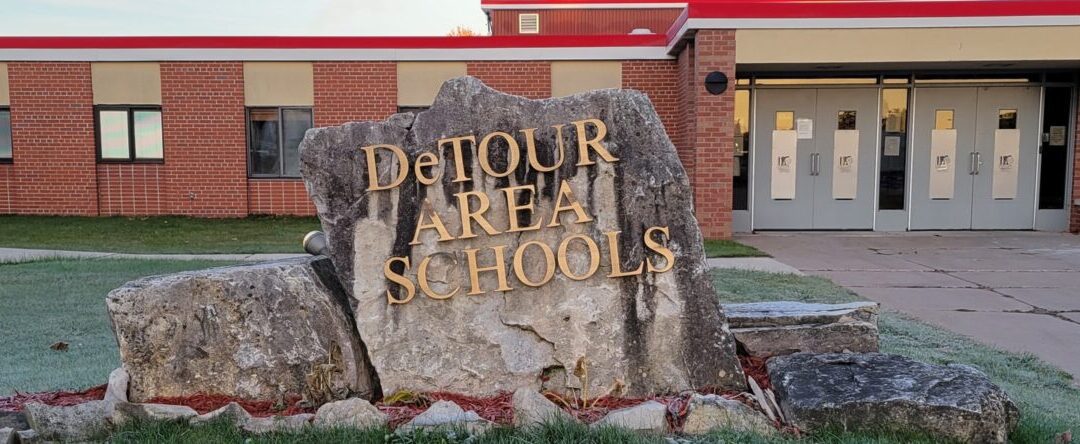
Brighter days are ahead for students in the Eastern Upper Peninsula
Superintendent Robert W. Vaught explains how academic achievement and the mental health of students, teachers, and parents have improved since...
About 72% of Michigan students considered not ‘college ready’
By Clara Lincolnhol, Capital News Service LANSING – Nearly three quarters of Michigan high school students are considered to be unprepared for...