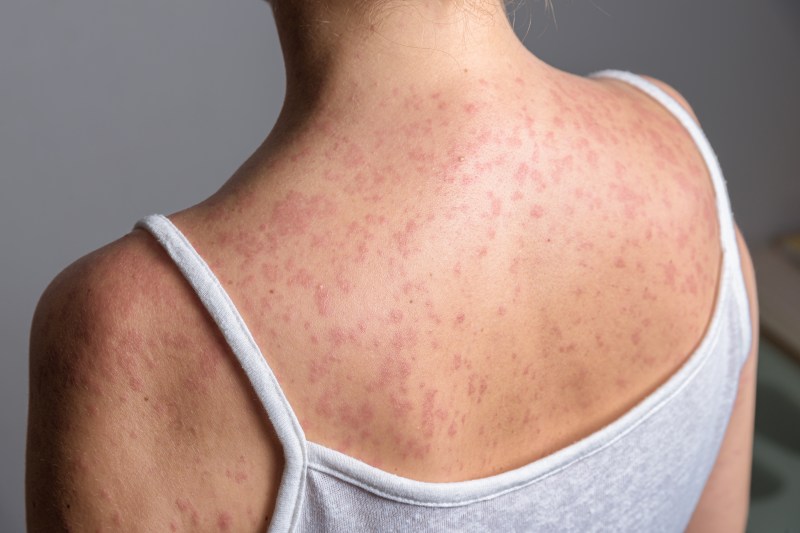
A Washtenaw County resident took a trip to Florida this spring and brought home more than souvenirs.
On March 12, the Michigan Department of Health and Human Services (MDHHS) and the Washtenaw County Health Department confirmed three linked cases of measles originating from the unnamed—and unvaccinated—traveler, bringing the state’s first measles outbreak of 2026.
Measles is highly contagious and kills more than 100,000 people per year. In addition to deafness, many who survive it suffer from “immune amnesia,” a phenomenon in which the immune system no longer recognizes previously survived illnesses and thus forgets how to fight them off effectively.
Yet despite readily available vaccines against it that have repeatedly been proven safe, measles is returning to Michigan. In February 2024, Michigan experienced its first measles case in five years. In 2025, 30 cases followed, and so far, MDHHS have confirmed another 14 this year.
The ongoing resurgence of measles has been connected to worsening childhood immunization rates, unvaccinated adults, and vaccine-skeptical legislators in office, even though the myth linking vaccines to autism was debunked 15 years ago.
“Nobody worried about vaccines because everybody got them, and because they worked,” said Eve Mokotoff, MPH, part of the leadership group of Defend Public Health. “And then you don’t think the diseases are bad because nobody has them, but nobody has them because you have the vaccines.
“So you stop taking the vaccines for various reasons, the vaccination rate goes down, and then kids get sick, and some of them will die or be permanently disabled.”
The fall, rise, and fall of measles immunization in Michigan
The last decade in Michigan has been a rollercoaster for protection against measles.
In 2014, the Republican-led state had the fourth-highest rate of vaccination waivers in the nation, since lawmakers allowed for medical, religious, or “philosophical” (personal belief) exemptions to vaccination.
With immunization waivers soaring, health officials created an administrative rule saying that anyone seeking nonmedical waivers for vaccinations would have to receive education on the risks of being unvaccinated.
The following year, kindergarten vaccine waivers dropped by 32%.
However, vaccine hesitancy spiked so much that the World Health Organization designated it one of the top threats to health for 2019. Their concerns were well founded: Michigan measles cases shot up from just one in 2015 to 46 in 2019.
“People […] get so firm in their beliefs, and it becomes part of their identity and changing their minds means changing their identity,” Mokotoff said. “We all defend the positions we’ve taken.”
Then, Michiganders voted Democrat Gretchen Whitmer into the governor’s office.
In 2020, the Republican-led Michigan Legislature sued Gov. Whitmer over COVID-19 emergency orders, lending more weight to vaccine skepticism.
“There was a lot of politicization of COVID,” Mokotoff said. “And the vaccine was part of COVID, so it spreads to other vaccines too.”
At the height of the COVID pandemic, at in-person sessions for vaccine education, vaccine skeptics became so animated that they yelled at and berated nurses for hours a day, creating an unsafe environment for them, said Dr. Juan Marquez, one county’s medical director.
In 2026, research shows that under the leadership of vaccine skeptics like Health and Human Services Secretary Robert F. Kennedy, Jr., children’s immunization rates have plummeted to just 66.5%. This is far below the 95% threshold of vaccination required to achieve “herd immunity,” which is the inoculation rate needed to protect people who can’t medically receive a measles vaccination to still be protected from its disease.
“One of the ways we protect babies is by having the people around them be vaccinated, because it’s a process,” Mokotoff said. “The idea that the culture would require you to be vaccinated to be around other people is simple social responsibility, and these vaccines are much safer than the diseases themselves.”
The Michigan officials fighting for—and against—protection from measles
In 2017, Rep. Tom Barrett (R-7th Congressional District) introduced a bill that would have prevented schools from banning unvaccinated students during disease outbreaks. He also supported legislation in 2021 that would’ve prevented mask and COVID-19 vaccine mandates and faced dishonorable discharge from the US Army for refusing the COVID vaccine. He chose to retire rather than accept the vaccine. Barrett has also aligned himself with vaccine-skeptical associations, including speaking at events for MAHA Action.
Meanwhile, Reps. Debbie Dingell (D-Ann Arbor), Rashida Tlaib (D-Wayne County), and Shri Thanedar (D-Wayne County) co-sponsored H.R. 5448 in the US House of Representatives—the Protecting Free Vaccines Act. H.R. 5448 would require Medicare, Medicaid, the Children’s Health Insurance Program, and private insurers “cover, without cost-sharing, vaccines that were recommended by the Centers for Disease Control and Prevention’s Advisory Committee on Immunization Practices as of October 25, 2024,” guaranteeing affordable vaccinations for Americans.
Since the release of the measles vaccine in the early-mid 1960s, measles cases in the US have plummeted from 458,083 in 1964 to just 1,983 in 2026. Unvaccinated Americans contract measles 15 times as much as those who are vaccinated. Despite this, Michigan Republicans like Barrett and vaccine-skeptical federal officials like Robert F. Kennedy, Jr. continue to fight immunization requirements at the state and federal level.
Read More: Fewer young people getting vaccinated in Michigan, study finds