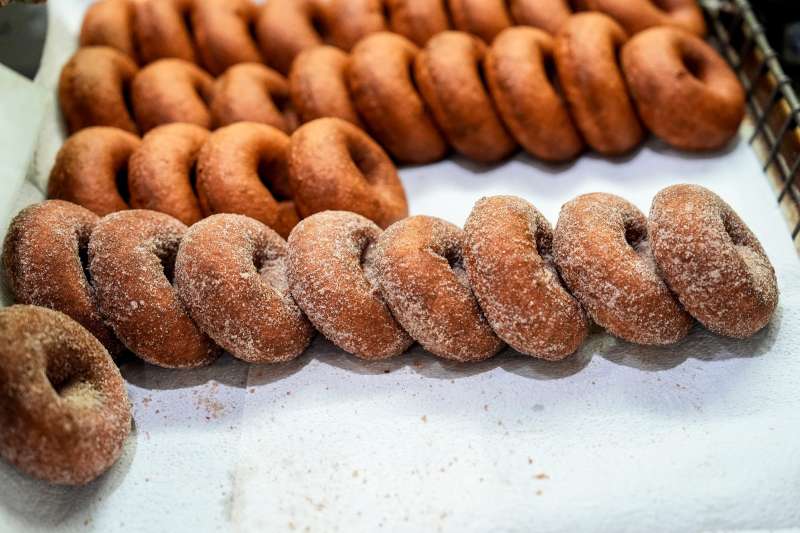
Nothing says fall in Michigan like a trip to grab doughnuts and cider — you may even catch stunning fall colors on the way.
From metro Detroit to Kalamazoo to the Flint area and beyond, there are plenty of local cider mills to patronize this season. Many offer family-friendly activities and a chance to pick your own pumpkins or seasonal produce.
Some Michigan cider mills are already open, harvesting apples and making the refreshing drink, and selling a variety of sweet baked goods. Other businesses still await their fall launch or are open now, but will begin making and selling cider come within the next few weeks.
The seasonal tradition dates back centuries and represents a cornerstone of local agriculture, with Michigan business owners carrying on family legacies of 19th century mills, serving up sweet treats for communities around the state.
Michigan’s official apple crop estimate of 25 million bushels (1.05 billion pounds) was announced Aug. 24. The 2026 estimate is under the average for the Michigan Apple industry.
Here’s what to know about cider mills in Michigan.
When do Michigan’s cider mills reopen for fall 2026?
There are many cider mills across Michigan. Here are opening dates and schedules for some mills across the state:
- Wiard’s Orchards in Ypsilanti: Country store and cider mill opens Sept. 8; fall hours 11 a.m. to 4:30 p.m. Sunday and Saturday.
- Almar Orchards in Flushing: Open year-round. Summer hours are 9 a.m. to 5 p.m. Monday-Saturday; noon to 5 p.m. Sundays. Fall hours not listed.
- Apple Barrel Cider Mill in Ithaca: Open year-round 7:30 a.m. to 5:30 p.m. Mondays to Saturdays; open for fall harvest 7:30 a.m. to 6 p.m. Mondays to Thursdays, 7:30 a.m. to 6:30 p.m. Fridays and Saturdays September to October
- Bayne’s Apple Valley in Freeland: Open now, 10 a.m. to 8 p.m. Mondays to Saturdays, 10 a.m. to 6 pm. Sundays
- Blake’s Orchard & Cider Mill in Armada: Store open now, 8 a.m. to 6 p.m. daily
- Blake’s Orchard & Cider Mill in Lyon Township: Store open now, 9 a.m. to 6 p.m. Sundays to Thursdays.
- Country Mill Farms, Bakery, Orchard & Cider Mill in Charlotte: Open now, 9 a.m. to 6 p.m. Wednesday to Saturday; starting Sept. open 9 a.m. to 6 p.m. Tuesdays to Saturdays, 11 a.m. to 6 p.m. Sundays
- Diehl’s Orchard & Cider Mill in Holly: Open daily, 9 a.m. to 6 p.m. through Oct. 31; open Saturdays and Sundays noon to 5 p.m. Nov. 1-23
- Alber Orchard & Cider Mill in Manchester: Cider mill opens Sept. 3, open 9 a.m. to 6 p.m. Sundays and Saturday, 9 a.m. to 6 p.m.
- Big Red Orchard in Washington Township: Opening for the fall season is TBD, 3 p.m. to 10 p.m. Wednesday through Saturday, 11 a.m. to 8 p.m. Sunday, closed Monday and Tuesday.
- Erie Orchards & Cider Mill in Erie: Open 9 a.m. to 7 p.m. Mondays to Saturdays and 11 a.m. to 5 p.m. Sundays; fall hours TBD
- Franklin Cider Mill in Bloomfield Hills: Opens Sept. 5 to Nov. 29, open 8 a.m. to 6 p.m. daily
- Goodison Cider Mill in Rochester: Opens Labor Day, open daily 9 a.m. to 6 p.m. until Thanksgiving eve; open 9 a.m. to 5 p.m. Fridays, Saturdays and Sundays in December until Christmas
- Klein Cider Mill & Market in Sparta: Open daily 9 a.m. to 5 p.m.
- Koan’s Orchard in Flushing: Open now, open 9 a.m. to 6 p.m. Mondays to Saturdays and 10 a.m. to 6 p.m. Sundays, cider mill to open around Sept. 15
- Kreps Apple Barn & Cider Mill in La Salle: Open now 10 a.m. to 6 p.m.
- Leaman’s Green Applebarn in Freeland: Open now, store open 7 a.m. to 1 p.m. Saturdays; fall hours TBD
- Long Family Orchard & Farm in Commerce Township: Open now noon to 6 p.m. daily or until sold out, fall hours may differ
- Meckley’s Flavor Fruit Farm in Cement City: Open 9 a.m. to 6 p.m. Wednesday through Sunday, 9 a.m. to 8 p.m.
- Miller Family Orchard in Vassar: Open year-round, fall hours TBD, 11 a.m. to 4 p.m. Tuesdays to Saturday, closed Sundays and Mondays
- Montrose Orchards in Montrose: Open now, 9 a.m. to 6 p.m. daily
- Pankiewicz Cider Mill & Farm Market in Casco: Open now, 9 a.m. to 5 p.m. Thursdays to Sundays until Oct.
- Past Tense Cider Mill in Lapeer: Holiday hours TBD
- Phillips Orchard & Cider Mill in St. Johns: Open year-round 10 a.m. to 6 p.m. Monday through Sunday.
- The Property Farms and McCallums Orchard and Cider Mill in Grant Township: Open now, fall hours TBD, 10 a.m. to 4 p.m. Thursday through Saturday, 12 a.m. to 4 p.m. Saturdays and closed Monday and Tuesday.
- Rex Young’s Orchard in Rives Junction: Opens for fall Sept. 2, 10 a.m. to 5 p.m. Mondays to Fridays, 9 a.m. to 5 p.m. Saturdays
- Stony Creek Orchard & Cider Mill in Romeo: Fall hours TBD
- Uncle John’s Cider Mill in St Johns: Fall hours TBD, open 9 a.m. to 6 p.m. Thursday through Sunday.
- VerHage Fruit Farms & Cider Mill in Kalamazoo: Open 10 a.m. to 6 p.m. Mondays to Fridays, 10 a.m. to 4 p.m. Saturdays, 10 a.m. to 2 p.m. Sundays through August; fall hours start Sept. 13
How can I find other apple orchards in Michigan?
The Michigan Apple Committee provides an interactive map on its website highlighting Michigan orchards. The map shows both farm markets and cider mills.
What is a cider mill?
A cider mill is a mill where apples are crushed into cider, a popular fall beverage served hot or cold. In Michigan, many apple orchards operate cider mills to produce the beverage from the varieties of fresh apples grown on their property.
How did cider mills get started?
Cider traces its roots to Europe, where it is typically fermented and served as an alcoholic beverage, per and Manoff Market Gardens and Falstaff, a European dining magazine.
European settlers planted apple trees in colonial North America in the 17th century, bringing over the custom of turning their apples into cider as a popular beverage, Manoff Market Gardens and Happy Valley Ranch Cider Press say.
Cider mills across the U.S. now offer cider as a fall staple, a non-alcoholic beverage, though the alcoholic version, known as hard cider, is also available at cideries nationwide, including in Michigan.
In Michigan, many cider mills are family-owned dating back several generations to the 19th century.
Reporting by Jenna Prestininzi and Jalen Williams, USA TODAY NETWORK / Detroit Free Press
USA TODAY Network via Reuters Connect