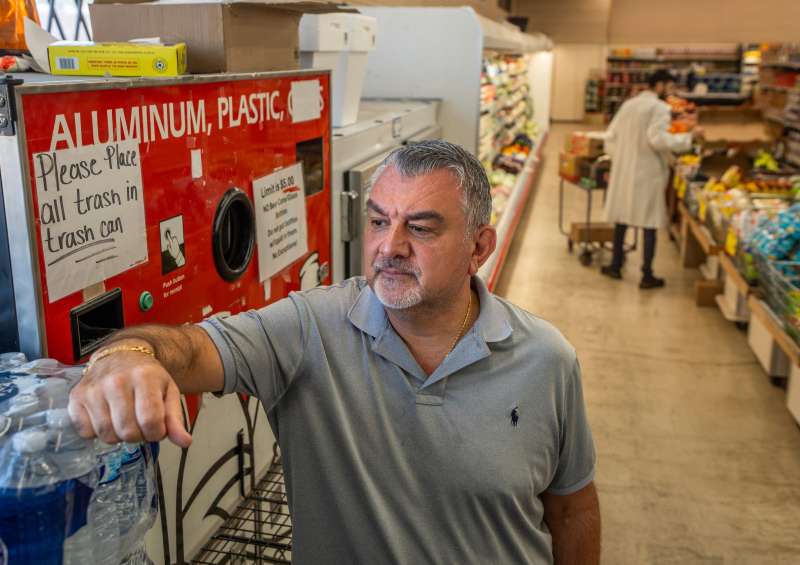
A group of independent retailers in Michigan is looking to make a major fundamental change to Michigan’s 50-year-old bottle and can, 10-cent deposit redemption program: no longer returning the beverage containers to the stores where they are purchased.
It’s a question of hygiene and food safety, says Bill Wild, CEO of the West Bloomfield-based Midwest Independent Retailers Association. The trade organization, operating since 1910, represents more than 1,000 retailers in Michigan affected by Michigan’s so-called Bottle Bill, passed by voters in a referendum in 1976.
“Let’s take the trash out of grocery stores,” he said.
“The state of Michigan kind of turns its head the other way as people are dragging these dirty bottles and cans back into the grocery stores. Most people store these in their garage, or maybe outside. People pick them up on the side of the road or out of garbage cans. There are a lot of pests and garbage and other unsanitary things that are ending up in these bottles and cans.”
MIRA is calling for a two-year sunsetting of the Bottle Bill while a new system is devised that separates bottle and can redemption returns from stores, perhaps through standalone recycle centers or through curbside recycling — which is already a place that bottles and cans are increasingly showing up as deposit-payers decide taking them in for their dime back isn’t worth the effort.
“Our retailers have been dealing with the economic burdens for years, for labor, the machines, the storage space,” Wild said. “Putting that burden back onto the retailer in basically a system that’s a pass-through — they are not making money off of this — it doesn’t seem right.”
A strong start
Michigan’s 10-cent deposit program on carbonated beverage bottles and cans is one of the oldest and most successful such programs in the US The program once boasted redemption rates above 95%, its 10-cent per-can or -bottle return the best in the country.
But a dime doesn’t go as far as it did in the 1970s and ’80s. Redemption returns began to lag, then plummeted beginning in 2020 when Michigan became the only US state to completely shut down bottle and can deposit returns during the COVID-19 pandemic. Statistics kept by the Michigan Department of Environment, Great Lakes and Energy, which regulates recycling in the state, show only 69.4% of deposits were redeemed last year, down nearly 20% from 2019.
John Denha owns and operates four grocery markets in southeast Michigan, including Savon Foods on 7 Mile Road in Detroit; 8 Mile Foodland in Southfield; and Family Foods stores in Detroit and Waterford Township.
“The problem with the empties is that it’s causing a lot of sanitary issues as far as the smell, the insects, the possible rodents,” he said. “Plus, we need to make room for them in our backrooms. And with all the [drink] syrup [residue], the machines need to be maintained.
“If we could get rid of them, it would be cleaner for our stores. I mean, we have fresh meat in the store, and produce right next door. We need to make sure everything is clean in those departments.”
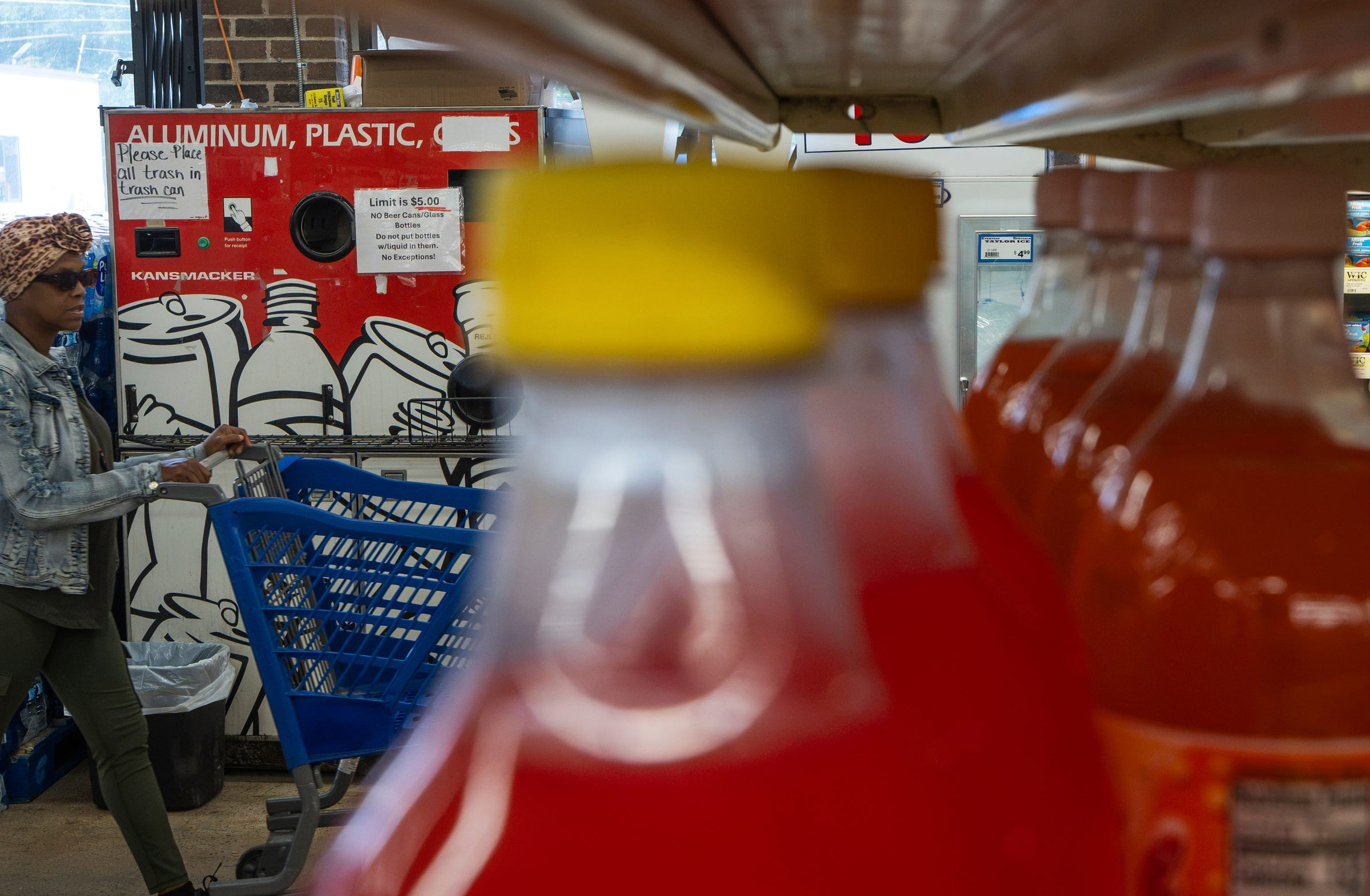
Tammy Koehler owns Honey Bee Market on Bagley Street in southwest Detroit. Unlike larger supermarkets that often have reverse vending machines to take back bottles and cans, her neighborhood grocery still does it by hand — she’s the third generation to operate the store, and said she started there as a child as a bottle and can sorter.
“It actually costs us money,” she said. “We have individuals that have to go through those bags of empties. It takes a lot of time to sort them out. You have the chance of people bringing empties back that are not returnable. Not everyone wants to do the job because it’s a dirty job.”
Koehler echoed the concerns on sanitation.
“You are dealing with a food environment,” she said. “No one wants to see that where they buy their groceries. I just don’t believe that it’s safe, really. It’s not safe for food safety and handing when you are bringing that into a food establishment.”
What other states do
Ten states run beverage deposit programs: Michigan, California, Connecticut, Hawaii, Iowa, Maine, Massachusetts, Oregon, New York and Vermont. States like Oregon utilize organized standalone facilities such as BottleDrop centers run by the Oregon Beverage Recycling Cooperative where consumers can drop off bulk bags. States like California, Hawaii and Connecticut legally license and certify independent redemption processors in separate standalone locations or shopping center parking lots to handle refund values.
Every deposit state has independent or standalone redemption options. Although Michigan’s Bottle Bill allows for such facilities, it still is nearly exclusively reliant upon redeemers being able to take the bottles and cans back to the stores where they purchased them.
That has long caused problems for retailers, said Shelie Miller, a professor in the University of Michigan’s School for the Environment and Sustainability and lead author of a study published last year that evaluated modernizing Michigan’s Bottle Bill.
“Basically, anybody who sells beverages that have a deposit on them are also required to accept them back,” she said. “It does not matter if you are a major superstore or a corner mom and pop shop.”
Large supermarket chains like Kroger and Meijer often have dedicated rooms with reverse vending machines. That comes at a cost, in expensive floor space and labor to address the bottle and can returns, but it allows for better separation between the redemptions and the store’s food for sale, Miller said.
“When you are a smaller retailer, you don’t have much floor space anyway, but you are required by law to take back these bottles and cans,” she said. “Usually you hand count, because it doesn’t make sense to have one of those reverse vending machines. It’s one of those pain points as to where you store these materials … separate the bottle unit from even just the unpleasantness of being a shopper coming in and experiencing beer funk smells.”
Michigan has the capability to operate independent redemption dropoff points in its Bottle Bill the way it’s written now, Miller said.
“I think there is overall support for the idea of having some sort of centralized collection system; but then you get to the question of who pays for it, and how does that actually get funded?” she said.
“When we brought together a consortium of folks throughout the industry, there was generally a consensus that the way the funding mechanisms and the way the dime flows should likely be revisited. Now, how should it be revisited? Everybody has a very different opinion on that.”
By state law, those 10-cent bottle and can deposits that aren’t redeemed, money known as escheat, is sent to the state Department of Treasury, with 25% of the money returned to retailers collecting the containers and 75% given to the Michigan Department of Environment, Great Lakes and Energy’s Cleanup and Redevelopment Fund for environmental remediation and pollution prevention. Some $1 million is also earmarked for a Bottle Bill Enforcement Fund to enforce against scams such as bringing in bottles and cans in bulk from other states and redeeming them for Michigan’s dime — a gambit made famous in an episode of the sitcom “Seinfeld.”
With deposit returns reaching a new low last year, escheat rose to $119.2 million, up nearly 23% from 2022.
It’s a system that doesn’t reimburse retailers for all of their redemption-associated costs — and the more effective they are in getting deposits redeemed, the less money that’s available.
“In a very perfect system where everybody actually brings back their bottles and cans 100% of the time, there is basically no funding whatsoever for anyone in the system to operate anything,” Miller said.
Mackinac Island demonstration highlighted issue
During the 2026 Mackinac Policy Conference held at the Grand Hotel on Mackinac Island, the Midwest Independent Retailers Association (MIRA) conducted public advocacy and a localized demonstration to push for critical updates to Michigan’s bottle return law. They held an event at Doud’s Market, the oldest independent family-owned grocery store in America, operating continuously since 1884.
“We just showed on Mackinac Island what burdens we have placed on these retailers,” Wild said.
With a turnover in leadership imminent in Lansing, MIRA members have also spoken with gubernatorial candidates and other legislative candidates, he said.
“What we find almost universally is, especially when you break it down to the sanitation piece of it, everybody agrees that we’ve got to get this out of grocery stores,” Wild said. “But then the rub is, so how do we do that?
“What MIRA has been trying to do is reach out to the environmental groups and all the stakeholders, because there’s an industry that’s built itself around these bottle returns. And we are trying to bring them to the table on the evolution of the Bottle Bill and the next phase of this.”
This article originally appeared on Detroit Free Press: Michigan food retailers want out of the bottle return business
Reporting by Keith Matheny, Detroit Free Press / Detroit Free Press
USA TODAY Network via Reuters Connect