By Rachel Lewis, Capital News Service
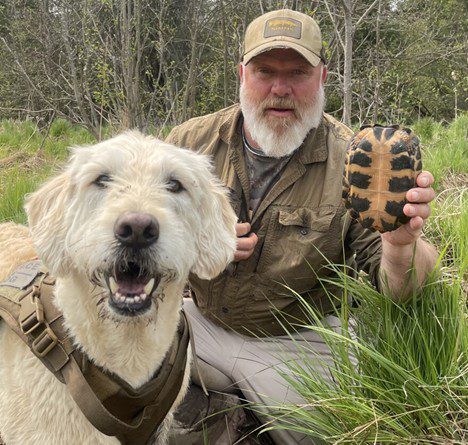
The Little Traverse Bay Band of Odawa Indians’ Natural Resources Department has been working to conserve the threatened wood turtle. Their top team member is Mooz, a 9-year-old labradoodle who has been helping his owner, Bill Parsons, find wood turtles for the past five years.
Parsons is an inland fish and wildlife program manager at the Natural Resources Department and has been researching turtles for over 30 years.
He first learned about using dogs to search for rare animals when he joined an agency that used canines to search for box turtles in 2019. After learning the training process, he realized his labradoodle met the criteria.
Part of the department’s process for tracking wood turtles involves attaching radio transmitters to females to track where they lay their eggs.
Parsons started taking Mooz to the woods, placing him on already found turtles, then rewarding him with a ball. Pretty soon, Mooz could detect turtles on his own, just from their scent.
“He learned very quickly that if he found a turtle, he got to play with his ball,” Parsons said. Now, Mooz is a valued member of the team.
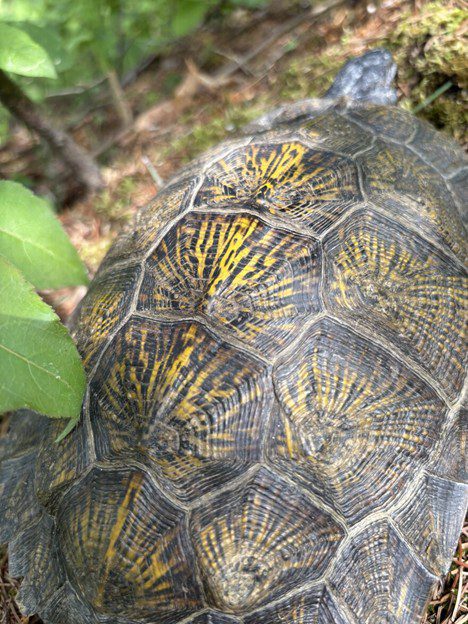
Wood turtles got their name from their uniquely patterned shells. They are usually found in cold and clear fast-flowing streams, according to the Michigan Department of Natural Resources (DNR).
“A lot of the turtles that we find are out visually, that we can see. The dogs fill in the gap and find the ones hidden in the vegetation. The dogs can sniff them out,” he said.
The Odawa tribe ended up hiring a canine handler to help Parsons and Mooz with their turtle search. Now, Parsons and the team instructor, Jake Lammi from Diamond Dog Detection Teams, work together to find wood turtles. During a river walk in May, the pair and their dogs discovered 42 turtles. Parsons said Mooz was responsible for finding 15-20 of them.
“You can tell they’re on the scent of something, and you can see he’s locked in on something that he can smell,” Parsons said. “He’ll indicate on it, and then I will show him the ball and say, ‘Show me.’”
“He will go over and touch his nose to the turtle shell or the vegetation. Once I verify that it’s a turtle, he gets his ball.”
For Mooz, walking in the woods and playing with his ball are the best rewards he could ask for.
“I think if it were up to Mooz, he would come to work with me every day,” Parsons said.
The name Mooz comes from the Anishinaabemowin word for moose.
Parsons said Mooz will often do demonstrations for the Odawa community, showing off his turtle-finding skills. He said wood turtles are culturally significant to the tribe because of their origin story.
“It’s pretty cool that the tribe is willing to spend their money and resources on this type of conservation work. Conservation of culturally significant species is still very important,” Parsons said. “I’m proud and happy to be part of that work that the tribe is committed to.”
The DNR considers wood turtles a threatened species. It says the turtles could become endangered or extinct without conservation efforts.
Tony Henehan, a state wildlife action plan coordinator with the DNR, said there are multiple reasons for the low turtle population, including egg poaching and people taking turtles off the side of the road.
“Some studies have shown that if you take even two adult turtles out of a population every year, after 10 or 20 years, that population will be extinct,” he said. “I know folks get concerned when they see turtles in a place where maybe they think the turtle doesn’t belong, but for the most part, that turtle is there for a reason.”
For wood turtles specifically, one of the biggest threats is raccoons, which are known for digging up and eating the turtle eggs.
“We’ve had increases in raccoon population sizes,” Henehan said. “We’re seeing adult turtles on the landscape. They’re able to survive, but their babies are not surviving or they’re not laying new eggs or the eggs are getting eaten.”
By attaching radio transmitters to the turtles found in Parsons’ surveys, his team can find where the eggs are laid and put wire cages over the nests, blocking access to the raccoons.

“After a couple of years of these surveys, Bill has shown the efficiency of using dogs to find these turtles, which is one of the most important components of any kind of survey for rare species, being able to find them,” Henehan said.
Henehan said that while the DNR doesn’t currently use dogs for its turtle research, Parsons’ success has been inspiring.
“We’re going to be working with Michigan Natural Features Inventory on researching whether you can use dogs to find the eastern massasauga rattlesnake (hibernation) dens because those are very hard to find. And so, we’re already thinking about other ways to incorporate dog work into rare species work, given some of the successes that the turtles have had.”
Parsons said Mooz isn’t planning on retiring anytime soon.
He has been taking classes with Lammi to learn how to sniff out guano, or waste, from a rare bat species that has had a population crash because of white nose syndrome. Parsons also said he has a younger labradoodle, whom he is working on training to find rare animals as well.
“It’s a lot of fun. I love my job, but I could see doing this full time too,” Parsons said. “Being able to get paid to go out in the woods and catch turtles with your dog is kind of like a dream come true.”
Rachel Lewis reported this story as part of a collaboration among Capital News Service, Michigan Public, the Mott Foundation and MSU’s Knight Center for Environmental Journalism.