The story of Northwest Airlines Flight 2501.
I recently took a trip out of state to visit family. As my plane flew over Lake Michigan, I was inspired to write this week’s topic.
Looking down from the tiny window of the Airbus I was flying in, I was captivated by the sheer size of this body of water and reminded of its tremendous power and the mysteries it holds.
It’s well known that the Great Lakes are home to a great deal of shipwrecks.
Some of these stories—like the sinking of the SS Edmund Fitzgerald—have become defining moments in Michigan lore.
But being on a plane, my mind raced to a more morbid question—has a plane ever crashed into Lake Michigan?
To my surprise, the answer is yes. And at the time, it was the deadliest commercial airliner accident in America.
Read on for the details.
The disappearance of Northwest Airlines Flight 2501
This story doesn’t start in Michigan, but in New York.
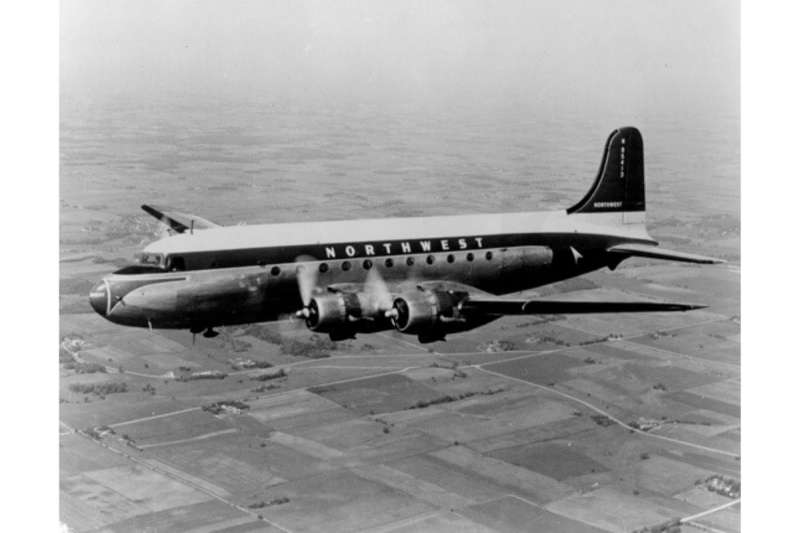
On the evening of June 23, 1950, Northwest Airlines Flight 2501 was set to depart from LaGuardia Airport in New York City for its daily transcontinental service to Seattle with a scheduled stopover in Minneapolis.
While the skies were clear in New York, the plane‘s pilot, Captain Robert C. Lind, had been advised of storms over Lake Michigan, but since other planes hadn’t reported severe turbulence, the plane was cleared for takeoff.
The plane—a Douglas DC-4 airliner carrying 55 passengers, including six children and three crew members—departed at 7:30 p.m.
According to Michigan Shipwreck Research Association co-founder Valerie van Heest, who has researched and written about the incident extensively, the DC-4 passed over Battle Creek at 11:51 p.m., flying at 3,500 feet—at this point, entering the storm front. Lind advised air traffic control that he’d pass over Milwaukee in 46 minutes.
Just after midnight, at 12:13 a.m., as the DC-4 was near Benton Harbor, Lind requested a descent to 2,500 feet. Air traffic control, however, denied the request due to other traffic in the area.
Lind’s request would be the last communication from the flight.
A search for answers
The next morning, as it became clear that something had gone terribly wrong, a widespread search began for the missing plane. The US Navy, US Coast Guard, and State Police from Illinois, Michigan, Wisconsin, and Indiana were all involved in the mission. Efforts included using sonar and dragging the bottom of Lake Michigan with trawlers, though they were unsuccessful.
A New York Times report from June 25 read:
A Northwest Airlines DC-4 airplane with fifty-eight persons aboard, last reported over Lake Michigan early today, was still missing tonight after hundreds of planes and boats had worked to trace the craft or any survivors. … If all aboard are lost, the crash will be the most disastrous in the history of American commercial aviation. … In Minneapolis, Northwest Airlines said the craft was ‘presumed to be down,’ and that they were beginning notification of relatives of passengers. In his last report, Captain Lind requested permission to descend from 3,500 to 2,500 feet because of a severe electrical storm which was lashing the lake with high velocity winds. Permission to descend was denied by the Civil Aeronautic Authority because there was much more traffic at the lower altitude.
While divers were never able to locate the plane‘s wreckage, oil slicks, debris, upholstery, and human body fragments were found floating on the surface of the lake.
In January 1951, the Civil Aeronautics Board issued a final report on a hearing over the plane‘s disappearance, concluding that a cause for the accident couldn’t be established. However, it determined the probable location of the crash was 18 miles north, northwest of Benton Harbor—far from any established airway.
To add to the mystery, several newspapers reported that eyewitnesses on the ground saw the plane shortly before its disappearance. One gas station owner in Glenn reportedly heard the plane‘s motors “plunk” twice and saw a “queer flash of light” as it flew over the area.
Recent developments
While investigating the flight in 2008, Michigan Shipwreck Research Association affiliate Chriss Lyon found an unmarked grave containing the remains of some of the plane‘s victims at a St. Joseph–area cemetery. According to van Heest, the remains were buried after washing ashore and without notification of the victim’s families. Later that year, a ceremony was held at Riverview Cemetery with some family members of the victims in attendance. A granite marker was placed at the site of the grave, listing the names of those aboard and the words: “In Memory of Northwest Flight 2501, June 23, 1950. Gone but Never Forgotten.”
Another mass grave was found in 2015 at Lakeview Cemetery in South Haven. Similar to the site in St. Joseph, a ceremony honoring the victims was held shortly after.
Since 2004, the Michigan Shipwreck Research Association has conducted an annual search to find the missing plane‘s wreckage. While the wreck of Flight 2501 remains to be found, these searches have uncovered several shipwrecks.