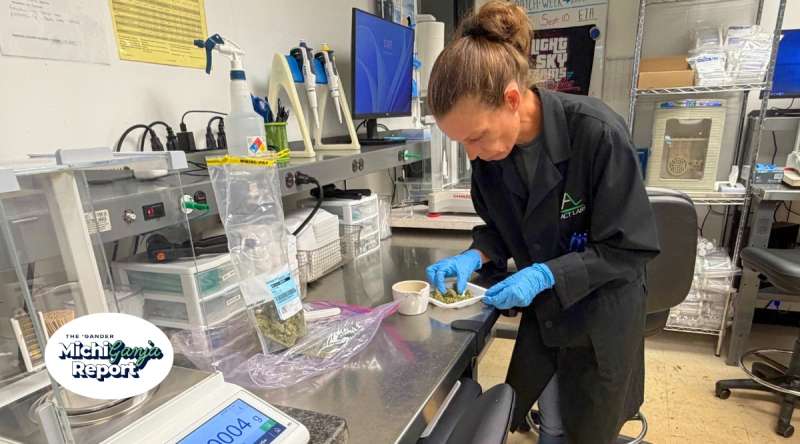
LANSING—You’re browsing the online menu for your local dispensary, sorting products from the highest THC to the lowest. You usually pick something near the top of the list. Most people do.
Amber Middlebrook wishes you wouldn’t.
Middlebrook is regional director at ACT Lab, a Lansing-based cannabis testing company whose machines are used to produce the same number that many Michiganders use to shop for weed.
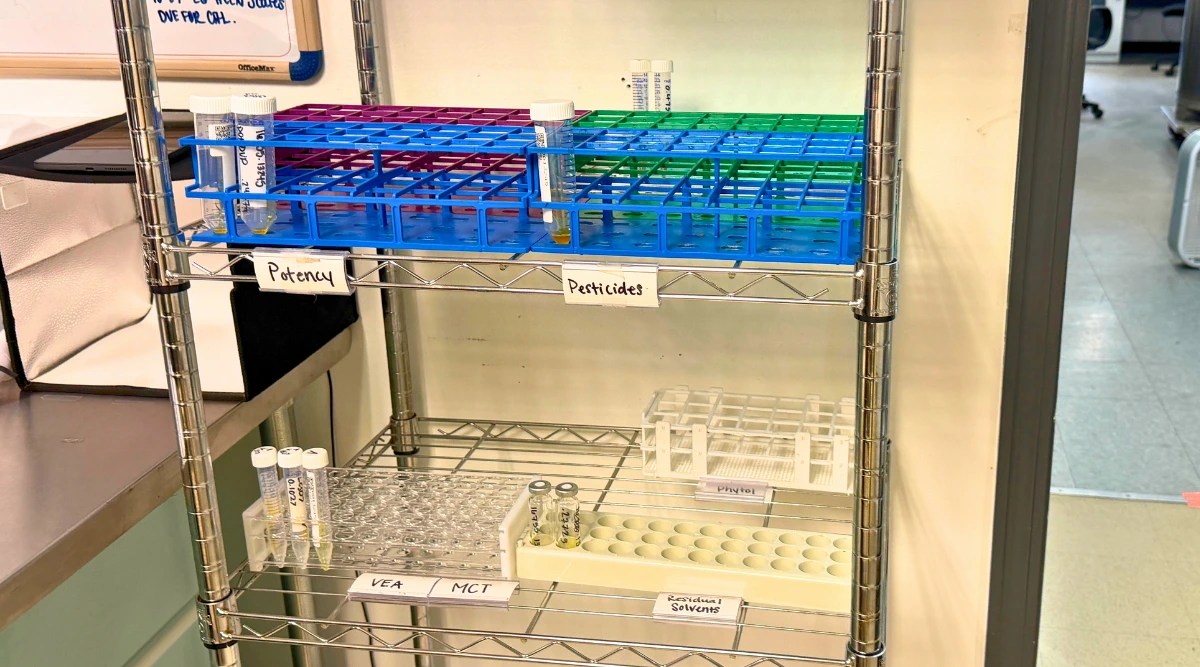
Every gram sold legally in Michigan passes through a lab like this first—screened for pesticides, heavy metals, solvents, mold, and potency. The state requires the THC number on the package.
Middlebrook has spent years watching Michigan’s cannabis industry rearrange itself around it. She thinks it has made the product worse.
“We’ve shifted our market to grow for THC, which doesn’t mean it’s the best product,” Middlebrook said during a tour of the Lansing facility. “We are eliminating things from the plant.”
How did one number take over?
Middlebrook laid out how the problem works—and it all starts with you.
All too often, customers walk into a dispensary and ask for the strongest thing on the shelf, looking only at the THC percentage. The budtender sells it. The dispensary, watching what moves, stocks more and pays a premium for it. The growers plan their next harvest around it.
“So that can really shift the market,” she said. “People can start utilizing that data to start growing a product that meets the customer’s demand. And they get tunnel-visioned on THC.”
What usually gets lost, Middlebrook said, is everything else in the plant—the terpenes and minor cannabinoids that shape how any given strain actually makes you feel. ACT Lab tests for 57 different terpenes. But those test results rarely get printed on the package, she said.
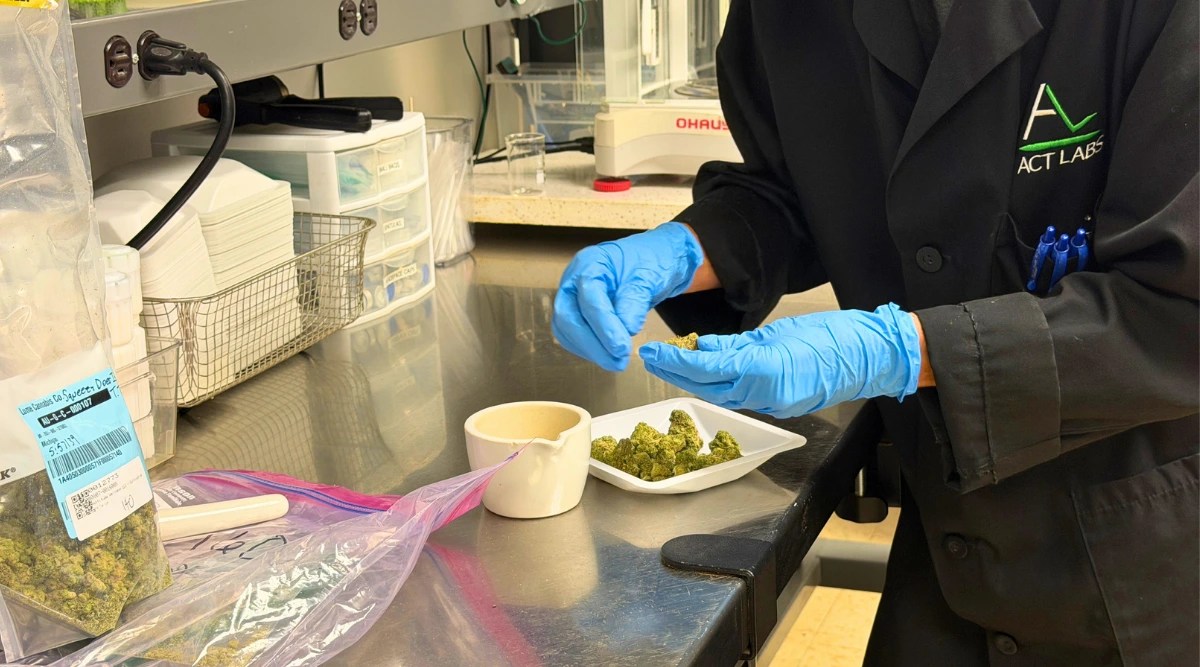
Middlebrook, who uses cannabis herself, said a higher THC number doesn’t necessarily translate to a better high. She has smoked 30% THC flower—yes, it exists—and felt almost nothing. But she’s also smoked 16% THC flower and, in her words, wondered where she was.
“That’s the entourage effect that everyone talks about,” Middlebrook said.
And her concern runs further than any single purchase at the dispensary counter. Middlebrook compares what’s happening to Michigan cannabis to what domestication did to the potato and the apple: a plant reshaped over generations based purely on what makes the most money.
“We are essentially changing the future of cannabis by the direction this is taking,” she said.
Who is producing the number?
ACT Lab was founded in 2011 by Jeff Nemeth, a Michigan entrepreneur who, according to Middlebrook, turned to cannabis after a car accident left him in chronic pain and on opioids.
The first lab didn’t open in Michigan. Licensing in Lansing proved slow, and the company opened in Illinois instead. Today, ACT now runs several testing facilities across eight states, including a recent acquisition in New Jersey, plus its first European location in Denmark.
The Lansing operation is not the company’s largest facility. It’s just the corporate headquarters with a lab attached, housed in a building the company has already expanded twice. During the upcoming outdoor harvest season, more than 400 samples a week will come through the door.
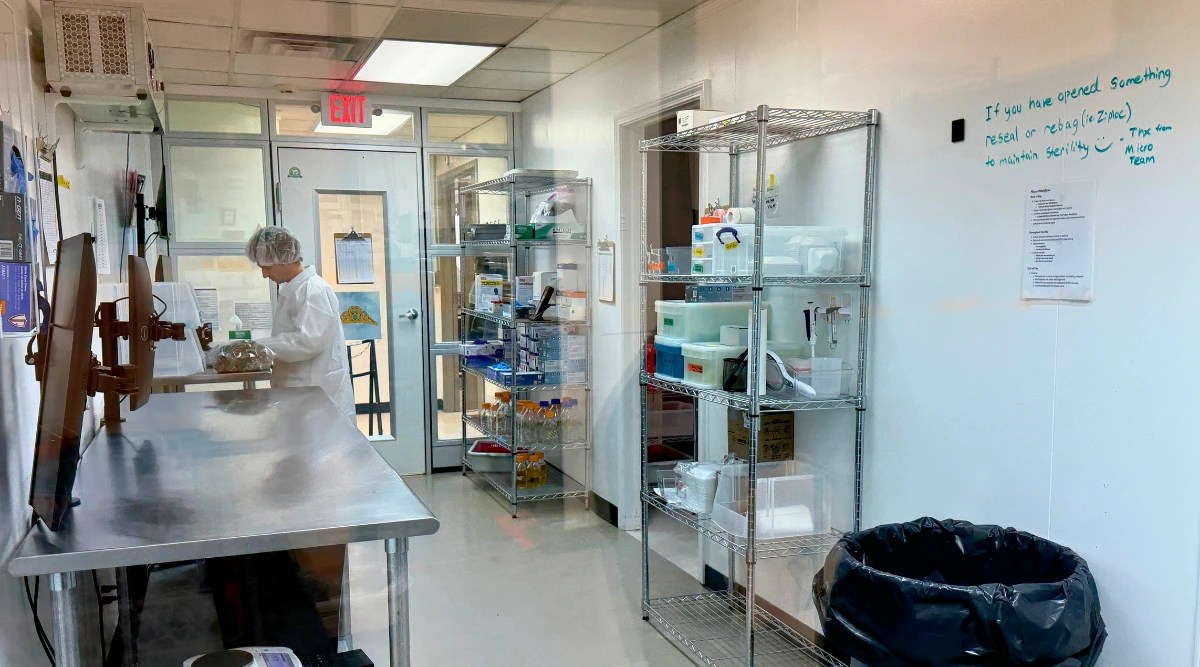
The lab itself is unremarkable. It’s a series of sterile rooms, filled with high-tech instruments, screens, and technicians preparing samples for testing and tapping away on keyboards.
ACT Lab describes itself as having a single private ownership structure. In practice, the Lansing company is majority owned by Intrinsic Capital Partners, a Pennsylvania private equity firm whose other cannabis holdings include retail software and a breathalyzer company.
Why did Michiganders stop trusting the numbers?
Michigan consumers have a reason to distrust the system.
In 2021, state regulators issued the largest recall in the state’s history after finding problems with testing at Viridis Laboratories—pulling an estimated 64,000 pounds of product from shelves. Growers sued. Many consumers started to question the numbers on the package.
Asked what that episode cost ACT Lab, Middlebrook’s answer was immediate.
“I don’t think it cost us anything,” she said. But the immediate consequence, however, was a need for additional staffing.
ACT Lab had to fly people in from Pennsylvania, Illinois, and Ohio to handle the flood of products that suddenly needed retesting to get back on the Michigan market. For Middlebrook, it was a lesson in proper documentation and in how quickly a lab’s reputation can disappear.
“We’re all in the same waters,” she said.
What happens when a grower doesn’t like a number?
The THC numbers can vary for a reason that has nothing to do with the science.
When a cannabis company doesn’t like a particular compliance result or the THC numbers on a harvest, they can simply send the product to another laboratory and try again, Middlebrook said.
“There’s nothing that’s preventing them,” she said.
That’s the practice the industry calls “lab shopping,” and it’s not considered cheating. .
Middlebrook said one large grower called her recently with the same product tested twice—26% at one lab and 31% at another—wanting to know which results to believe. She said she couldn’t tell him which was right. Some variation in testing is unavoidable, she said. No two buds ever produce identical results. But a five-point spread can be a real problem.
Michigan’s response is supposed to be a state-run reference laboratory that would set a benchmark and audit all 19 of the state’s private labs against those standardized results.
The state has funded the laboratory since 2024 and even hired a director, Claire Patterson. But it still cannot accept a sample—namely because cannabis remains federally illegal and the Michigan Legislature still hasn’t passed a bill giving the state facility explicit authority to possess it.
That legislation cleared the Senate 34-1 in March. It has sat in a House committee since April.
Middlebrook testified in support of it.
“It’s all about bettering ourselves,” Middlebrook said.
Whose problem is it?
Asked directly whether a laboratory like ACT Lab that produces the numbers also bears any responsibility for what those numbers are doing to the market, Middlebrook pointed elsewhere.
“That’s regulatory,” Middlebrook said.
The state requires potency on the label; ACT provides the data cultivators order. What happens next is all up to the state, the growers, the processors, and the customers themselves, she said.
“We need more educated consumers,” Middlebrook added. “And where does that start? It starts with us as consumers—with our voice and what we’re asking for at the dispensary.”
Instead of the THC number, she suggests paying attention to what a product actually does.
Some consumers keep a journal—what they bought, the terpene profile, and how it made them feel—and buy toward the pattern. She does a version of this herself. There are strains she won’t touch, she said, because she wants to feel comfortable in her own skin rather than in space.
Before data, she said, people bought weed purely on presentation.
And the nose still knows.
“I think data’s important,” she said. “But not everything. Not all data is important. You have to be able to filter appropriately. … Take ownership and responsibility over your own life choices.”
READ MORE: 5 quick hits of cannabis news from across Michigan

Want more Michigan cannabis news, product picks, and culture? Click here to sign up for The MichiGanja Report, our free weekly newsletter about all things marijuana.