
MICHIGAN—For months, the cannabis industry warned state lawmakers about what would happen if they passed a 24% wholesale tax on marijuana: sales would fall, businesses would close, workers would lose jobs, and the state would collect far less revenue than projected.
Lansing didn’t listen. So, here we are.
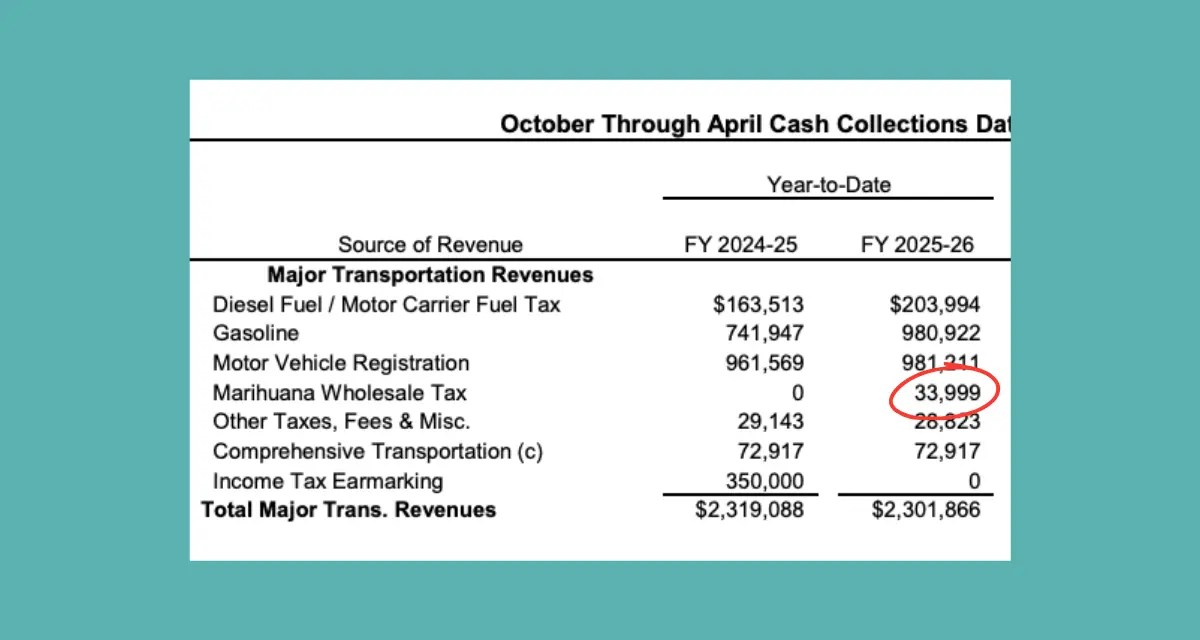
A report released this month from the state Treasury confirms what the industry predicted all along. In the first three months of 2026—the first full quarter under the new tax—the state collected just under $34 million from its new wholesale levy, far short of the $105 million it anticipated.
And at the current pace, the controversial new wholesale tax could end up leaving Michigan nearly $300 million short on road funding this year—with no clear plan to fill the gap.
“This so-called road funding plan has failed exactly as the cannabis industry said it would,” Robin Schneider, executive director of the Michigan Cannabis Industry Association (MICIA), said in a press release. “Our elected leaders made the cannabis industry a sacrificial lamb in order to have the illusion of a road funding fix. In reality, the only thing they have accomplished is the decimation of a strong industry that served as an economic driver for this state.”
How did we get here?
Michigan’s new 24% wholesale cannabis tax was passed last year to help avert a state government shutdown. It was billed by Gov. Gretchen Whitmer as a way to raise an estimated $420 million a year to help cover road and bridge maintenance throughout the state.
Because the cannabis industry already faced a 10% state excise tax and a 6% state sales tax, the new levy pushed Michigan’s effective cannabis tax rate to among the highest in the country.
Meanwhile, the industry was already battling against oversupply, collapsing wholesale prices, and razor-thin profit margins. Industry leaders predicted the tax would only make things worse.
How’s that working out?
Not great.
Recreational cannabis sales have dipped. More than 900 licenses have gone inactive since adult-use sales began in Michigan. And layoffs and facility closures have been accelerating.
The MICIA says the damage is exactly what it predicted. The industry group has long argued that stacking a new wholesale tax on top of existing state taxes would shrink the legal market and push consumers back toward the illicit market—and that the state would ultimately collect less tax revenue as a result. The first quarter’s numbers suggest they may be on to something.
Meanwhile, the state’s cannabis businesses are still getting squeezed from both directions.
Businesses that are paying the tax are absorbing higher costs and thinner profit margins, while delinquent operators—who reportedly face no real consequences until at least January 2027—can keep prices artificially low and undercut everyone who is playing by the rules.
What now?
The Michigan Cannabis Industry Association is fighting the tax on two separate legal fronts. Its latest lawsuit filed in March argues the wholesale tax is actually an illegally disguised sales tax.
Both cases are still working their way through the courts.
On the legislative side, a bipartisan repeal bill sponsored by Sen. Jonathan Lindsey (R-Coldwater) has been introduced and referred to the Senate Government Operations Committee, where leadership reportedly tends to park measures it has no intention of moving.
The issue is also spilling into this year’s governor’s race. Genesee County Sheriff and Democratic gubernatorial contender Chris Swanson, so far, is the only candidate in the race who has publicly pledged to repeal the wholesale cannabis tax if elected in November.
The bottom line
An industry that created 40,000 jobs and generates hundreds of millions of dollars annually for the state was handed a bill it couldn’t pay—all to patch a funding gap that Lansing couldn’t solve. The roads still aren’t fixed. The industry is bleeding. And the leaders who pushed this tax are probably going to have to head back to the drawing board whether they want to or not.
READ MORE: 7 quick hits of cannabis news from across Michigan

Want more Michigan cannabis news, product picks, and culture? Click here to sign up for The MichiGanja Report, our free weekly newsletter about all things marijuana.