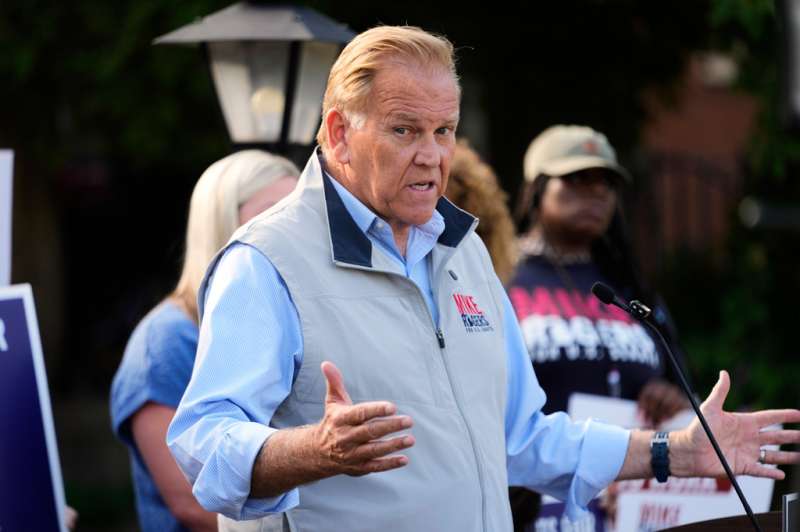
After retiring from public office over a decade ago, former Republican Rep. Mike Rogers is back (again)—and he’s asking Michigan voters to send him back to Congress this fall.
Rogers represented Michigan in Congress from 1995-2001 and then served the state’s eighth congressional district, which represents areas of Midland, Saginaw, and Flint, from 2001-2015. He tried to secure a Senate seat in 2024, but narrowly lost to Democrat Rep. Elissa Slotkin. Rogers is now slated to take on Democrat Abdul El-Sayed during the general election on Nov. 3.
Related: Rogers vs. El-Sayed: Michigan could decide which party runs the US Senate
If elected, Rogers promises Michiganders that he will “lower costs, protect our families, [and] defend our freedoms.” But some Michiganders aren’t convinced, citing Rogers’ conservative legislative track record while in office and the relationships he’s built with wealthy elitists since retiring from his role as a lawmaker in 2015.
To help put the pieces together for voters old and new, here are three things Michiganders need to know about Mike Rogers before they fill out their ballots.
1. Mike Rogers has voted 14 times to weaken Medicaid.
Throughout his previous congressional career, Rogers voted 14 times to weaken Medicaid, contributing to roadblocks for low-income families across Michigan who needed access to critical healthcare.
This includes a ‘yea’ vote from Rogers in 2003, which passed a budget bill that cut $92 billion in federal Medicaid funding. In 2011, Rogers voted in favor of cutting an additional $700 million from Medicaid by turning the system into a block grant program, allowing the federal government to give states a fixed amount of money for healthcare instead of paying a matching percentage based on the actual costs the state accrues.
Two years later, alongside other Michigan Republicans likeRep. Bill Huizenga of the 4th congressional district, Rogers voted in support of an amendment that required congressional approval for all rules under the Affordable Care Act (ACA). The amendment further delayed the law from being enacted and prevented over one million uninsured Michiganders from accessing affordable healthcare at the time.
In more recent interviews, despite pushback from local Michigan families who rely on the ACA to afford essential healthcare, Rogers has said that he’s committed to “phasing out” ACA subsidies and would vote against any compromise to extend them if elected to the Senate.
Rogers has also publicly called the passage of the Republican-backed reconciliation bill that was signed into law by President Trump last year a “monumental victory,” despite reports that further federal funding cuts to Medicaid would (and later did) put Michigan hospitals and other health organizations at risk.
Today, as a result of these decisions, thousands of Michiganders have lost their Medicaid coverage, and over 130,000 dropped their ACA healthcare coverage after premiums increased.
Video: Why Michigan hospitals are quietly panicking right now
2. Mike Rogers has consistently supported laws that attack Michiganders’ reproductive rights.
A majority of Michiganders support abortion rights, and new research reveals that abortion remains a major issue for voters in states like Michigan during the current election cycle.
In recent years, Rogers has echoed Trump’s position that abortion policies should be left up to individual state governments, and has said that he wouldn’t support federal proposals and policies that he called “inconsistent” with Michigan law.
However, some Michiganders remain unconvinced given Rogers’ lengthy track record of opposing reproductive rights during his 14-year career representing Michigan in the US House of Representatives.
Related: Mike Rogers tries to distance Senate campaign from his anti-abortion record
After completing a candidate questionnaire for the Michigan Catholic Conference during his campaign in 2000, Rogers said that he supported an initiative known as the “Human Life Amendment,” which would ban abortion from the moment of conception and enshrine fetal personhood in the Michigan Constitution.
Two years after he was elected to office, Rogers co-sponsored 2003 legislation that intended to suspend the US Food and Drug Administration’s earlier approval of mifepristone, a drug used for medication abortions. While the legislation never came to the House floor for a vote, that didn’t stop Rogers from reintroducing the legislation a second time in 2005—and receiving the same result as before.
After his reelection in 2012, Rogers voted alongside Republicans for a bill that would’ve banned most abortions without exceptions for rape or incest. While that bill failed in the House, Rogers co-sponsored legislation alongside US Rep. Jim Jordan (R-Ohio) a year later that sought to ban and criminalize abortions across the US.
That legislation never made it to a vote. Rogers later voted in support of another anti-abortion bill in 2013 that aimed to ban abortions after 20 weeks, with limited exceptions. That bill passed the US House, but did not pass through the US Senate.
And while Rogers has been out of office for several years, he’s continued to make his stance as a self-proclaimed “pro-life candidate” clear. In 2023, after moving to Florida, he told reporters that he would’ve voted against Proposal 3—which cemented the right to reproductive freedom, including abortion care, into Michigan’s Constitution in 2022—if he had still been a resident of the state.
Watch: Anti-abortion group spending $4.5M to elect Mike Rogers in Michigan
3. Mike Rogers has tried to restrict the rights and freedoms of individuals in the LGBTQ+ community.
As transgender youth and other members of the LGBTQ+ community face backlash from the Trump administration and Republican allies, Michiganders are digging into Rogers’s decades-long record of opposing LGBTQ+ rights ahead of the election on Nov. 3.
In 2004, Rogers said that denying gay people the right to marry wasn’t discriminatory because “they’re claiming a right that has never existed” and that “polygamists argue the same case” in a statement to the Livingston County Daily Press and Argus. He also voted several times against marriage equality while in office.
Rogers has also tried to restrict or outright remove other rights designed for LGBTQ+ individuals, including voting against the Employment Non-Discrimination Act, a federal law passed in 2007 that prohibited employment discrimination based on sexual orientation.
He later voted against the repeal of “Don’t Ask, Don’t Tell,” which barred LGBTQ+ individuals from openly serving in the military.
Watch: Mike Rogers puts bigots at center of his MI “faith” team
In recent years, Rogers has voiced his support for legislation aimed at banning transgender athletes from participating in sports that align with their gender identity. During his 2024 Senate campaign, Rogers joined former US Education Secretary Betsy DeVos and anti-trans activist Riley Gaines during an event in Oakland County.
While scientists have repeatedly debunked the belief that transgender individuals should be excluded from participating in sports, that didn’t stop Rogers from signing a pledge at an event created by the Independent Women’s Voice—the political action arm of one group that was on the advisory board for far-right policy blueprint Project 2025—to “uphold legislation that preserves female opportunities and private spaces.”
Rogers will take on Democrat Abdul El-Sayed during the general election on Nov. 3.
To check your voter registration, see your ballot, or find your polling location, go to gandernewsroom.com/voter-registration.