MASON—Michiganders have spent the last year fighting data centers township by township, meeting by meeting. Will Lawrence thinks that fight is too small.
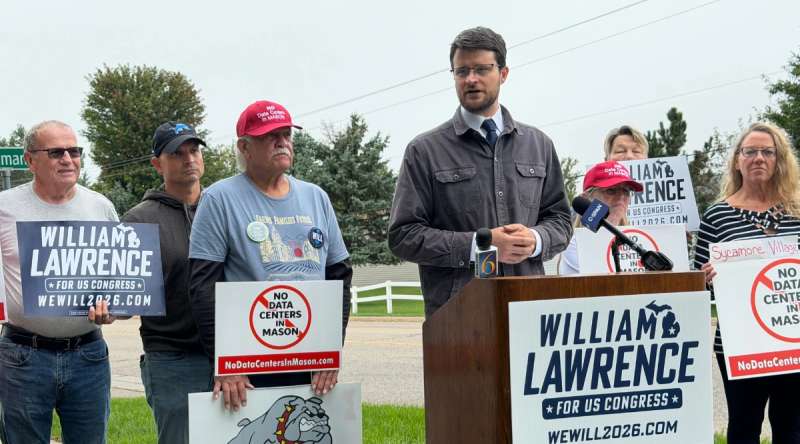
Standing near the site of a proposed hyperscale data center in Mason, the Democratic candidate running in Michigan’s 7th Congressional District on Thursday released a plan that goes well beyond the township-by-township fight. He wants to halt new data center construction across the country, halt the development of advanced artificial intelligence models along with it, and then tax the industry’s profits to fund a jobs program for the workers it leaves unemployed.
Lawrence calls it “STOP”—the Stop Tech Overreach Plan.
“AI development is out of control,” he said at this week’s announcement, flanked by several of his supporters. “Tech billionaires are bulldozing towns and farms to build data centers to make themselves even richer. They’re threatening Michigan jobs. They’re driving up our energy costs, harming our property values, and threatening our air and water.”
The plan has two steps. The first is a pause. The second is a rulebook.
Step One: Stop building
Specifically, Lawrence is calling for an immediate federal moratorium on all new data center construction while Congress has a chance to write some enforceable rules on the industry.
His argument is largely the same one that residents in Mason have been making for the last year. Data centers consume enormous amounts of electricity and water. They arrive with tax exemptions attached. And under Michigan law, local governments have limited power to say no.
Lawrence pointed to the massive Stargate project in Saline Township as the cautionary tale, describing a case where developers filed lawsuit after lawsuit until the project was approved.
“The power imbalance was such that the township had to fold,” Lawrence said on Thursday. “That’s why we need a federal moratorium to respond to the calls of residents across the 7th District, to put a stop to this, and then set regulations in place that will level the playing field.”
The plan also calls for a moratorium on the development of advanced AI models themselves.
In recent weeks, AI researchers have warned their own products are at risk of slipping out of human control. At the press conference, Lawrence framed it as a product safety question.
“We’re hearing from the experts that AI models threaten to kill all of humanity. They say maybe a 10% chance that that could happen,” he said. “Even if there’s a 1% chance, that’s too great. We have consumer protection laws in place that prevent even 0.1% of a fatal incident from taking place with a product on the consumer market. These AI models should be no different.”
Step Two: A national AI compact
If the moratorium is the brake, Lawrence’s compact is the steering wheel.
The centerpiece is a New Deal-style national jobs program funded by a tax on AI profits and tech billionaire wealth. His plan says those jobs could include caring for the elderly, improving public lands, restoring wetlands, and staffing community centers. They would be union jobs, with apprenticeships aimed at recent graduates and mid-career workers displaced by automation.
Lawrence was blunt about why he thinks that piece is urgent: the industry’s failure scenario, he said, is catastrophe. But even its stated success scenario would create mass unemployment.
“Maybe they’ll kill everybody by accident, but the success scenario is that tens of millions of people will be put out of work,” Lawrence said. “That’s how they’re selling their product.”
The compact also includes:
- “Humans only” decisions. AI couldn’t autonomously drop a bomb, hand down a sentence, or deny a medical claim, and couldn’t be the final word on hiring or firing.
- No AI bailouts. If the sector crashes, no taxpayer rescue.
- No sacrifice zones. Zoning buffers, environmental standards, an end to tax giveaways, and compensation for communities that do agree to take on a data center project.
- Union labor. Data centers that do get built get built by skilled union crews.
- Limits in schools. No AI in elementary school; tight restrictions through high school.
- No AI surveillance. An end to warrantless tracking via Flock cameras and similar tools.
- Safety rules. Independent review of new models, firm standards, and liability for AI labs.
- A treaty process. Begin talks with other global powers on setting international AI rules.
Lawrence also returned repeatedly to what he described as a risk to a generation’s basic capacities: “Our basic skills of critical thinking, reading and writing are very much at threat. We could experience a whole generation of learning loss if we don’t put a stop to this right now.”
It’s worth noting: Lawrence’s plan overlaps substantially with a 22-point platform released by Democratic US Senate candidate Abdul El-Sayed. But they differ on the public ownership of AI.
El-Sayed’s platform would build on US Sen. Bernie Sanders’ proposal to move equity in the largest AI companies into public hands, with democratically elected boards and mandatory public benefit charters. Lawrence said he’s open to the idea but stopped short of endorsing it.
“It’s something that we should be looking at, but I am concerned about that being a backdoor to a bailout of irresponsible investment decisions,” Lawrence told reporters this week. “So it’s not something that’s off the table, but it’s not something I’m ready to fully embrace at this time.”
Checking the receipts
Lawrence has been railing against data centers for at least a year. He’s delivered public comment in Lyon Township, Mason, Williamstown Township, and Lansing. His debut TV ad of the Democratic primary was about data centers—filmed near the site of this week’s press conference—and he was among the first candidates nationally to call for a federal moratorium.
Earlier this month, he also became the only Michigan candidate to sign the AI Pact.
Barrett, like other Republican lawmakers, has repositioned himself as a data center skeptic who favors leaving decisions to local communities. But his voting record cuts the other way.
Barrett voted for the One Big Beautiful Bill Act, which included $83 billion in tax breaks for data centers and, in earlier versions, provisions that sought to block state and local governments from regulating AI. He also backed the SPEED Act, which would scale back environmental reviews for such projects. Federal filings show he has also taken campaign contributions from Big Tech investors and from corporate PACs tied to Google, Amazon, Microsoft, and Oracle.
Lawrence’s campaign puts the figure from data center developers and allied interests at nearly $1 million across the 2024 cycle, including support from a super PAC funded by Elon Musk.
“Tom Barrett voted to give billions of dollars in tax breaks to build data centers while cutting our health care to pay for it,” Lawrence said at this week’s press conference. “It’s no surprise that he did that after the AI developers spent nearly a million dollars to get him elected in the last cycle.”
When asked the question that follows every call for an AI pause—that China will build it anyway, so a US moratorium would only cede ground—Lawrence pivoted his response to democracy.
“The biggest risk would be to disregard our own democratic principles by overruling the clear mandate of the people of this district and the country, which is to put a pause on AI data centers and advanced AI development because it’s not safe for the American people,” Lawrence said.
Lawrence’s full plan is available at wewill2026.com/ai.
READ MORE: How many AI data centers are planned in Michigan? We counted.