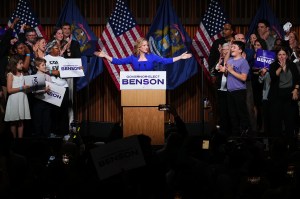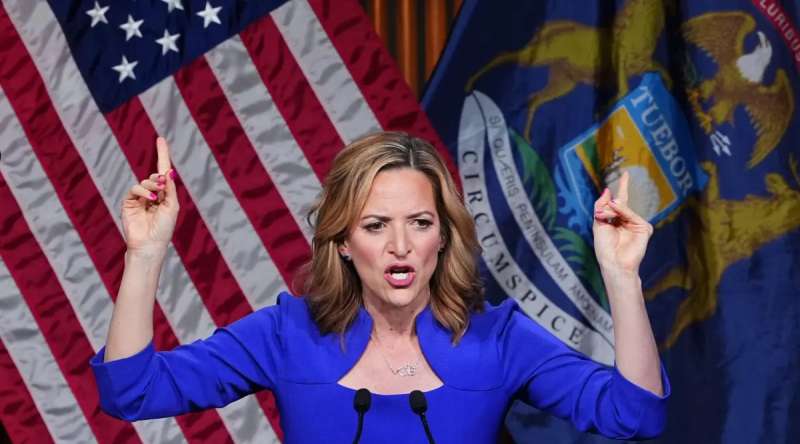
MICHIGAN—Jocelyn Benson already knows the first legislation she wants to sign as governor.
It’s the Michigan Voting Rights Act, a package of bills that would write new protections against voter discrimination into state law after the US Supreme Court stripped away a key part of the federal Voting Rights Act in April. And for some Michiganders, it may sound familiar.
Democrats have now tried to pass this legislation twice before, and both times it stalled in the state House. But in January, Benson will take control of the governor’s office and Democrats will lead both chambers of the state Legislature for the second time in more than four decades.
Benson reportedly first made the pledge in October at a campaign event for state Sen. Kevin Hertel (D-St. Clair Shores), where she said “the first bill I will sign is a Voting Rights Act.”
Incoming legislative leaders also say they’re on board to make it a priority in 2027.
“I’m sure it’s going to get done,” incoming House Speaker Ranjeev Puri (D-Canton) told WLNS.
Why does Michigan want its own protections?
In 2013, the US Supreme Court gutted Section 5 of the Voting Rights Act, which required certain states with histories of discrimination to get federal sign-off before changing their election rules.
And this year, the court also dismantled Section 2. That provision was the main tool courts used to block election laws that hurt minority voters, even when discrimination wasn’t the explicit goal.
The Michigan Voting Rights Act is designed to rebuild those protections at the state level, creating what officials at the ACLU of Michigan have described as a “civil rights firewall.”
Twelve states, all led by Democrats, already have their own voting rights acts in place, according to Votebeat. Michigan would be the first true swing state to join them.
What would change at the polls?
The latest iteration of the Michigan Voting Rights Act hasn’t been introduced yet.
But the legislation is expected to closely track the four-bill package—Senate Bills 961–964—that passed the state Senate along party lines in June. That version would:
- Ban state and local governments from adopting rules that curb voting access for certain groups, including racial and language minorities, and let voters sue when they do.
- Allow courts to order fixes, including redrawn district maps and procedural changes.
- Require translated ballots and election materials in more communities—including Arabic, the state’s third-most-spoken language, which federal law doesn’t cover.
- Codify curbside voting into state law, let voters bring their own translators to the polls, and allow people to hand out food and water to voters who are waiting in line.
- Create a nonpartisan voting and elections institute to track and publish election data.
The bills would also build on a trend Michigan voters started themselves. Since 2018, they’ve approved ballot measures creating automatic voter registration, no-excuse absentee voting, Election Day registration, and early in-person voting. More than 4.8 million Michiganders voted this month, setting a new state record for midterm turnout, according to the certified results.
Third time’s the charm?
Democrats first introduced the Michigan Voting Rights Act in 2023, the last time they controlled all of state government. It sat in committee for almost a year, passed the state Senate in September 2024, and then died in the state House during a chaotic lame-duck session.
State Senate Democrats, led by state Sen. Darrin Camilleri (D-Trenton), tried again this May. The Senate passed the package but it’s been parked in a state House committee since June.
Camilleri, now the incoming Senate majority leader, said the bills will be a top priority in January.
What happens next?
The bills still need to be reintroduced.
They’ll also need to pass both chambers before they can reach Benson’s desk.
Local clerks, who would handle much of the work of carrying out the law, have pushed for changes to past versions over worries they could be sued or called out for honest mistakes.
Lansing City Clerk Chris Swope told Votebeat that conversations with lawmakers suggest the 2027 version may address some of those concerns, and that he expects the act to pass.
On election night, Benson made clear she’ll be ready to sign it.
“Our Democratic trifecta is going to go to Lansing and pass a voting rights act for the state of Michigan to ensure that every citizen in this state is protected at the ballot box,” she said.
READ MORE: Camilleri pushes Voting Rights Act as a firewall for Michigan voters
Don’t miss Michigan’s biggest stories—follow The ’Gander on Instagram.