Tony Spaniola doesn’t need a lab report to know his lake is contaminated. He can see it.
“Unlike many other places that have PFAS impacts, we see visual signs of PFAS contamination regularly,” said the Oscoda resident.
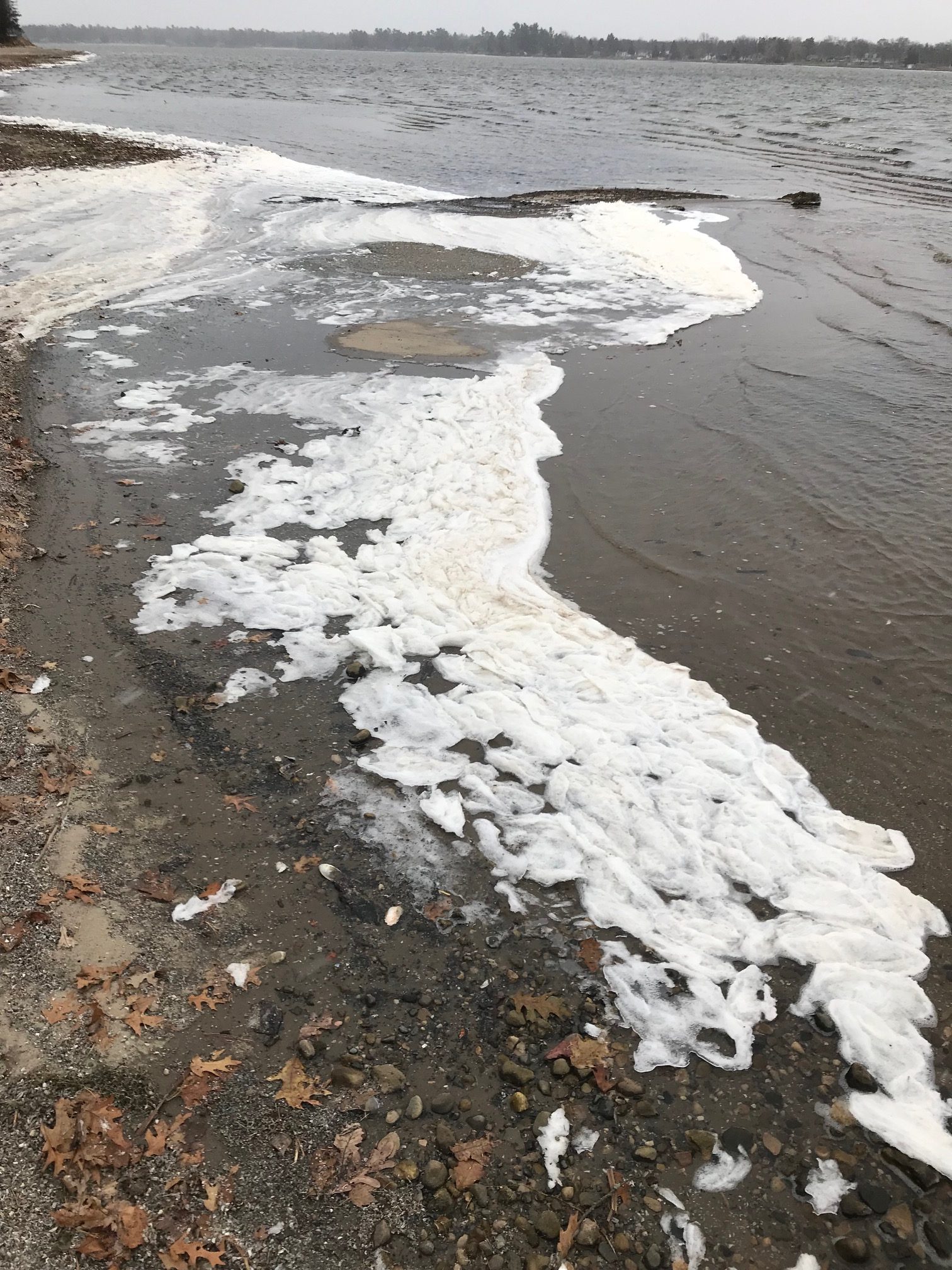
The white foam that gathers on the surface of Van Etten Lake washes through the rocks and creeps up onto Spaniola’s property, located directly across from the shuttered Wurtsmith Air Force Base. The foam carries PFAS, the toxic “forever chemicals” that leach from the base into the groundwater. Warning signs around town tell people not to touch the foam, not to eat the fish, not to eat the venison.
“It is a regular visual reminder of the problem,” Spaniola said.
Spaniola is co-chair of the Great Lakes PFAS Action Network. His fight started in the fall of 2016, when the health department sent a letter telling his family not to drink from their well. It arrived in the middle of the Flint water crisis.
“If you shouldn’t be drinking your water today, you shouldn’t have been drinking your water for a while—like for a long time,” he said. “You start to think about all the different family members, friends, people who have come and gone there over the years. You brush your teeth, you take showers, you water the plants, the dogs drink it. It’s everywhere.”
Ten years later, the state agency responsible for protecting people like him is shrinking. In the budget deal passed in July 2026, House Republicans cut the Michigan Department of Environment, Great Lakes, and Energy (EGLE) by 30%. House Speaker Matt Hall (R-Richland Township) bragged about it on the House floor, calling the deal “probably the most decisive budget victory for the Republicans” and saying the EGLE cuts would blow people away.
RELATED: Trump won’t stop trying to defund the Great Lakes
EGLE Director Phil Roos warned last year that cuts of this scale would severely undermine the agency’s ability to tackle PFAS, protect drinking water, and hold polluters accountable.
Spaniola has watched EGLE for decades, and he says this round of cuts is just the latest chapter in a long story of defunding. The agency has gone from one of the best in the country, he said, to one hollowed out under Gov. Rick Snyder into something that existed “largely to stamp permits and to help polluters.”
“I’m all for cooperation, but when people don’t cooperate, you’ve got to take action, and it really became a toothless agency,” he said. “There is a lack of institutional memory for what the agency should be. And then when you have cuts that are coming on top of it, they are stretched very thin. It’s just going to make things worse, plain and simple.”
Twelve days after the cuts passed, the diminished agency made one of the biggest calls in its history. On July 15, EGLE reissued the permit for Enbridge’s Great Lakes Tunnel Project, which would house a replacement for the 73-year-old Line 5 pipeline beneath the Straits of Mackinac.
EGLE’s own permit acknowledged the project would likely destroy or remove historic and cultural resources, including the remains of tribal ancestors.
Whitney Gravelle, president of the Bay Mills Indian Community, said reading that finding left her disheartened, angry and dismissed. Tribes told EGLE the remains were there. The agency made them prove it.
“It was as if we had to continuously prove ourselves over and over again. We would tell EGLE, ‘There are cultural and ancestral remains here. You cannot do this project.’ And then they asked us to prove it, like they couldn’t just believe us,” she said.
“We did the studies, and then we proved it, and then they still did it anyways.”
The permit requires Enbridge to meet mitigation conditions. Gravelle, however, said she doesn’t trust a now-gutted EGLE to enforce those conditions.
During the surveys for the project, she said, the only monitors on the ground were tribal monitors from Bay Mills, Sault Tribe, Little Traverse Bay Bands, and Nottawaseppi. Not one state official was present. Tribal biologists had to stop Enbridge’s surveyors from trampling endangered species. An Enbridge bird expert even played eagle calls off his cell phone because he had never heard one. During an earlier permit process, Gravelle said, Enbridge dug up a burial site and never notified the tribes.
For Bay Mills, the tunnel is not just a pipeline fight. The Straits sit in territory tribes ceded in 1836 in exchange for rights they were promised forever, including the right to fish those waters. Gravelle said people often misunderstand what that means.
“Our treaties did not carve out individual rights; they carved out lifeways and they carved out relationships,” she said. “Treaties are not something only to be found in a history book. They’re not something on old parchment paper. They are living exchanges and promises, and that is what this country’s integrity relies upon: the promises it made, not only to this nation but to other nations like my own.”
Promises need enforcers. The agency tasked with holding Enbridge to its permit conditions is the same one that couldn’t put a single monitor on the ground during the surveys—and its budget is about to shrink further.
“Knowing that their budget is going to be reduced even more moving forward means that they’re going to have less resources, less staff, and more incompetency regarding this permit process,” she said.
Bay Mills is now analyzing every legal avenue, and a Michigan Supreme Court decision on the 2023 Public Service Commission permit could come any day. Gravelle rejects the state’s rationale that public and private need for the pipeline outweighed everything else. “It’s an excuse,” she said. “This is mostly about private need, and I think we’ve all been caught in the trap of misinformation and propaganda that has been put forward by Enbridge.”
Enbridge’s own experts admitted under oath that shutting down Line 5 would move gas prices by less than a penny. “We don’t need it at all,” Gravelle said. “We have seen Line 5 shut down before for almost 90 days… and nobody noticed. We still got propane to our homes, we still got fuel for our vehicles, and it did not impact the pricing of any of it.”
The state cuts are happening at the same time as a massive federal retreat. In May, the Trump administration’s EPA formally proposed rescinding drinking water limits for four of the six regulated PFAS chemicals, and letting some water systems delay compliance on the other two until 2031. Spaniola notes there are more than 15,000 PFAS variants with no regulation at all. “This is a massive threat to human health in the United States that we’ve got to pay attention to,” he said.
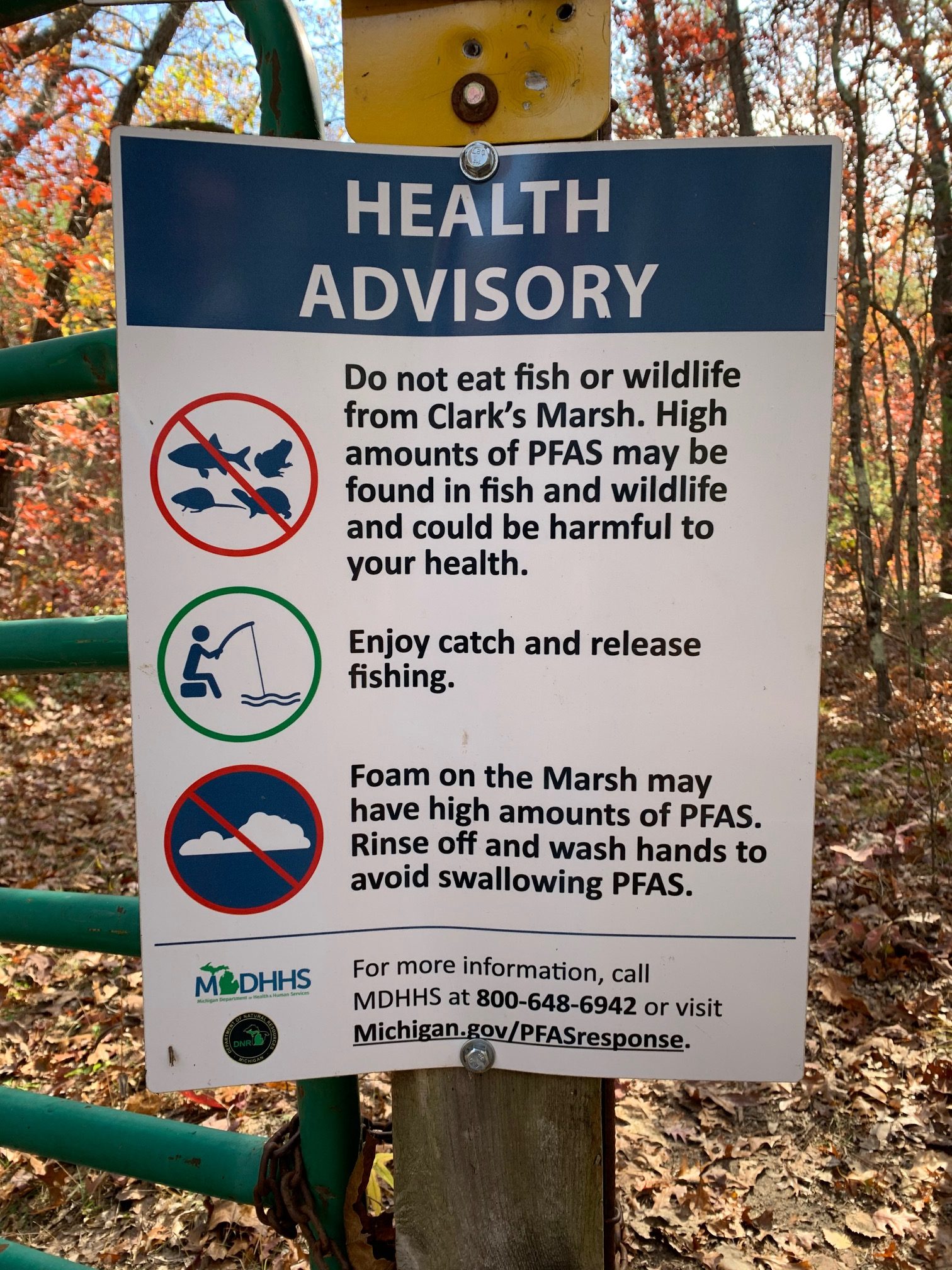
And this isn’t an Oscoda problem or a Straits problem. “There are water bodies all over Michigan that have fish you shouldn’t be eating,” Spaniola said. One in six tested has fish too contaminated to eat, he added, and the state has a standing advisory against touching foam on any beach.
“If your little kids are out playing, what do little kids like to do with bubbly-looking white suds? They put it on their face. They put it in their mouth,” he said. “That’s the worst thing they could possibly do.”
Gravelle says Michiganders already understand what’s at stake. Water is the one thing that unites the state.
“Part of the problem of today’s political climate is that we are reactive and not proactive,” she said. “You are taking the easy road, the short road, and you’re not actually doing what is best for the greater good—and I think that is the trap that the state fell into with Enbridge.”