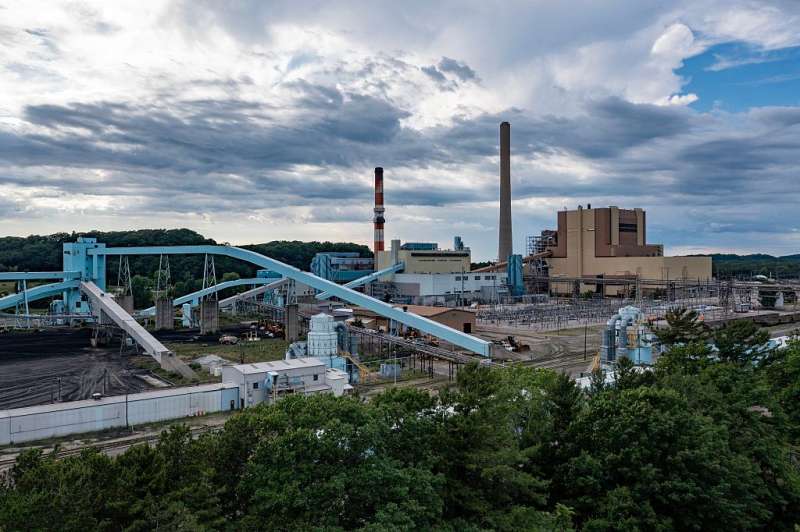
Jan O’Connell was on the phone talking about how long West Michigan might have to wait for a ruling on the J.H. Campbell coal plant when the person on the other end interrupted her.
“‘Oh my God, Jan. It happened,’” she recalled him saying.
O’Connell, a Grand Rapids resident and Sierra Club organizer who had spent years fighting to close the plant, initially thought her friend was joking. Then she saw the headlines: A federal appeals court had rejected the US Department of Energy’s (DOE) first order forcing the plant to remain open.
“it’s a big step in the right direction,” O’Connell told The ‘Gander shortly after the ruling. “We don’t know what’s coming up next and how things are going to turn out, but this is the first big decision legally that we’ve had, and we’ve waited a long time.”
The US Court of Appeals for the DC Circuit ruled Sept. 11 that DOE went beyond its authority when it issued the first emergency order requiring Consumers Energy to keep Campbell available to operate after its planned May 31, 2025 retirement. The court threw out that original order.
But the decision does not mean Campbell will close immediately.
A later DOE order—the sixth to date—still requires Consumers Energy and MISO, the regional grid operator that serves 15 states and Manitoba, to keep the 1,420-megawatt West Olive plant available for operational use through Nov. 14. The DOE order directs MISO to use economic dispatch, meaning it should call on the plant when it is the least costly option available, to minimize costs to ratepayers. An Consumers Energy official said it is reviewing the court ruling, but will continue complying with the current order in the meantime.
A win with limitations
For O’Connell and other Michiganders, the ruling was welcome after a long fight that did not begin with the court case.
She said a West Michigan family who lives close to the plant had counted down the final 100 days before Campbell’s planned closure in May 2025 because they were looking forward to the quiet after years of cohabitation with the facility. But then DOE issued its first 90-day emergency order just a week before the scheduled retirement.
“It was a major big deal for them at this plant,” O’Connell said. “They were so looking forward to it.”
The court’s decision puts a legal boundary around DOE’s ability to make that kind of intervention, ruling that the department cannot use a broad, long-term concern about future power supply as an “emergency” reason to override a state-approved plant retirement plan.
The court said the emergency authority at issue is intended as a limited, last-resort tool for an acute electricity shortage requiring immediate federal action. It is not meant to replace the long-term reliability planning conducted by states, utilities, and regional grid operators.
That distinction matters in Michigan because Consumers Energy, state regulators, and MISO had already spent years planning Campbell’s retirement.
Michigan had a replacement plan
Consumers Energy’s decision to lose Campbell was part of a broader 20-year plan, announced in 2021, to end the company’s use of coal by 2025 and expand renewable energy, battery storage, and other generating resources. Campbell’s three remaining coal units were scheduled to retire by May 31, 2025, 15 years before the end of the plant’s planned design life.
The state-approved plan relied on several replacement resources: Consumers Energy acquired the 1,200-megawatt Covert Generating Station, a natural-gas plant in southwest Michigan, extended two oil-and-gas units at another facility, and planned additional solar generation and battery storage.
According to court documents, the Michigan Public Service Commission approved the plan in 2022, finding it would improve the region’s ability to meet electricity demand. MISO also concluded that Campbell was not needed to satisfy its reliability standards under the retirement plan.
This was all central to the court’s ruling, but it has been DOE’s position that the emergency orders have protected the grid, and have been necessary due to rising electricity demand, serve-weather risks, and uncertainty over the growing demand from data centers.
From reporting Engineering News-Record, DOE did not say whether it would seek further review of the ruling or explain how the decision could affect the later Campbell orders.
The price of staying open
The fight over Campbell is also a fight over the bill.
According to the Michigan League of Conservation Voters, the closure was going to save Michigan residents $600 million by 2040. Instead, Consumers Energy reported at least $259 million in costs associated with keeping the plant operating from May 2025 through June 30.
Consumers Energy is seeking to recover costs across MISO’s north and central regions, not solely from its Michigan customers. In an email sent to The Detroit News, the company said it will “work to ensure that everyone who benefits from power from the Campbell plant across the Midwest pays their fair share.”
Michigan Attorney Dana Nessel has challenged the order before the Federal Energy Regulatory Commission. Her office argues that customers should not have to pay for a plant operation it considers unlawful.
“Hundreds of millions of dollars in unnecessary costs are stacking up, and Michigan families will be forced to foot the bill to keep online a plant that should have been retired more than a year ago,” Nessel said in an August statement after the DOE’s sixth order. “My office remains committed to challenging these unlawful extensions before the Court to protect our ratepayers.”
A health concern
Like the Michigan family living near the plant, O’Connell said the issue is not just an argument about power-grid policy.
O’Connell has asthma and lives roughly 30 to 40 miles from the plant. On days when the air feels heavy, she said she noticed it when she tried to breathe outside.
“The high cost to ratepayers is a big concern, but so are the health issues,” she said. “This plant has been the dirtiest unit in West Michigan, so all of West Michigan was excited to see this plant close because of our air quality.”
The court’s opinion acknowledged that Campbell emits sulfur dioxide, nitrogen oxides, and fine-particle pollution, and that the plant’s emissions cause about 30 excess deaths each year when it operates.
Clean Air Task Force (CATF), which represented the Michigan Environmental Council in the case, said its analysis estimated that retiring Campbell could save up to $1 billion in health-related costs and prevent nearly 70 deaths annually in Michigan.
“Despite the agency’s claims that the unreliable plant was ‘essential’ to addressing a supposed emergency, there was no evidence to support that assertion,” Frank Sturges, senior attorney at CATF, said in a statement. “There is, however, clear evidence that retiring the plant will deliver public health and economic benefits to Michiganders without compromising electricity supply.”
The wait continues
The court ruling applies to DOE’s original 2025 order, which has already expired. Legal challenges to the later extensions remain unresolved.
O’Connell expects the fight to continue if DOE issues another order when the current one expires in November.
“Even though it’s a step in the right direction,” she said. “There’s still a lot to go in terms of turning the ship around and getting that plant closed.”