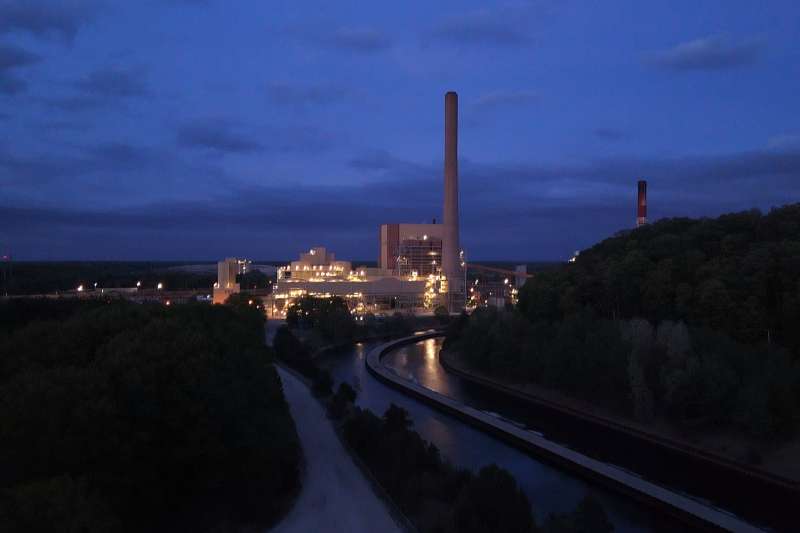
The J.H. Campbell coal plant in West Olive was on its last leg in May of 2025, when the owners got some bad news. The then 63-year-old plant had been winding down in preparation for retirement, no longer keeping up with maintenance tasks and burning up the last of its coal supply, ready to make way for cleaner energy options in the state.
Then President Donald Trump gave the order for it to stay open using an emergency order that many felt had questionable validity. The plant would have to continue operating for 90 more days, reordering coal, keeping workers on site, and working with failing parts until the feds decided what to do next.
“It was supposed to close officially on the 31st of May, and the coal was all finished, everything was done, and he did this order on the Friday of Memorial Day weekend just less than a week before the shutdown,” said Jan O’Connell, the senior energy issues organizer for the Michigan Chapter of the Sierra Club, a grassroots environmental organization.
Then it happened four more times. Four more emergency orders keeping the plant open, bringing it to its current predicament: still in operation more than a year after it was set to close, with no long-term plan to transition to the renewable energy sources it had promised.
“They were more than ready to close it,” O’Connell said, referring to Consumers Energy. “They were ready to go full speed ahead in renewables.”
But the limbo isn’t the biggest problem. Experts say it’s costing about $605,000 per day to keep the plant open, and those costs are being passed onto consumers who draw power from the MISO grid (Midcontinent Independent System Operator), servicing 15 Midwest and central states.
And those costs are coming at a time when Americans are struggling to pay higher and higher utility bills.
“Our rates with Consumers have been going up and up,” O’Connell said.
A halt in progress
Tyson Slocum, director of the energy program for consumer advocacy group Public Citizen, called it another of Trump’s “vanity projects,” describing the president as hellbent on preserving coal plants “regardless of whether it makes sense.”
“The president has two overall goals when it comes to energy policy,” Slocum said. “The first is ending and reversing the clean energy transition, so stopping wind and solar and promoting fossil fuels. And the second is projecting US power abroad by maximizing fossil fuel exports.”
O’Connell had been working to convince Consumers Energy of the benefits of switching to greener energy sources for the better part of 12 years. Then, in 2021, the utility company finally announced they would close their plant to pursue wind and solar options, as well as battery storage.
“When the wind doesn’t blow and the sun doesn’t shine, it’s stored, and the energy can be used from those energy battery plants,” O’Connell said.
The closure had been studied and experts agreed that retiring the plant would not negatively impact the power grid; there would be no shortage of energy for MISO, which makes Trump’s decision all the more baffling.
“He is doing that to reward his donors and to bring coal back,” O’Connell said.
The impact on consumers
While Consumers Energy has had to scramble to reorder coal and maintain staffing at the plant, the emergency order to remain open isn’t costing them directly.
“It’s not going to cost the company anything—they get to recover from ratepayers 100% of the costs that comply with the order,” Slocum said.
Consumers Energy filed a rate hike increase request to the Michigan Public Service Commission on June 2, to the tune of $456 million. Those costs would be spread to consumers of the 15 states within MISO.
“If it gets approved, it would be a rate increase of 9.8% to 10%,” O’Connell said.
What’s being done
In January, seven groups, including the Sierra Club and Public Citizen, joined forces to challenge the orders. Attorney General Dana Nessel has also filed a request for rehearing on the issue.
“It’s up to a federal judge to determine whether or not the Trump administration has overstepped its authority under Section 202(c) of the Federal Power Act,” Slocum said. “Obviously, it would be great to have Congress step in, but right now the majority of Congress has zero interest whatsoever in doing its job and conducting any oversight whatsoever.”
In the meantime, Trump continues to use 202(c) to continue operation of five additional plants:
- Indiana: R.M. Schahfer Generating Station and F.B. Culley Generating Station
- Washington: TransAlta Centralia Coal Plant
- Colorado: Craig Station
- Pennsylvania: Eddystone Generating Station
And he’s announced plans to open two new coal plants in Alaska and West Virginia.
J.H. Campbell’s future will again be decided on Aug. 16, when the current order expires. At this rate, O’Connell predicts the plant will be ordered to stay open until Trump leaves office.
“It’s like getting hit twice,” O’Connell said. “We’re having to pay these exorbitant costs for energy, and getting less of the renewables.”