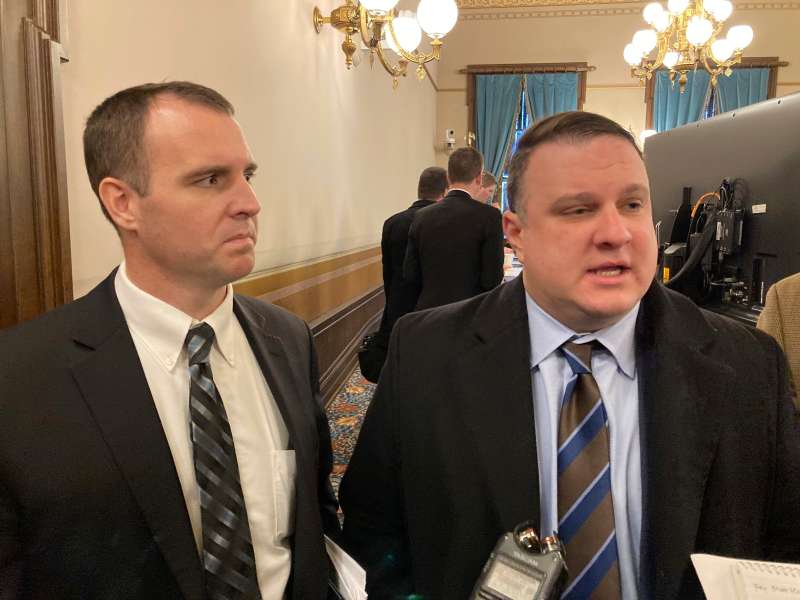
A bill proposed by the Republican-controlled Michigan House of Representatives would likely raise residents’ energy bills and possibly frighten off investors, undoing three years of hard work and tangible gains.
In 2023, under Democrat leadership, Michigan’s state Legislature passed a half-dozen bills to begin a statewide transition to clean, renewable energy and to improve grid reliability, following industry forecasts and jobs data.
As previously reported in a 2024 article for The ‘Gander, those clean energy bills, combined with federal incentives from the Inflation Reduction Act, helped Michiganders save money each month. Reporter Kyle Kaminski told the story of Ann Siegle and her family, of East Lansing, whose electric bills were cut in half by switching to solar power thanks to federal and state legislation passed by the Biden-Harris administration and Michigan’s Democrat-led state government.
And the Siegles weren’t alone.
“More than 117,000 Michigan families have now reportedly benefited from more than $134 million in tax credits to help lower the cost of clean energy and provide energy efficiency upgrades to their homes,” Kaminski wrote.
Yet in March of this year, the State House—now controlled by a Republican majority and led by Speaker of the House Rep. Matt Hall (R-Richland Township)—announced plans to repeal those clean energy laws, which could leave Michiganders with higher utility bills at a time when the cost of living is already rapidly increasing.
Looking to the future of Michigan energy
One sector that’s gone in the opposite direction and become more affordable over the last 15 years is clean energy. Global investment in clean energy is now $2.15 trillion USD, which is nearly double that of fossil fuels. Clean energy employs roughly 45 million people, which is 50% more people than fossil fuels, and that gap is widening.
In a state bound on three sides by North America’s largest reserve of freshwater, staying ahead of energy trends is crucial for Michigan’s environmental future. It’s one reason why in 2023, Democrats decided to take action.
One bill they passed in 2023 demands that energy companies meet a standard of 50% clean energy by 2030 and 100% by 2040. Another bill answered concerns about mass layoffs: To ease the transition and minimize job loss, legislation established a new office in the Department of Labor and Economic Opportunity to help Michigan workers migrate from fossil fuel jobs to their clean energy counterparts.
And the public interest is there, even predating the legislation that has made it easier. In April 2025, Western Michigan University’s WMUK ran a story about Portage resident Rick Freiman, who tried in 2019 to have solar panels installed on his roof. Unfortunately, his homeowner association wouldn’t allow it.
Frieman, like countless other Michiganders, aims to power his house fully with renewable energy, and in the last 13 months, that dream is getting closer to reality.
“That decision is no longer up to HOAs,” reported Michael Symonds, citing House Bill 5028, or The Homeowners’ Energy Policy Act. HB5028 makes it much more difficult for HOAs to deny solar panel installations on Michigan rooftops.
Switching to renewable energy pays off big in the long run, saving a household over $61,000 in 25 years, but skeptics often mention the initial investment costs. However, some of these expenses at the beginning would be offset by a third bill Democrats passed in 2023: ensuring utility companies make energy use more efficient, which would save Michiganders over $100 million every year for over a decade.
In other words, these three bills mean harnessing as much clean energy from a free source as batteries can hold, bringing more jobs to Michigan without leaving gas and coal workers behind, and reducing the upfront costs through increased energy efficiency. Now, Republicans in Michigan’s state House want to repeal the clean energy laws.
The risks of rolling back clean energy policy
Immediately after the clean energy bills passed in 2023, businesses began investing big in Michigan clean energy. Transmission planners, solar developers, and battery-storage companies shifted gears to prepare for the future. Even Michigan utilities companies started pivoting. Developers have already bought land, planned projects, signed contracts, and in some cases begun construction on renewable energy facilities.
If Republicans repeal Michigan’s clean energy bills, the resulting market uncertainty may concern investors seeking risk protection—at the cost of Michiganders—to allay their fears of ever-changing laws.
In the meantime, Michiganders would continue to be tethered to facilities like the J.H. Campbell coal-fired power plant, which is responsible for 44 deaths and 18 heart attacks each year. Last year, the plant was scheduled to close, yet President Donald Trump imposed an emergency order to keep it open. Additionally, the Trump administration’s trade wars, tariffs, and the war in Iran—which has bottlenecked the global oil supply—have sent energy prices skyrocketing and increased Michigan’s fossil fuel dependence. Despite this, Hall has repeatedly defended Trump’s tariffs.
Meet the lawmakers attacking clean energy—and their own constituents
On March 11, Rep. Pauline Wendzel (R-Watervliet) introduced House Bill 5710 to Michigan’s Republican-led House of Representatives. H.B. 5710 would repeal and replace Public Acts 233, 234, and 235, which were among the six clean energy laws passed by Democrats in 2023 and 2024. Wendzel’s bill would throw out the clean energy work and lock in higher costs for Michigan residents, keeping them dependent on fossil fuels.
After Wendzel introduced it, the bill was co-sponsored by nearly 40 Republican state representatives, including Reps. Steve Frisbie (R-44th District), Kathy Schmaltz (R-46th District), and Karl Bohnak (R-109th District). Reps. Rylee Linting (R-27th District) and Jamie Thompson (R-28th District) also co-sponsored H.B. 5710, despite the damage already done to their regions.
Compared to the statewide average, Yoopers represented by Bohnak pay up to 40% more on their electricity bills every month. Frisbie’s, Schmaltz’s, and Linting’s constituents also pay more than the state average.
H.B. 5710 is only one part of Republicans’ Project Lighthouse, which experts say would not only waste money already spent on clean energy investments since 2023 but also wipe out the Energy Waste Reduction program, one of the energy efficiency programs that has played a part in saving Michiganders $6 billion in electric costs since 2009. Project Lighthouse would also roll back oversight of utilities companies, leaving them with less accountability and Michigan residents with less protection against unnecessary spending.
Critics of H.B. 5710 have said the state should instead adopt a Ratepayer Bill of Rights to hold big energy companies accountable and protect consumers.
The realities of renewable energy pricing
In their efforts to repeal Michigan’s clean energy bills, state legislators like Wendzel have called clean energy an “unrealistic, unobtainable green dream.”
However, a 2022 study conducted by Stanford University showed that by combining wind, solar, water, and energy storage, 145 countries could meet 100% of their energy needs in a transition away from fossil fuels. The transition would pay for itself in six years and add 28 million more jobs than it would lose.
Along with Wendzel, State Rep. Pat Outman (R-Six Lakes) is part of the effort to repeal Michigan’s clean energy bills. While running for reelection in 2024, Outman said that the effects of the bills would be “devastating” in terms of energy reliability and affordability. He falsely claimed that “If you look at every state and country that has gone down the path of getting most of their energy from renewable sources their prices have skyrocketed.”
The states with the highest percentages of renewable energy generation are South Dakota (96.5%), Montana (81.2%) and Iowa (79.4%). How do their energy bills compare to the rest of the US?
Americans pay an average of $0.1607 per kWh for electricity. Residents of South Dakota, Montana, and Iowa all pay well below that average, ranging from $0.1312 per kWh to $0.1318.
Outman’s top campaign donors in 2024 included Michigan Petroleum Association, Michigan Oil and Gas Association, and DTE Energy. He also took over $11,000 combined from the Matt Hall Campaign Committee and the Matt Hall Majority Fund. Hall himself received $7,000 in donations from DTE Energy in 2025 alone, according to Michigan League of Conservation Voters.
READ MORE: Michigan leaders say Trump’s hatred of clean energy will hike utility bills, kill jobs