Republican state Rep. Andrew Fink called into question the outcome of the 2020 election results and opposed laws to make it easier for Michiganders to vote. This year, he wants a seat on the highest court in the state.
Editor’s Note: This story has been updated and corrected to reflect new information that was recently presented to The ’Gander Newsroom by Fink. That information confirms Fink was not in attendance at a “Stop the Steal” rally at the state Capitol on Jan. 6, 2021, as had been previously reported here and elsewhere. We regret the error.
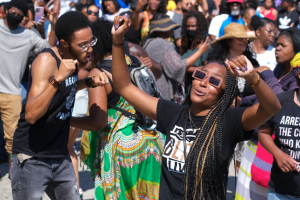
MICHIGAN—About 20 minutes after rioters breached a barricade on the west side of the US Capitol building on Jan. 6, 2021, state Rep. Andrew Fink (R-Adams Twp.) was posting a photo on Facebook, showing armed protesters gathering outside the Michigan State Capitol.
Fink was just six days into his first term as a state lawmaker. But after watching ex-President Donald Trump lose an election just a few months earlier, Fink appeared willing to amplify right-wing conspiracy theories about election fraud.

“All citizens have the constitutional right to petition the government for the redress of grievances, and these citizens have the right to know that all our elections are free and fair,” he wrote. “Governor Whitmer and Secretary Benson, these are your constituents, too. Will you commit to helping make sure Michigan’s elections are beyond reproach? Because that’s our job.”
Fink also called into question the integrity of the 2020 election a few days earlier.
“The 2020 election has generated deeper concern and more questions about the integrity of our elections than any other election of my lifetime,” Fink posted to Facebook on Jan. 4, 2021. “Many Americans, including many of my constituents, are not certain that their votes have been counted, which leads to doubt about whether they are citizens of this country or subjects.”
The small protest in Lansing on Jan. 6, 2021 paled in comparison to the violent riot in Washington DC that left several people dead, injured more than 100 police officers, caused more than $2.7 million in property damage, and led to nearly 1,000 people being arrested.
But both demonstrations had a similar goal: to keep ex-President Donald Trump in power despite there being no evidence to support claims of voter fraud.
Now in his second term in the state House, Fink is running this year for the Republican nomination for a seat on the Michigan Supreme Court. And if elected, he could be overseeing some of the most critical legal matters in Michigan—including issues dealing with elections.
Fink on Facebook
Despite multiple media reports that allege Fink attended the so-called “Stop the Steal” rally in Lansing, a representative for Fink told The ‘Gander (and provided evidence to support) that he wasn’t at the event that day—merely sharing a photo that someone else had taken.
But when Fink shared an image from the event, along with a caption demanding “the right to know that all our elections are free and fair,” there was no credible evidence of any issues or fraudulent activity tied to the presidential election results—and they still haven’t surfaced.

Numerous bipartisan investigations have repeatedly debunked claims of voter fraud in the 2020 election. A coalition of federal and state election and cybersecurity officials have called it “the most secure in American history.” And Trump’s own attorney general, along with a lengthy list of his former staffers, have said there was never any proof to support Trump’s conspiracies.
Still, within a few weeks after the 2020 election, Fink was echoing Trump’s false allegations of “outright fraud to terrible mistakes that must be corrected” in posts on his Facebook page, and encouraging other Trump supporters in Michigan to “stay vigilant, and stay the course.”

In his Jan. 4 Facebook post two days before the so-called “Stop the Steal” rally in Lansing on Jan. 6, Fink also called on state officials to conduct a “complete review of the 2020 election.”
“Without free elections, the people have no way of knowing whether governmental officials are representing them or simply ruling them,” Fink wrote in a post on his Facebook page. “Any evidence of criminal fraud should be investigated just like any other crime would be.”

In another Facebook post while he was campaigning for state House in 2022, Fink criticized a news report about his candidacy, emphasizing that he had “NEVER said that he has not seen evidence of voter fraud.”
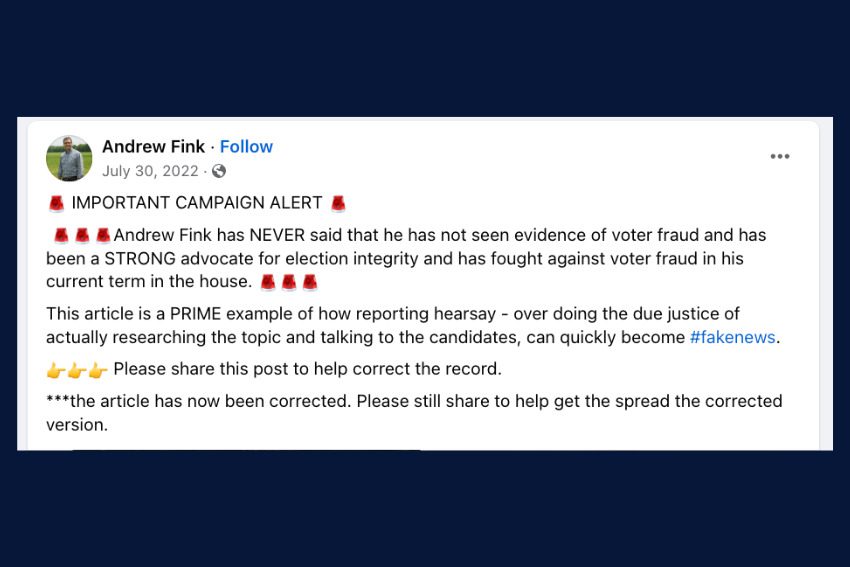
And Fink’s record of raising questions about Michigan’s election results (without producing any evidence to support claims of voter fraud) was enough to earn him the label of being a “threat to Democracy” in a 2022 report from the Republican Accountability Project—along with 150 other Republicans in Michigan who have allegedly sowed distrust or lied about the 2020 election.
Fink’s record
According to his campaign website, Fink is running for the state Supreme Court “because our justice system needs to be focused on the law” and because he felt compelled by a “sacred duty” to uphold the Constitution. His campaign website doesn’t mention any other specific issues beyond a broad commitment to “defending our rights” and “constitutional freedoms.”
“I am ready to take the oath of office and do justice under law,” his website states.

Fink is (or at least has been) a member of the Federalist Society, a right-wing legal network that has reportedly adopted a wide range of conspiracy theories surrounding widespread voter fraud, and whose members have publicly promoted theories about a “stolen” election in 2020.
Fink also has a bachelor’s degree from Hillsdale College, a college that has reportedly become involved in many political issues in recent years—including Trump’s attempt to overturn his defeat in 2020. Fink also reportedly worked as a district director for former state Senate Majority Leader Mike Shirkey, who falsely claimed that the Jan. 6 attack on the US Capitol was staged.
During his time in office, Fink has repeatedly voted against bills that were designed to make it easier for Michiganders to vote—including new laws to expand voter registration—as well as laws that criminalize poll worker intimidation and regulate artificial intelligence political ads.
Fink also voted against a bill to tighten up the election certification process that Trump tried to disrupt following his 2020 loss, as well as bills to implement an early voting ballot initiative and lift a state ban that prohibited hiring drivers to transport voters to the polls on Election Day.
Additionally, Fink has voiced opposition to state budget increases—which included state funding that was designed to help the Secretary of State’s office implement recent voter-approved constitutional amendments that expanded voting rights (like early voting) for Michiganders.
What’s at stake?
Although Fink planned to run against Supreme Court Justice Kyra Harris Bolden for a partial term on the bench, he is now reportedly instead seeking a seat held by retiring Justice David Viviano—and whoever holds the seat will have a say in some important issues facing Michigan.
Unlike the US Supreme Court, where judges are appointed and (at least theoretically) expected to be non-partisan, state Supreme Court justices in Michigan are nominated by political parties and have a specific party affiliation—though that party affiliation is not displayed on the ballot.
The Court currently leans Democratic, with four Democrats and three Republicans. With two seats up for grabs this year, the winners of the election could shift the court in a new direction.
The state Supreme Court is the highest legal authority in the state, and it wields the power to decide whether laws are constitutional and whether voter ballot initiatives can move forward.
The Court also has the power to interpret state laws and how they apply to Michiganders.
For example, in September 2022, after a ballot initiative to enshrine reproductive rights into the state Constitution was initially blocked by Republicans on the state Board of Canvassers, the Michigan Supreme Court stepped in and approved the initiative.
That decision was ultimately the only reason why Michiganders could decide on issues like abortion access (and expanded voting accessibility) via ballot measures in November 2022.
Last year, the Court also decided that ex-President Donald Trump should remain on the presidential election ballot this year, despite his role in the Jan. 6 insurrection at the US Capitol.

Democrats and Republicans are likely to rule differently on different subjects. And recent decisions in other states have shown just how powerful a role state supreme courts play.
In Arizona, for instance, the state Supreme Court in April upheld a 160-year-old law that banned all abortions unless the patient’s life was in danger. In Alabama, another state Supreme Court decision found that frozen embryos were people and (temporarily) caused IVF providers to stop offering services in the state. The Florida Supreme Court in April also upheld a 15-week abortion ban, a decision that allowed a six-week ban to go into effect this summer.
The Court could also impact future presidential elections as Republicans continue to undermine the state’s election systems. In 2020, for instance, the Michigan Supreme Court decided not to hear a legal challenge to the state’s presidential election results—instead concluding based on a mountain of evidence that ex-President Donald Trump had lost the race in Michigan.
READ MORE: Thomas promises ‘new voice of fairness’ for Michigan Supreme Court
For the latest Michigan news, follow The ‘Gander on Twitter.
Follow Political Correspondent Kyle Kaminski here.