MICHIGAN—London Gadd wanted to be a commercial pilot. She loved soccer, drawing, and making people laugh. She was 12 years old when she died by suicide in 2024.
Her mother, Charay Gadd, contends that algorithm-driven social media feeds walked her daughter from an innocent search about alligator-skin boots into a spiral of self-harm content—one that she couldn’t see and the platform had no interest in stopping.
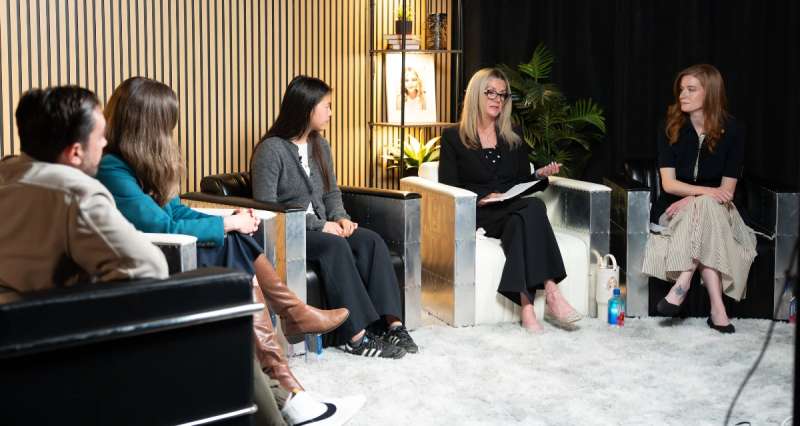
Charay Gadd shared her story at a town hall hosted by The ‘Gander this month to help ensure her daughter doesn’t become a statistic. She’s demanding new policies to crack down on Big Tech at both the state and federal level. Her calls for change are starting to be heard.
“How many children have to lose their lives before they realize this is real?” Gadd said. “This isn’t hypothetical anymore. There’s documentation showing that they know what they’re doing.”
Gadd was joined by state Sen. Mallory McMorrow; Dr. Jenny Radesky, a director at Michigan Medicine; and Mariella Ma, a University of Michigan senior and student lead for Design It For Us, a youth-led coalition that’s actively pushing back against Big Tech’s business models.
The conversation largely centered on Kids Over Clicks, a package of state legislation that was introduced last year, passed the Michigan Senate in April, and now sits in the state House.
McMorrow framed the stakes plainly: policymakers dropped the ball, and kids have been paying for it. And she’s not waiting on Washington; she wants the Michigan House to take action.
“Policymakers failed,” she said. “They let this go completely unchecked, and we are now living with the consequences of it. … They have used our kids to generate profit, keeping kids’ eyeballs online as long as possible, and I think people have had enough.”
The Kids Over Clicks package—which includes Senate Bills 757–759—would formally ban social media platforms (like Facebook and Instagram) from serving children addictive, algorithm-driven feeds unless parental consent is provided. It would also mandate stricter data privacy and safety settings for kids, while giving parents more direct control over their accounts.
An additional bill in the package, Senate Bill 760, would ban platforms from connecting children with online chatbots that are capable of encouraging harmful, explicit, or illegal activities.
McMorrow calls it a starting point—not a finish line.
“This is just scratching the surface,” McMorrow said. “I want to be clear about that. … But it would be a tremendous step forward, and Michigan would be leading the country.”
Radesky pushed back on the argument that parents shoulder sole responsibility for regulation.
“That is the oldest trick,” she said. “When industry doesn’t want to be responsible for something, you go to individual responsibility. That’s what the tobacco companies did.”
Radseky said the platforms’ algorithms often work directly against what families need: kids who can sleep, focus on homework, and come to the dinner table. And no parental control tool meaningfully competes with what these platforms were specifically engineered to do, she said.
“This is the only type of product that kids interact with so much during the day that doesn’t have safety regulations,” Radesky added. “We need it to be easier. We need safety by default.”
Ma, who grew up with these platforms and now organizes against them, said her generation has hit a breaking point. She’s urging her peers to start talking about it—in person, not just online.
“Our attention is their money,” she said. “People are starting to realize this and log off.”
McMorrow said that’s the kind of pressure that moves companies and that lawmakers passing Kids Over Clicks would only add to the urgency. The bill needs state House votes to advance.
“Contact your state representative,” McMorrow urged Michiganders at the town hall. “And then we gotta change who we have in Washington to hold these tech companies accountable and to get the money out of [politics] that is robbing us from the ability to protect our kids.”
Want to speak up? Kids Over Clicks is currently under consideration before the Michigan House of Representatives. Find your state representative here.
READ MORE: Whitmer says state protections against Big Tech aren’t enough
Don’t miss Michigan’s biggest stories—follow The ‘Gander on Instagram.