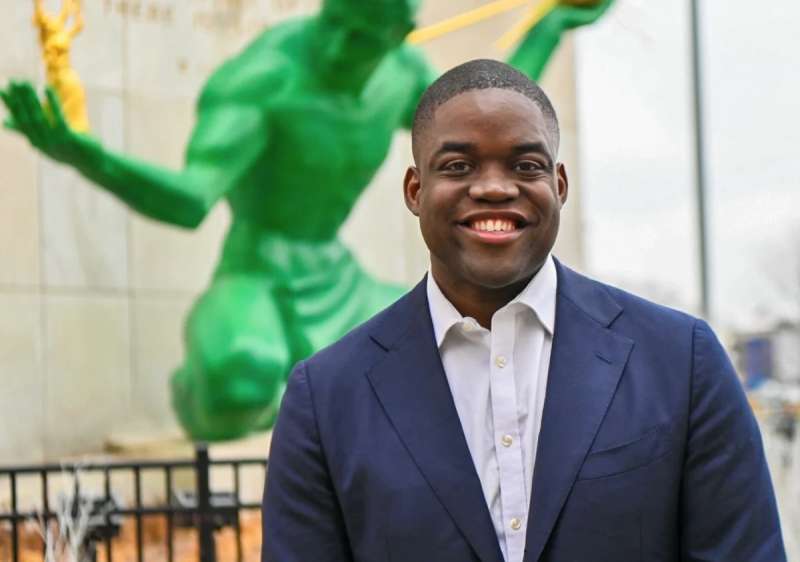
Democratic state Senate candidate Justin Onwenu says he wants to rebuild trust, invest in neighborhoods, and help deliver a new generation of leadership to Michigan politics.
LANSING—Justin Onwenu isn’t waiting for a crowded field.
The 29-year-old attorney, organizer, and Detroit’s first Director of Entrepreneurship and Economic Opportunity is the first candidate to enter the race for Michigan’s 1st Senate District, an open seat that includes parts of Detroit, Ecorse, Lincoln Park, River Rouge, and Wyandotte.
The election isn’t until next year. But Onwenu said it’s never too early to connect with voters.
In an exclusive interview with The ‘Gander, Onwenu framed his state Senate campaign around three key issues: job growth; local neighborhood investments; and perhaps most notably, breaking the “doom loop” to make the state government something worth trusting again.
The following Q&A has been edited and condensed for grammar, style, and clarity.
You’re the only declared candidate so far. Why start early?
Sometimes, candidates only talk to voters a month before the election. And by that time, folks are frustrated that the only time people come around is for votes. I’m getting out there early because I’m excited to be able to earn the support of folks in Detroit and Downriver.
When did it click that running for office was the way to make change?
I’ve observed a lot of government work over the years. As an organizer, I wrote an ordinance after a disaster along the Detroit riverfront and saw how elected officials can respond to crises.
As an attorney working with labor unions, and now as a city official, I’ve seen how much change can be made through government. But really, the election of President Donald Trump and the lame duck session last year made it clear our government hasn’t been working the way it could.
What does uniting Detroit and Downriver look like in practice?
This is probably the lowest-turnout district in the state. When people talk about why they’ve checked out, the same issues come up: affordability, job stability, education. I’m running on rebuilding our economy, investing in housing, neighborhoods, and cleaning up our government.
I think making government work for the people is something that brings the people together.
Why do you think turnout is so low—and what’s your plan to change it?
It’s a very diverse district. There are a lot of folks who are bilingual and multilingual. I think some of it has to do with language accessibility. Sometimes, campaigns are only in one part of the city.
I’ve organized in Detroit, River Rouge, and Ecorse. I’ve done a lot of work in the small business community, but also on the labor front. I teach labor law. I’m on the board for the Detroit Riverfront Conservancy and have done environmental work on the river. When I think about the important issues for Detroit, I feel well positioned to weave all of those experiences together.
You’ve landed some notable endorsements. Who do you still need to win over?
I think it’s important to continue to be out there on the ground. I’m honored to have the endorsement of dozens of elected officials from mayors to City Council members to state representatives. But I think the most important thing is just connecting with voters.
Sometimes folks think races are won on social media and through endorsements. I know it will take a whole lot of work and I’m glad to have support in reaching voters every single day.
You could become the youngest member of the state Senate and possibly the only Black man serving there in 2027. What responsibility comes with that?
I hear from voters who feel their voices haven’t mattered, that they haven’t really been represented in our state Legislature. It’s not just about criminal justice reform. It’s economic issues like access to good-paying jobs. It’s about expanding and investing in skilled trades; tackling the racial wealth gap; protecting our communities from redlining and discrimination; health disparities; the maternal health crisis that impacts Black women disproportionately.
When budget decisions get made, having someone in the room whose experience is actually rooted in the local community, I think, is important. So, I’d be honored to serve. But really, I’m going to be focused on the issues that matter to our community and the whole district.
What’s the No. 1 thing Lansing could do right now for working families?
There are a lot of workers who are dealing with wage theft right now. And when we think about labor rights, local control, and project labor agreements, there’s some pre-emption that has prevented the labor movement from making progress at the local level that should be addressed. There are coalitions to be built between conservatives and Democrats on that front.
I also think we are investing far too little in the mom-and-pop shops that anchor neighborhoods. And then on the housing front, of course, we need to be building more affordable housing. And from a baseline affordability standpoint, reducing property taxes should be another top concern.
I know you’re big on transparency. What’s broken and how do you fix it?
There is a doom loop when we think about our low ratings on government trust and transparency. And there are some folks who have exploited that mistrust—Donald Trump being one of them. So, I think it’s important for Democrats to push back with real reforms like expanding the Freedom of Information Act to cover the governor and the state Legislature.
I supported the campaign that required financial disclosures and got term limits codified into our state Constitution. But with the disclosures we’re seeing, I also think that still needs more reform. We should also talk about taking compensation decisions out of our lawmakers’ hands.
It’s not always that there’s a problem, but it’s the perception that there may be a problem. I think investing in an ethical government could really build trust and increase voter turnout as a result.
What’s something organizers remember that career politicians forget?
Politics needs to be done by addition, not subtraction. The larger the task, the more important it is to build coalitions with folks. As part of that, we should always need to be talking with anyone and everyone—even to people who you think may disagree with you. I tend to think being dogmatic is harmful for our movement. Being open minded and available is important.
Is it a state senator’s job to push back against the Trump administration?
Yes. The state senator elected in 2026 will see the last two years—hopefully—of the Trump administration. I think we need to be comfortable speaking truth to power and standing up against the attacks on our history, heritage, and communities. The attacks we’re seeing on our immigrant communities and our Black communities are profound. We’re also seeing attacks on our economy that are having real consequences. And we’re seeing a federal government that’s more focused on self-enrichment than on getting costs down and employment numbers up.
I don’t see much concern from Trump on stopping the policies that are driving a lot of this chaos. So, I think it’s important for our state government to stand up. But at the same time, we can’t be beholden to only focusing on issues that are on the news or are being driven by Trump.
I endorsed Kamala Harris in the last election. To me, that’s a very important question for candidates to be able to answer. But I’m also focused on local issues more than anything.
That’s rebuilding our economy, investing in neighborhoods, and cleaning up our government. There’s a lot of work to do in Michigan that has nothing to do with Donald Trump.
If you could accomplish just one thing in your first term, what would it be?
A government-ethics package—FOIA, a stronger State Board of Ethics, better financial disclosures. Deepening public trust makes everything else possible: lowering property taxes, taking on prescription drug prices, investing in small businesses and workers, and more.
When voters see your name on the ballot, what do you want them to think of?
A new generation of leadership. Passing the baton is important. When I say I’m an organizer, it’s not just a job title. It’s an approach to building relationships and solving issues. I often say organizer before attorney. I feel experienced. I feel ready. I would also bring a new style and a new generation of leadership that I think is desperately needed in our state government.
Finish the sentence: Michigan needs leaders who…
Michigan needs leaders who deliver.
As a younger candidate, I think it’s important for people to know how serious this is to me.
I’ve helped deliver millions of dollars investing in Detroit small businesses and startups. I’ve also had a lot of experience in this district securing neighborhood funding and working closely with labor. I’ve built a record and trust within all of these communities to help bring people together.
About the candidate
Here’s what to know about the candidate, his platform, and the road ahead:
Justin Onwenu is Detroit’s Director of Entrepreneurship and Economic Opportunity, an adjunct professor at the University of Detroit Mercy School of Law, and a former appointee to Gov. Gretchen Whitmer’s Black Leadership Council. He also works with labor unions, organizes on environmental justice and air quality, and serves on the Detroit Riverfront Conservancy board.
Onwenu is the first (and so far the only) Democrat to announce a campaign in the state’s 1st Senate District. He has already garnered support from Downriver leaders, the state Democratic Party Black Caucus, former US Rep. Andy Levin, and several Detroit-area state lawmakers.
The 1st Senate District includes parts of Detroit and Downriver communities like Ecorse, Lincoln Park, River Rouge, and Wyandotte. The seat is open in 2026 due to term limits—giving voters plenty of time to get registered to vote and learn more about the candidates before Election Day.
The Primary Election is on Aug. 4, 2026 and the General Election is on Nov. 3, 2026.
READ MORE: A historian’s guide to living history in and around Detroit
Don’t miss Michigan’s biggest stories—follow The ‘Gander on Instagram.