BY KYLE DAVIDSON, MICHIGAN ADVANCE
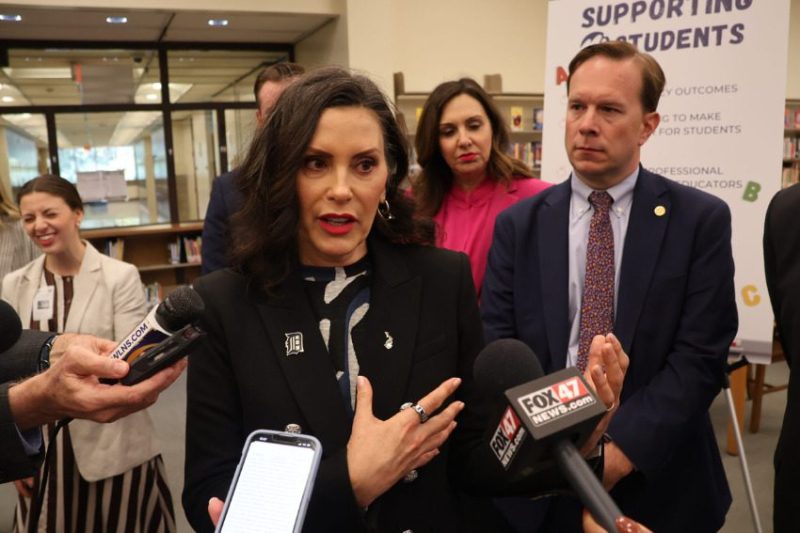
MICHIGAN—After taking questions from students at Gardner International Magnet School in Lansing, Gov. Gretchen Whitmer joined Democratic lawmakers in the library as she prepared to sign legislation providing schools with additional funding alongside bills to make sure students are screened for dyslexia.
Following the passage of Michigan’s School Aid budget for Fiscal Year 2025 over the summer, multiple education groups raised concerns about a decrease in funding for student safety and mental health, calling on the Legislature to provide additional financial support for these efforts.
The FY 2025 budget allocated $26.5 million in grants for per-pupil mental health and school safety compared to the $328 million included in the FY 2024 budget, which expired on Oct. 1.
While the Legislature noted its intent in the final budget bill that $598 million in funding that had been freed up by decreasing payments into the Michigan Public School Employees’ Retirement System (MPSERS) be “used to support student mental health, school safety, the educator workforce and academic interventions,” Republicans spoke out against the decrease in funds specifically set aside for mental health and school safety, with state Rep. David Martin (R-Davison) releasing a statement saying it “recklessly and unnecessarily put our children at risk.”
Democrats later put forth a $126 million supplemental, which included $1 million in funding to support a tip line for students to anonymously report “improperly stored firearms that were accessible to a minor. After some back and forth between the House and the Senate, the proposal — House Bill 5503 — ultimately cleared the legislature on Sept. 25, before it was presented to the governor on Thursday.
“With this school aid supplemental, a total of $150 million is invested into our school districts for safety, infrastructure and mental health support this year. Parents can send their kids to school with peace of mind, knowing that the House Dems have listened to their concerns and have taken real action to deliver schools the resources they need to keep kids healthy and safe,” said House Education Committee Chair Matt Koleszar (D-Plymouth), who previously worked as a teacher in the Airport Community School District in Carleton.
Chuck Alberts, president of the Lansing Schools Education Association, thanked lawmakers for acting on the supplemental, saying mental health in schools had not been a priority for far too long.
“The more we try to avoid the need, the worse the epidemic grows for our students and families. Only through direct recognition, funding, successful programming and resources can this dangerous course be diverted,” Alberts said.
“Students, parents, loved ones and staff have a fundamental right to learn and work in an environment that is safe from threats of violence. … As we all know all too well, we have real acts of violence in our schools.We need to look no further than down the road to Michigan State University and Oxford to make the point that school violence is real, and lives are at risk every day,” Alberts said. “I’m hopeful that with the passage of this additional school safety and mental health funding, we are taking the necessary steps to create schools that are safe for all. This can longer be a hope, dream or prayer that things happen. It’s now a time of action.”
In addition to the school aid supplemental, Whitmer also signed Senate bills 567 and 568 which requires schools to screen all kindergarten through 3rd grade students to be screened for dyslexia three times a year for dyslexia if they have not been previously screened. It also requires screenings for students in grades four through 12 who demonstrate behaviors indicating dyslexia.
The bills also include requirements to ensure dyslexic students receive multi-tiered support and that teachers receive training on dyslexia and utilize evidence-based reading practices in their classrooms.
During the press conference Caroline Kaganov, whose son has dyslexia, discussed her efforts to ensure her son received the educational intervention he needed.
“When my child was first diagnosed with dyslexia, I didn’t realize how hard it would be to get him the correct intervention to ensure he could be successful. I worried about all the kids falling through the cracks. I worried about the kids whose moms couldn’t afford outside intervention. I worried about the kids who pretended they knew how to read, even though they were feeling less than their classmates. I worried about the kids who were acting out in class, because being the bad kid is even more than being the kid who can’t read,” Kaganov said.
“Access to literacy will no longer depend on if your parent can afford to get you intervention. These bills are that intervention. The public schools should be a safety net to catch each child where they are, and give them what they need to be successful. I believe these bills will change the trajectory of literacy in Michigan,” Kaganov said.
Before signing the bills, Whitmer acknowledged the growing challenges with literacy in Michigan and across the nation.
“This is a fundamental issue. Literacy impacts your ability to get and keep a job, access critical benefits, read and pay bills, support your own kids as they learn, exercise your civil rights and improve your financial situation. We know that the inability to read also can create bad outcomes for kids. This is well-documented,” Whitmer said.
“After decades of disinvestment in public education, we know that there are a lot of kids who didn’t get the support that they needed. We have reversed that trend. We have a lot more good work to do, without question, but we are improving outcomes,” Whitmer said.
She also noted some of her administration’s past legislative victories, including securing funding for free school breakfast and lunches, and passing legislation aimed at reducing gun violence, including universal background check and safe storage requirements, as well as extreme risk protection order laws, also known as red flag laws.
With the additional school safety funding schools can hire campus resource officers, upgrade alarm systems, or otherwise spend it to address their safety needs, Whitmer said.
However, some Republicans have remained critical of the plan, with Rep. Jaime Greene (R-Richmond) releasing a statement after the signing arguing the bill should have restored the nearly $302 million cut to school safety funding from last year’s budget.
Republicans in both the House and Senate each introduced their own proposals to restore school safety funding to last year’s levels.
“This isn’t a win for Michigan families—it’s an attempt at damage control,” Greene said. “Lansing Democrats caused this crisis when they slashed funding that schools relied on to protect our students and support their mental health. Now, they’re throwing a partial fix at the problem and hoping everyone will forget the mistake they made.”
When asked about the $1 million in funding for a safety tipline, Whitmer said she didn’t have much more to share.
“We’ve been really focused on improving outcomes for students, improving the safety in the classroom, and giving people the wraparound support that they need. So I’m proud of that work, but there’s always going to be more to do, and that’s, I think, just one example of an additional step that we’re taking,” Whitmer said.
READ MORE: Michigan parents and lawmakers want to help teachers help dyslexic kids
This coverage was republished from Michigan Advance pursuant to a Creative Commons license.