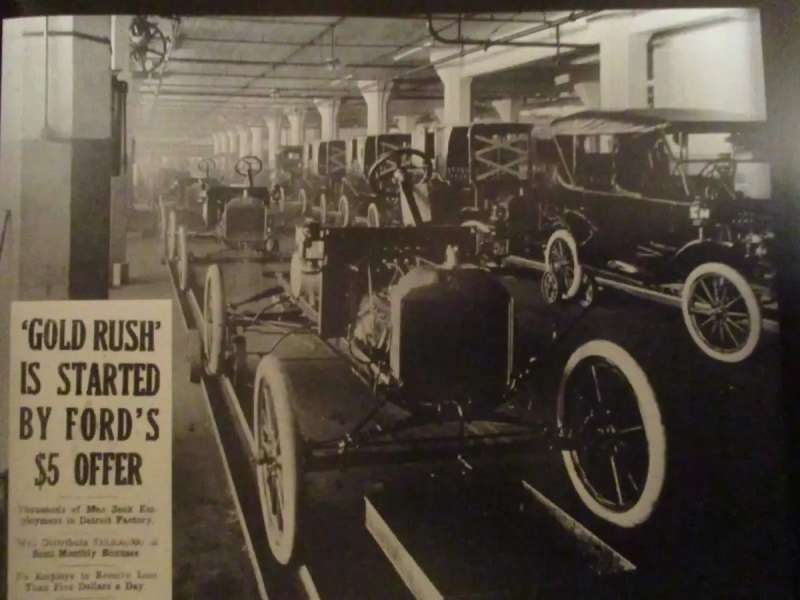
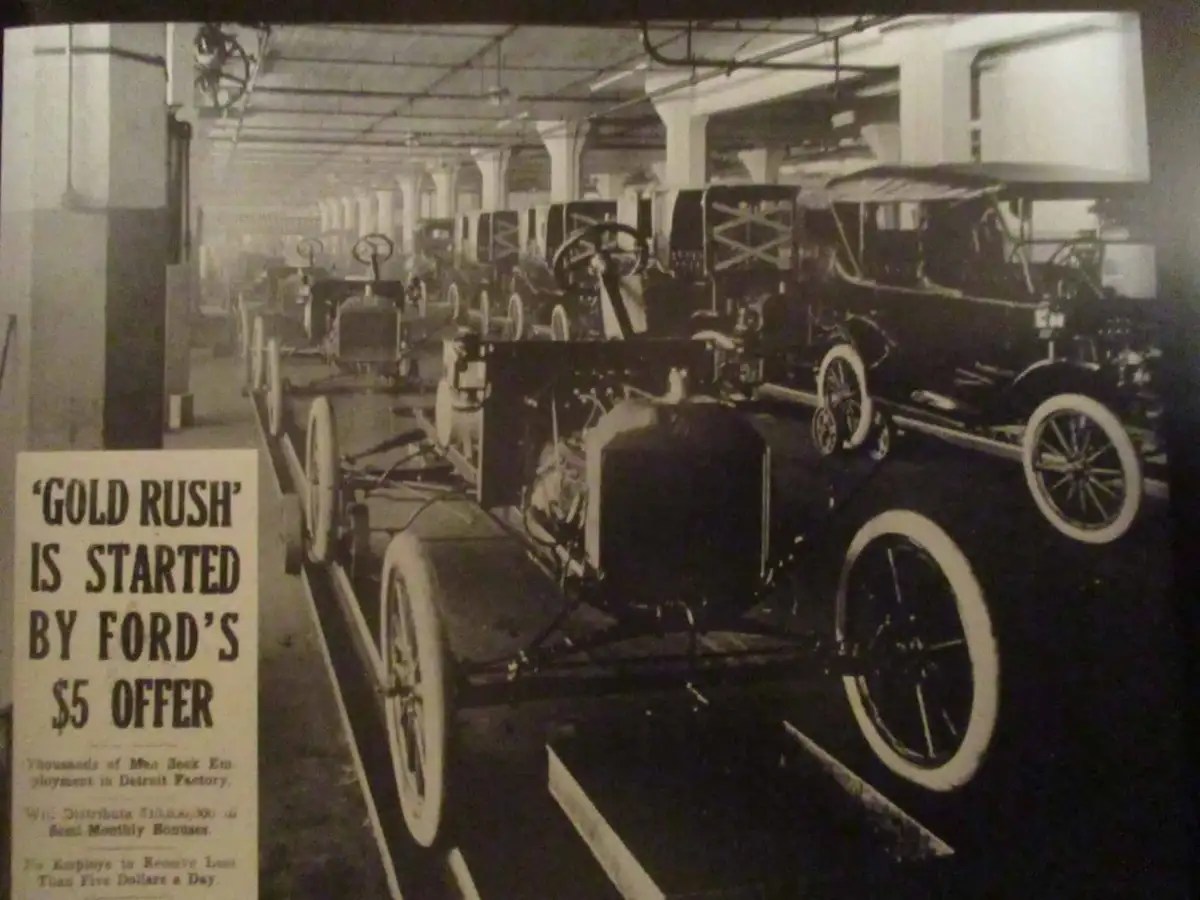
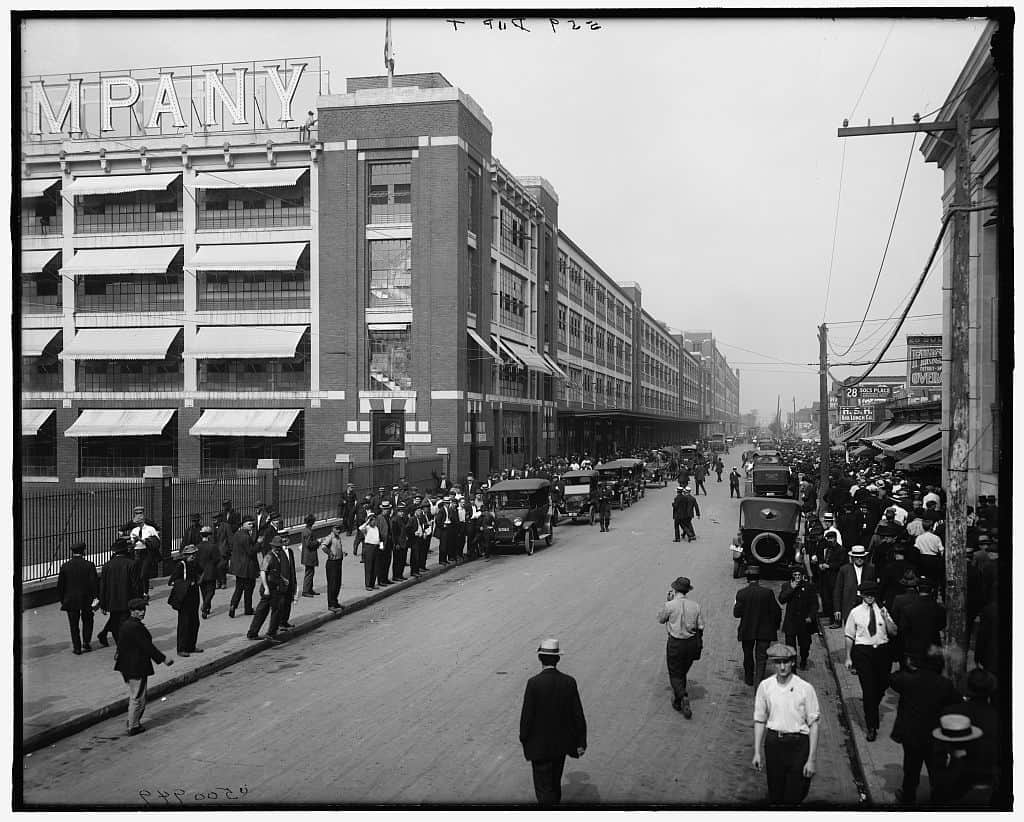
In the first week of 1914, Henry Ford and his iconic Ford Motor Company made a consequential announcement: Ford workers’ daily wages would be boosted to five dollars. This move, which more than doubled previous wages, became the talk of Detroit—and made headlines far outside the Motor City.
After all, never before had “ordinary” employees seemingly benefited so directly from the fortune of their organization’s founder, and the Five-Dollar Day was viewed as yet another way Ford helped shape the industry.
The story behind the Five-Dollar Day is largely intertwined with Henry Ford’s most famous innovation: the assembly line, which allowed workers to drastically speed up production of Model Ts and other vehicles. To make this happen, though, there was a human cost; expectations of ultra-quick work meant employees had to meet time limits and repeat the same task over and over every day.
The result? An employee roster that was unstable at best. Ford needed a way to boost employee retention—and, some argued at the time, generate some positive press—and the pay boost was born. Ford hoped the change would motivate workers to stay at the company, which would streamline operations for the entire assembly line.
But there were conditions attached to the income boost, which was actually structured as a bonus system instead of a true raise (hourly rates technically remained the same, but Ford would tack on a bonus for employees who met requirements during daily production, bringing their total payout to the equivalent of five dollars daily).
To qualify, workers had to meet a series of standards that extended beyond their on-site job performance: Ford wanted employees to maintain clean homes, avoid alcohol, build savings accounts, keep their houses free of boarders, and treat their families with respect—yes, “don’t abuse your family” was a condition on which employees qualified for the Five-Dollar Day deal.
This was a radical new approach to employment, to say the least, and Ford took things a step further by establishing a new branch of the company known as the Sociological Department.
It might sound shocking by modern standards, but the department was designed to monitor employees’ home lives and make sure they lived up to what Ford viewed as necessary requirements for representing the auto company during off-work hours. The way he saw it, workers with more stable home lives would also be more capable of focusing while building cars on the fast-paced assembly line.