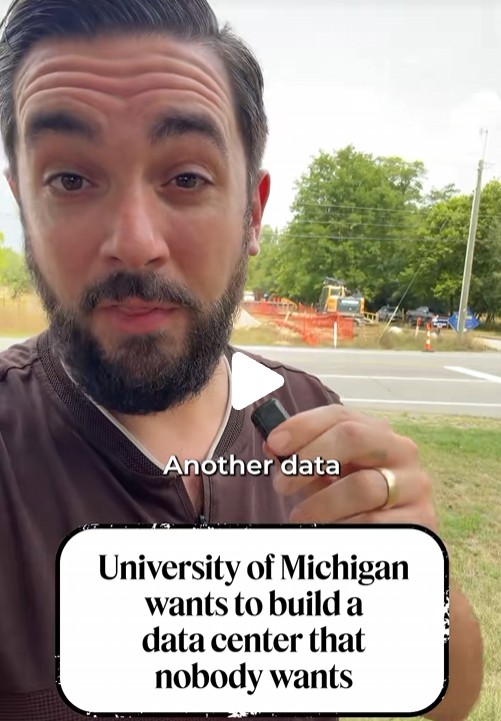
Data centers are a hot-button issue in Michigan going into this year’s midterms, and some Republican candidates are scrambling to say what voters want to hear.
Their records on the issue, however, tell a very different story. The ’Gander’s Kyle Kaminski brings us the receipts.
Plus: AI-generated deepfakes are draining Michigan seniors’ savings while Meta profits from the ads pushing them. State agencies are racing to catch up.
|
|
|
Michigan voter roll found to be mostly clean in independent review (Votebeat): An independent audit has found Michigan’s voter rolls are largely accurate, with 99.99% of the state’s 8.3 million registered voters having complete, valid personal information on file. The review also identified a small number of registrations involving potential noncitizens, dead voters, and inaccurate birthdates, though officials said the findings show proactive maintenance rather than evidence of widespread voting problems.
Group makes last-minute push for citizenship voting proposal (Bridge Michigan): Supporters of a proposal requiring Michigan voters to prove their citizenship are asking the US Supreme Court to order the measure onto the November ballot before the state finalizes it Friday. The proposal was blocked after election officials found too many petition signatures invalid.
El-Sayed, Rogers agree to second debate (The Detroit News): Abdul El-Sayed and Mike Rogers have agreed to a second debate in their race for Michigan’s US Senate seat, with the candidates set to face off Oct. 21 in a statewide broadcast hosted by Detroit’s WXYZ-TV. The candidates had already agreed to an Oct. 8 debate in Grand Rapids, while Rogers has not committed to a Sept. 15 debate proposed by Fox 2.
|
|
|
|
|
Good news: Michigan Republicans have suddenly decided that data centers are bad. Bad news: They all seem to have decided this within the same two-week stretch.
During the same two weeks, their own party’s campaign operation was privately warning AI companies that this issue was costing Republicans votes. So, let’s talk about what they were doing before that.
|
|
|
Here’s the deal: Data centers are a radioactive issue in this state. Polling in May found 55% of Michiganders don’t want one within 25 miles of their home.
There are several dozen already operating here, and dozens more proposed. More than 50 communities have now hit pause, covering about 1,500 square miles, roughly the size of Rhode Island. So, the politics here aren’t complicated. But here’s what is—some of the Republicans at the top of your ballot this November already got a chance to vote on exactly this issue. And at least one of them already has big money invested in the industry.
Let’s start with the vote. Last year, the House’s version of Trump’s Big Beautiful Bill had a provision buried in it—for 10 years, it would have blocked any state or local government from enforcing a law regulating artificial intelligence systems, and that includes data centers.
At the time, the National Conference of State Legislatures warned Congress it would have stripped states of their power over permitting, construction, and the operation of these facilities. And Republicans like US Reps. John James and Tom Barrett voted for it anyway. Barrett is a congressman for Greater Lansing, and he’s got a new ad out about protecting Michigan from big tech billionaires and standing up to his own party. But here’s what didn’t make the ad. Barrett voted for the final tax package for data centers, which reportedly handed six AI companies $83 billion in tax breaks.
And here’s the kicker. Barrett had company. John James, the Republican nominee for governor, sat on the committee that wrote this whole thing. He voted to keep this language in when Democrats voted to strip it out. He voted to advance it, twice. He voted for it again on the House floor. Then, in June, when someone asked him where he stands on data centers, James advocated for local control.
Republican US Senate candidate Mike Rogers is in on this, too, but he didn’t vote on anything, because he’s been out of Congress for a decade. What he’s got instead is a portfolio. Reporters found millions of dollars in investments tied to data center development. He’s also endorsed Trump’s AI framework, the one that speeds up federal permitting for these projects. He got called out, and now he says he supports a moratorium.
And this isn’t just a Rogers problem. Barrett’s campaign has also collected money from the corporate packs for Google, Amazon, Microsoft, and Oracle. James has also taken more than $100,000 from executives tied to Walbridge, the contractor building Stargate.
So what? Well, there are two layers between you and a data center, and both of them are on the ballot this year. The first is Lansing. State law already says your township can’t ban one out right. And that’s a rule the next governor and state legislature can rewrite any time.
The second layer is in Washington. That’s the one these guys voted to demolish. No state rules, no local rules, nothing for 10 years. It failed, but the push hasn’t stopped. What they believe about data centers is easy to say in an ad. How those same politicians voted is already on the record.
Get the full story in this edition of so what? Michigan.
|
|
|
(AP Photo/Teresa Crawford)
|
By Kristine Gill
No, CNN’s Dr. Sanjay Gupta, actor Steve Martin, and tech guru Bill Gates are not selling a manuka honey supplement to cure Alzheimer’s. Yet seniors across the country who have come across AI scams and “deepfake” videos featuring the celebrities’ likenesses have shelled out cash for the snake oil the videos promote. In turn, scammers are profiting.
States like Michigan have worked to protect vulnerable populations by creating an Elder Abuse Task Force in 2019 and issuing repeated warnings to consumers—including messages specifically about celebrity deepfakes, which are videos and images generated by AI to falsely impersonate people or organizations. But tech experts say social media platforms, such as Meta-owned Facebook, play a significant role in perpetuating these scams, even with protective efforts from lawmakers.
“Whoever is behind the scam, whether it’s somebody in Vietnam or somebody in Alabama, they cannot execute that scam without Meta reviewing, approving, and collecting money from the ads they are running,” said Katie Paul, director of the Tech Transparency Project.
Michigan seniors reported nearly $170 million in losses to cybercrime last year, according to data from the Federal Bureau of Investigation’s 2025 internet crime report. 2025 was the first year the agency began tracking AI scams in particular, with the most complaints nationally for those ages 60 and older stemming from phishing or spoofing scams and cryptocurrency schemes.
|
|
|
By Abby Deatrick
Under the Trump administration, ICE enforcement has intensified across the US with targeted arrests and increased activity in communities. This enforcement has led to major increases in arrests, widespread fear, and death. This enforcement is reaching far beyond people with criminal convictions. In July, the majority of the approximately 49,000 people arrested by ICE had no criminal convictions or pending criminal charges, and less than 4% had a past violent criminal conviction.
Here in Michigan, ICE arrested 2,349 people from Jan. through Oct. 2025, nearly tripling the number of arrests in the same period the year prior. Meanwhile, people held in the North Lake Processing Center in Baldwin have reported serious concerns about legal representation and access to emergency and routine medical care.
Here are five ways to fight back against ICE and protect immigrant communities in Michigan.
|
📣 Have an event to add? Email Abigail Deatrick, The ’Gander’s state organizing coordinator, with details. Please send submissions at least one week before the event.
|
|
|
🚨The ’Gander wants to hear from West Michigan residents.
Has living near the J.H. Campbell Plant affected your health, home, work, or air quality? If so, email: jessicasimmons@couriernewsroom.com.
|
|
|
Would you recommend this newsletter to your neighbor?
|
|
|
You are receiving this email because you opted in via our website.
Our mailing address is:
The ’Gander / COURIER Newsroom
3229 Greenpoint Ave., PMB 532
Long Island City, New York 11101
Want to change how you receive these emails?
You can update your preferences or from this list.
|
|
|
|